Pulitzer Center Update December 19, 2025
Watch the Workshops: '1619' Global Connections Series
Country:

Project
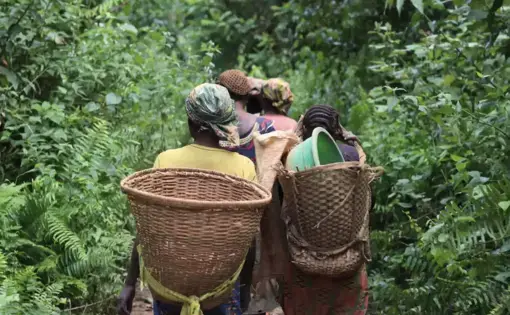
Our Minerals, Your Rules
Supply chain traceability schemes are failing to improve the lives of artisanal miners in the...

The 1619 Global Connections Series was a professional development series for educators connecting themes from The 1619 Project to underreported stories on pressing global issues. The series, made up of four parts, was designed to equip educators with resources and strategies for bridging students’ local experiences to the historical context informing them and the global issues connecting them to other parts of the world.
The Pulitzer Center U.S. Engagement and Outreach team engaged over 240 educators in the four workshops, which each connected the racial justice themes in The 1619 Project with one of our Pulitzer Center focus areas: Climate and Environment, Peace and Conflict, Global Health, Human Rights, and Information and Artificial Intelligence. Educators connected with grantees Neenma Ebeledike, Mélanie Gouby, Asia Alexander, Ridwan Karim Dini-Osman, Arijit Douglas Sen, and Hilke Schellmann; explored curricular resources from the Pulitzer Center Lesson Library and the 1619 Education Materials Collection; and practiced strategies for developing media literacy and critical thinking about complex issues in effective, developmentally appropriate ways. In a survey, 85% of attendees reported highly recommending the series to colleagues, and 87% reported increasing their understanding of a Pulitzer Center focus area.
Educators interested in exploring resources and materials from the series can visit our Global Connections Series Resource Collection. Recordings of journalists' conversations from the first three workshops are accessible on the Pulitzer Center YouTube channel. The views expressed by participants throughout the Global Connections Series reflect each speaker’s personal experiences and interpretations of global issues and public policy. As with all Pulitzer Center programs, the conversation is intended for educational purposes.
Workshop 1: Understanding Environmental Racism
During the “Understanding Environmental Racism” workshop, educators engaged with Neenma Ebeledike’s reporting project Allensworth Rising: A Fight for Water to explore how journalism can help students understand the racialized impacts of climate change on a local and global scale. Pulitzer Center staff member Kendra Grissom facilitated the conversation and Q&A with Ebeledike, exploring the intersections of climate, racism, and human rights in her reporting.
The conversation is well summarized by the following quote from Ebeledike: “My biggest takeaway from all of this is that climate stories are human stories. We cannot separate one from the other. It’s not just about the climate, it’s about the impact it has on humans. So behind every statistic we see about contaminated wells or arsenic, there is a family that is impacted.”
After the conversation with Ebeledike, educators engaged with the Four Components of A Healthy Classroom framework developed by Pulitzer Center staff member Donnalie Jamnah for the 1619 Education Network program, and utilized the framework to evaluate a Pulitzer Center lesson connected to the theme of environmental racism.
Chreese Jones, a webinar attendee, reflected on her engagement with a lesson plan from Pulitzer Center Teacher Fellow Faydren Battle.
“I took more time after today's session to review Unhomed: How Issues of Place Displace African Americans. In it, I identified evidence of all four components including:
- Intentional focus on the history, identity, and challenges of African Americans. I love the student voice options of a news report or TikTok.
- Through the teaching materials, there's an effort toward making this content accessible, for example, specialized student needs.
- Regarding Social Emotional Learning, with a focus on systemic issues that displace individuals, it provides a platform for discussing trauma and well-being.
"This is similar to the history of the decision to develop Highway 94 to run through the center of the Rondo community [in Minnesota], displacing many African Americans. I am working on a curriculum for a new Afrocentric Program that will include this history, as the program is located on the side of that highway.”
Workshop 2: Elevating Critical Voices in Conflict
In the “Elevating Critical Voices in Conflict” workshop, educators engaged with Mélanie Gouby’s reporting project, Our Minerals, Your Rules, from the Democratic Republic of Congo. Together, the journalist and educators explored how journalism can introduce underrepresented perspectives to help students explore multiple pathways to peace. Pulitzer Center staff member Donnalie Jamnah facilitated the conversation with Gouby about how the voices and lived experiences of artisanal miners in the Congo are overlooked and ignored in global attempts to enforce "conflict-free" minerals.
The dialogue included a history of colonization and conflict in the Congo and the importance of engaging a diversity of root causes and solutions to modern issues. Gouby shared, “What this is really about is a system that was created to sort of wash our hands of the problems that Congolese people are facing, which are really directly linked to a history of imposed colonization and exploitation … We can’t just wash our hands of the issue there, and we need to be working with Congolese communities to find the solutions that will actually benefit everyone.”
After the conversation with Gouby, educators reviewed the Identity Resource Screening Tool created by 1619 Education Network alumni Julie Emra and Noncy Fields. Educators used the resource to plan a lesson for their classroom connected to workshop themes.
An attendee working with students from middle school through adulthood said she found the tool applicable to the restorative justice work facilitated by her education program.
“This is the first time I've been introduced to the IRST. However, I can see it being useful for building a relationship with the RP(Responsible Party) and Co-Facilitator working on a case, especially if the offense is concerning cultural, ethnic, or racial differences.”
Workshop 3: Envisioning Healthy Black Futures
The “Envisioning Healthy Black Futures” workshop began with a journalist conversation centering Ridwan Karim Dini-Osman's reporting project Ghana Battles Deadly Meningitis Outbreak Amid Shrinking Foreign Aid, and Asia Alexander's reporting The Hidden Cost of Being a Black Teacher in Mississippi. Pulitzer Center staff member, Kendra Grissom, facilitated the conversation with Alexander and Dini-Osman about how their reporting projects engage with the intersection of racism/nationalism, health, and human rights. Throughout the workshop, participants explored how journalism can help students recognize historical and present-day racial inequities in health, and envision a better future.
When asked about what this exploration could look like with parents and students outside the school context as well, Dini-Osman offered, “I think we often underestimate how much kids know… But I think what parents can do is to openly talk about some of these issues. Let's model the values that we care about. Empathy, fairness, curiosity; those are the things that we need to talk about. We need to create an environment where some of these difficult conversations, even for children, can take place, because these conversations are taking place among their peers, and the best parents can do is to create the room to be able to expand that conversation at home.”
Educators continued their learning after the conversation by engaging with the "Healthy Black Futures" section of Pulitzer Center’s cross-disciplinary project Ode to Healthy Futures or the essays “Medical Inequality,” by Linda Villarosa, and “A Broken Healthcare System” by Jeneen Interlandi, from The 1619 Project.
Michelle Stevens, an attendee working with graduate students, found the resources relevant to work in her classroom setting as well, sharing, “I think this would be great to include in my Johns Hopkins masters of public health program. I’m very inspired by this work.”
Workshop 4: Legacies of Slavery in AI
For the final workshop of the series, “Investigating Legacies of Slavery in AI”, educators engaged with Arijit Douglas Sen’s reporting Peering into the Black Box and Hilke Schellmann's reporting Are AI Hiring Tools Racist and Ableist? Pulitzer Center staff member Donnalie Jamnah facilitated the conversation between Schellmann and Sen about how their reporting projects examined the accuracy, bias, and impact of AI tools deployed in places of high consequence, like schools and hospitals. Throughout the workshop, participants explored how journalism can help students investigate the benefits and harms of the technology around them.
Both Sen and Schellmann brought an informed and aware perspective to the conversation, centering the concerns and needs that are present in classroom settings. Schellmann’s approach to investigation included testing AI tools herself, which she offered as an approach to better understanding how they work with the caveat of student privacy in mind.
She noted, “In some of the tools that I tried, I used my personally identifiable information and tools took my recording. I could erase that, but with students, it’s always a little different because they can’t really consent to some of this … School settings are a little bit different than my personal office.”
Sen presented a list of suggested questions for educators to consider as a “gut check” when implementing new tools in the classroom:
- Could a human do this task that the AI is doing?
- Can you check whether the output is true and verifiable?
- What are the consequences if this tool is wrong?
- Would it be worse for this tool to have a false negative or a false positive?
To close the workshop, educators utilized the AI Accountability Classroom Toolkits created by the Pulitzer Center’s 2024 AI Teacher Advisory Council to engage with Karen Hao’s AI Colonialism project.
An attendee working with middle school students reflected, “The ideas explored in today's conversation align closely with my work as a 7th grade social studies teacher since the curriculum emphasizes critical thinking, multiple perspectives, and the lasting impact of historical systems on the present. During the session, I questioned traditional historical narratives by asking whose voices have been centered and whose have been left out by AI algorithms. This is an approach I actively encourage in my classroom.”
Upcoming with 1619
We encourage all educators interested in future events and opportunities from our 1619 Education Programming to subscribe to our 1619 Education Newsletter and to regularly explore the digital 1619 Education Materials Collection.
Educators in and around Washington, D.C., can bookmark their calendars for our upcoming event in collaboration with the D.C. Public Library, "Freedom and Resistance: An Exhibition Inspired By The 1619 Project."

Systemic neglect and environmental injustice have left residents with contaminated water.

