Story
 July 11, 2025
Running Dry: Frequent Droughts Are Swelling the Flow of Migrants Into South Africa
Country:


Earth Island Journal looks at how climate-induced extreme heat is hammering rural farmers, and also...
They are also easing the border crossing
IT IS DAWN on a warm December morning, and Joshua Tuso, 41, is huddled with some 20 undocumented migrants in a disused warehouse in Zimbabwe’s Beitbridge Town, which borders South Africa. Some of the migrants — who have traveled here from across Zimbabwe, Malawi, and Somalia — are smoking cheap cigarettes in the dim light to calm their nerves. Others recite prayers from small Bibles distributed by the nonprofit Gideons International. A few appear drunk and aloof about the risk of their impending trip. Tuso crouches near his bags, vigilant about their contents, as a guard stands outside, keeping an eye out for border police.
Beitbridge Town, home to 58,000 inhabitants, is very dry. The town and its surroundings, which are marked by parched earth and thorny trees, is the last foothold of Zimbabwe before one crosses into South Africa. But not everyone traveling across the border goes through the high-tech immigration and customs gates at the official Beitbridge crossing, where shiny cameras capture faces, and every traveler is fingerprinted.
That’s because Beitbridge is located next to the Limpopo River, which meanders eastward along the Zimbabwe-South Africa border before passing through Mozambique and emptying into the Indian Ocean. The town’s booming formal economy is fueled by legal cross-border haulage and warehousing. Its informal economy is built around smuggling migrants and cargo into South Africa across the riverbed, and to a lesser extent, out of it, for those coming back.

As a nonprofit journalism organization, we depend on your support to fund more than 170 reporting projects every year on critical global and local issues. Donate any amount today to become a Pulitzer Center Champion and receive exclusive benefits!
“In Beitbridge, humans, cars, and donkeys don’t sleep, [constantly] ferrying humans and merchandise to and from South Africa. Let me be clear: No one is coerced here. Needy migrants pay to be trafficked down south,” says Wilo, 40, who leads the small group of smugglers (or “spotters”) guiding the undocumented migrants across the river. “It’s team-work,” says Wilo, wiping a spot of sweat from his brow. (Wilo declined to divulge his legal name for fear of being targeted by law enforcement officers and other cartels.)
Waiting in the warehouse until it’s safe to continue on, Wilo’s dusty, taped Huawei smartphone rings with an avalanche of messages, pleas from migrants wanting his services. Several South African and Zimbabwean border agents confide to Earth Island Journal that they are familiar with his illegal enterprise. Money talks in Beitbridge, they say.
Wilo says he has been moving migrants across the border for 10 years. But while South Africa has long been a destination for those fleeing conflict and political instability elsewhere on the continent, recently the number of migrants has been rising. That’s in part due to worsening impacts of climate change — including extreme droughts, floods, and failing agricultural soils — which are displacing tens of thousands of people from neighboring countries.
While South Africa has long been a destination for those fleeing conflict and political instability elsewhere on the continent, recently the number of migrants has been rising.
Tuso is among them. He has spent the last week making the 600-kilometer trip here from his home in Birchenough Bridge, a semi-arid district in rural eastern Zimbabwe. The exhausting journey required negotiating for cheap fares in haulage trucks heading down to South Africa. He is fleeing drought and the hardships it has brought on him and his family of five children and two wives. (Polygamy is relatively common in parts of sub-Saharan Africa.)
Though climate change is driving Tuso south, that’s not where its impact ends. Climate disruption is also easing the final stretch of migrants’ difficult journey into South Africa — and contributing to rising tensions across the border.
BIRCHENOUGH BRIDGE — NAMED for the bridge that crosses the Save River — was once an agricultural community with a reliable water source, irrigated by a network of canals built by the government back in the 1980s. Tuso used to grow beans and onions on his one-hectare farm there and reared some goats as well. But during the past two decades water resources in the area dwindled due to overdrawing for agriculture, siltation, and increasingly frequent and intense droughts. When the most recent drought worsened in 2024, Tuso’s crop harvest collapsed, and most of his goats died. Scores of his neighbors’ livestock perished too. “It’s pointless to continue on farming,” he says.
This has become a common experience in rural communities as the climate crisis brings punishing dry heat, crop failures, and extreme hunger to large swathes of the African south. The World Meteorological Organization declared 2024 the hottest year on record, and southern Africa is among the most climate change-impacted regions in the world. An ongoing, severe drought that began in 2023 — the worst the region has experienced in 100 years — spurred Zimbabwe, Malawi, Zambia, Namibia, Lesotho, and Botswana to declare states of emergency due to groundwater depletion, agricultural losses, and resulting food shortages.
A recent Oxfam report speaks to the scale of the crisis, finding that the number of people experiencing extreme hunger in eight drought-stricken eastern and southern African countries surged to 55 million last year, or 20 percent of the population.
Drought isn’t the only problem. “When the rains finally come, they are bringing storm floods that wash away the fertile topsoil,” says Chimwene Phiri, 35, a former carrot, tea, and maize farmer from Shire Valley in southern Malawi, who is also traveling with Wilo’s group. Data backs up his assessment: Globally, flash floods have become 20 times more frequent since 2000.
Failing crop yields in the Shire Valley, Malawi’s most fertile farming district, are helping fuel a wave of hunger. That, along with a collapsing currency and protests related to drought-driven price increases for staple foods, led Phiri and his wife to leave.
The majority of their fellow migrants, too, have left their homes due to hunger and drying lands. The group traveling with Wilo includes a total of eight farmers from Malawi and Zimbabwe and two Somali food traders. They join a growing tide of migrants looking for better opportunities elsewhere, including an estimated 10,000 Zimbabweans who leave the country each year, the vast majority for South Africa.
The trip is never easy. Migrants travel long distances and can encounter violence, conflict with wildlife, and exposure to the elements. The Limpopo River Valley is hot, rife with Malaria-carrying mosquitoes, and has few drinking water points. Migrants often fear rehydrating at these sites at all, worried that by coming out into the open, they will face arrest. Though reliable numbers are unavailable, migrants are known to die of hunger, thirst, and drowning, among other causes. Nevertheless, drought is making one part of the journey easier: crossing the Limpopo River.
During wet years, the 1,750-kilometer river, Africa’s seventh longest, is perilous. It can stretch 40 to 50 meters wide near Beitbridge Town in normal times, creating a natural barrier between the two countries that includes strong currents and more than a few crocodiles.
The 412,000-square-meter Limpopo River Basin, which stretches across Botswana, South Africa, Zimbabwe, and Mozambique, is vulnerable to extreme weather events.
But the 412,000-square-meter Limpopo River Basin, which stretches across Botswana, South Africa, Zimbabwe, and Mozambique, is vulnerable to extreme weather events, and in recent decades, drought has been a prominent feature there. Water levels have been stressed due to more frequent high temperatures, as well as other factors like withdrawals, and streamflows have been trending downwards. During the 2023-24 agricultural season, 37 percent of the basin experienced drought.
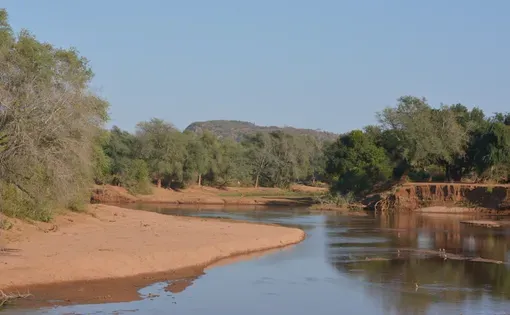
The Limpopo River is vulnerable to these shifting conditions. And while the river has been known to dry out during the winter in the past, locals say there have been more dry months now than in recent years, and that the river has gotten easier to cross. “You can walk on top of the dry river back and forth as much as you like now in December,” Wilo says, smiling as he holds a cigarette in the corner of his mouth.
He is counting notes, a mix of loose South African rand currency and US dollars. The going rate per migrant is currently $80 per adult, a significant amount for migrants. It used to be $160 when the Limpopo was flooded five years ago, and smugglers demanded more for crossings. “Years back, when the climate was wetter and the river ferocious all year, this would be a dice with death, surely,” he says.
Vusilizwe Thebe, a professor of development studies and head of the department for anthropology and archaeology at the University of Pretoria, underscores this point. Though the river is also susceptible to flash flooding, when water volumes in the river decrease dramatically, it means “migration flows can be exacerbated, and more people can actually now cross the river without thinking twice,” he says. And that, he adds, makes the region “rather borderless.”
AFTER WAITING OVERNIGHT at the warehouse, Wilo receives a message on his cellphone that a new group of “friendly” soldiers has assumed their shift guarding the river border. Everyone springs up quickly from the warehouse floor, moving outside to pick their way through thorny bushes toward the edges of the Limpopo River. A group of women sell frozen drinks and corn to those passing by.
Given the more favorable conditions of a drier river, Wilo now makes the trip across the riverbed frequently. He says he helps roughly 50 people a week cross into South Africa. “Fifty people, that’s modest because on very busy days reckless gangs I know do 120 just in the morning,” he says. “It’s grannies, young men, mothers. This week, I even shipped across the river babies who were a week old.”
Raising $80 is not easy for migrants, Tuso says. Though he paid the fee in US dollars, others pay smugglers in goods, such as with a goat or five chickens per person. Wilo says 30 percent of the fee goes towards paying off “pliable” security agents armed with old Soviet AK-47 guns at the river crossing points.
Livhuwani Makhode, the director of South Africa’s home affairs ministry, said they have “zero-tolerance” for any border guards accepting bribes from human smugglers, while the Zimbabwe immigration department didn’t reply to Earth Island Journal’s request for comment on the matter.
Costs aside, South Africa is the top destination for African migrants due to the country’s relatively stable government and advanced economy. The country has been witnessing a surge in immigration in recent years. According to a 2022 report by the Institute for Security Studies, an independent research organization based in the capital, Pretoria, there are about 3.95 million migrants in South Africa, making up 6.5 percent of the population. While the number of migrants has increased over the last few decades, that figure is in line with international norms.
“We are preferred because we’re exploitable. We are hungry, controllable, and profitable for farm and factory owners.”
Anos Chindondondo, 50
Tuso and other migrants we spoke with say that, once across the border, the majority of migrants from Zimbabwe and Malawi tend to settle in one of three places. The top destination is Mpumalanga, an eastern South African province that is the hub of the country’s booming wildlife conservation and tourism industry. Jobs as porters, wildlife park guards, sanctuary fencers have fewer barriers to entry. Next is Gauteng Province, a hub for upwards of 30,000 illegal gold miners, mostly migrants who work in pits that are often filled with toxic methane gas. Third is the Free State province in central South Africa, which is part of the country’s breadbasket, producing large amounts of wheat, sunflowers, and maize. Many migrants with agrarian experience feel particularly well-qualified for jobs as harvesters or planters there.
“That’s because we’re rural farmers in Zimbabwe, we’ve got transferable skills,” says Tuso, who initially planned to head there.
But the transition to life in South Africa can be extremely difficult, Tuso’s uncle, Anos Chindondondo, 50, tells the Journal by phone. Chindondondo worked as a handyman at a wheat plot in southwestern Zimbabwe until severe droughts compromised the operation beginning in 2017. When crops and livestock began to fail, he was enticed by rumors of good employment in South Africa. He crossed the Limpopo in 2021, he says.
“We heard that White farmers need us Zimbabwean and Malawian migrants to work as tractor drivers or chaperone wealthy tourists who are visiting private-owned wildlife game parks,” he says, explaining that he settled in the coastal city of Cape Town. “They said salaries are ‘good’ because locals don’t want these types of jobs.” Once there, Chindondondo found the situation to be much more complex. Some large commercial farmers and factory owners, overwhelmingly White, prefer to employ desperate foreign migrants in low-paying jobs rather than South African nationals, he says. “We are preferred because we’re exploitable. We are hungry, controllable, and profitable for farm and factory owners.”
Migrants also face xenophobia. South Africa has a “history and present” of anti-foreigner sentiment and violence, says Rhoda Bawawa, an activist with the Zimbabwe Immigration Federation in Johannesburg. She cites 2008 as a particularly grim example. That year, anti-foreigner mobs murdered 62 migrants, injured 1,700, and displaced tens of thousands more across South Africa.
Tensions have continued to simmer since then, and in 2022, anti-immigrant sentiments led to the founding of the group Operation Dudula (Dudula means “to force out” in Zulu) in Soweto, a low-income township west of Johannesburg. The group is known to raid migrant-owned businesses, as well as workplaces and homes of migrants. Chindondondo experienced this violence firsthand: In 2022 when he was employed as a car wash guard in Soweto, xenophobic mobs threatened to burn down the place if the managers kept hiring foreigners. Operation Dudula has since become a national political party.
The targeting of migrants and migrant-employing businesses, experts say, traces in part to the economic conditions in South Africa — at 32 percent, the country has among the world’s highest unemployment rate. A 2024 survey of 1,000 South Africans between the ages of 18 and 24 found that 87 percent thought immigrants were taking jobs and government resources from South Africans. Eighty-six percent thought they were increasing crime rates. (Research suggests that immigrants actually foster employment for South African citizens by working in complementary jobs.)
Climate change may also be exacerbating xenophobia. Like other countries in the region, South Africa is contending with increasingly frequent and severe floods, droughts, storms, and fires, and resulting internal migration. Low-income communities living in informal urban settlements as well as in rural agricultural areas are particularly vulnerable. These are the same communities where undocumented migrants tend to settle as they seek affordable accommodation, leading to tensions over scarce resources.
“In South Africa, xenophobia mostly happens during disaster responses when there is contestation over scarce relief aid, and locals may feel that foreigners should not be considered, or are creating unnecessary competition over resources,” Thebe says.
Loren Landau, former chair of the Consortium for Refugees and Migrants in South Africa and past member of the president’s Immigration Advisory Board, has observed similar dynamics elsewhere too, as climate shocks deepen legacy community tensions. “It’s kind of [desperate people] converging in one place and we see that same pattern in Kenya, we see it in Tanzania,” he says. “It’s people from very different places coming into one area and those are often areas with very few services, very [little] housing, maybe no water and no sanitation. That is a recipe for conflict,” he says.
That conflict is now boiling over into national politics. In 2023, South Africa launched a new border authority to try to curb immigration. The government has also increased efforts to deport immigrants. Last year, deportations surged by 18 percent. “We are intensifying use of aerial survey drones, AI tools, security patrols to catch, deter, prosecute, and deport illegal [immigrants],” says Michael Masiapato, head of the South Africa Border Management Authority. “The border is not a free-for-all, lawless zone.”
AS MIGRANTS CONTINUE to flow out of countries like Zimbabwe and Malawi, climate and community advocates are looking for ways to build resilience at home and help people adapt, rather than leave. One of those advocates is veteran climate and sustainability campaigner and Environmental Buddies Zimbabwe Founder Shamiso Mupara, who lives in Zimbabwe’s Marange district.
Marange has always been dry, and food security has long been an issue there. But drought, deforestation, and rising temperatures are exacerbating the crisis. Until the Trump administration dismantled the United States Agency for International Development (USAID) earlier this year, much of the district’s food was brought in on USAID trucks.
Mupara founded Environmental Buddies Zimbabwe in 2013 to address these intersecting issues. “We are regrowing and preserving lost native food forests, which not only provide nutritious diets for families, but local employment, and the ability for rural dwellers to stay on the land, thrive on the land even in years of extreme droughts,” she says. The initiative leads rural women in planting indigenous species that are resilient to extreme heat and that provide food, feed for livestock, and other earnings. While Mupara is focused on native plants, others are looking to new varieties.
Tapuwa Nhachi, an independent consultant who previously worked on sustainable livelihoods with the Centre for Natural Resources Governance in Zimbabwe, notes that some African countries have been importing new food crops and livestock that can withstand higher temperatures. He points to an emerging initiative that has seen Nigeria’s dairy farmers import semen from Brazilian cattle breeds that can withstand extreme heat in tropical climates, in an effort to breed more resilient animals. “When I heard of it, I said that’s a fantastic model, easily adoptable for small scale farmers here in Southern Africa,” he says.
Tuso has observed similar efforts. He says wealthier farmers in Zimbabwe import sturdier Boer goat breeds from South Africa to crossbreed with local breeds in the hope of creating offspring that can endure lack of pasture in dry years. But at $500 a goat, climate-resilient livestock breeds are “very expensive solutions,” he says.
AT THE EDGE of the Limpopo riverbed, Tuso and the migrant group encounter a small, muddy pool. They cross it easily using a wooden bridge built by the cartels. The rest of the riverbed is dry, nothing but sand for them to walk over.
After crossing the river, they come to a broken razor-wire fence erected by South Africa’s authorities. Tuso simply walks through a gap as Wilo gifts a R100 ($5) note to a South African security officer standing nearby. Then they are in South Africa, walking through the baobab tree forest that grows alongside the country’s N1 national highway. Twenty minutes later, they emerge in Musina, a frontier town in South Africa.
As Tuso sits down to munch a loaf of bread and drink a soda, he sees a group of locals gesture at him and hears them whisper an offensive xenophobic slang, ‘kwerekwere.’ Instantly, he says, he realizes he will be living on the margins of society in South Africa.
He hugs and bids farewell to Wilo. The members of his group are disbanding to catch buses and haulage trucks to Johannesburg, 700 kilometers away. From there, they will decide where to proceed.
He is lucky, he says. Though he initially planned to look for farming work in Free State, his uncle, Chindondondo, has lined up a job for him as a trucker’s assistant for a White commercial farmer who supplies fresh potatoes to 10 supermarkets around Cape Town. It’s a hectic job, and the salary for undocumented immigrants like him is ZAR 4000 ($250) a month. A citizen of South Africa would get $550 for the same job, industry insiders estimate.
He knows it will be tough, but he believes he’ll boost his wages here. The cost of food and goods in South Africa is also lower than in Zimbabwe, so he plans to send items home across the border in haulage trucks. He has family to care for back in Zimbabwe, and he is convinced the help from South Africa will go far there.
Of the new life that awaits him in South Africa, he says: “I’m willing to start from the bottom of the food chain.”
Thumbnail photo caption: The Limpopo River in the dry season. Image by Pietpixel/Shutterstock. South Africa, 2023.