Story
 November 5, 2025
Hunted and Hooked: Costa Rica’s Hammerhead Sharks Caught in a Loophole of Law and Survival
Country:

The country has fallen behind in marine protection.
“Bycatch is a word invented by the fishing industry to avoid responsibility,” Randall Arauz, Costa Rican environmentalist.
Five hours off the coast of Golfito, a small fishing town in southwestern Costa Rica, hues of yellow and pink light up the sky. Crew members on the sportsfishing yacht, The Thumper, battle the urge to not sleep as they know that dawn is the optimal time to capture hammerhead sharks.
“Tiburon martillo!” “Es un tiburón martillo!” yelled captain Bobby McGuiness-Guevara from the second floor of his boat.
Crew mate Gabriel Uiena-Parin races to the fishing pole as it bends into an arch. He grips the handle and begins to reel in the hammerhead shark carefully. A team of marine biologists including Randall Arauz and Jeffry Madrigal-Mesen run from their beds and quickly move to the deck.
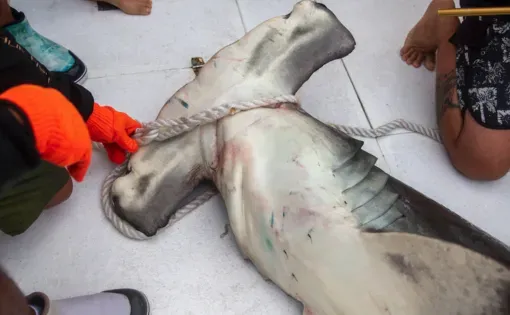
Once Uiena-Parin and his mates wrap a thick ivory rope around the head of the two-and-a-half-meter shark, they swing the back door open and pull it from the Pacific Ocean onto the main deck.

As a nonprofit journalism organization, we depend on your support to fund more than 170 reporting projects every year on critical global and local issues. Donate any amount today to become a Pulitzer Center Champion and receive exclusive benefits!
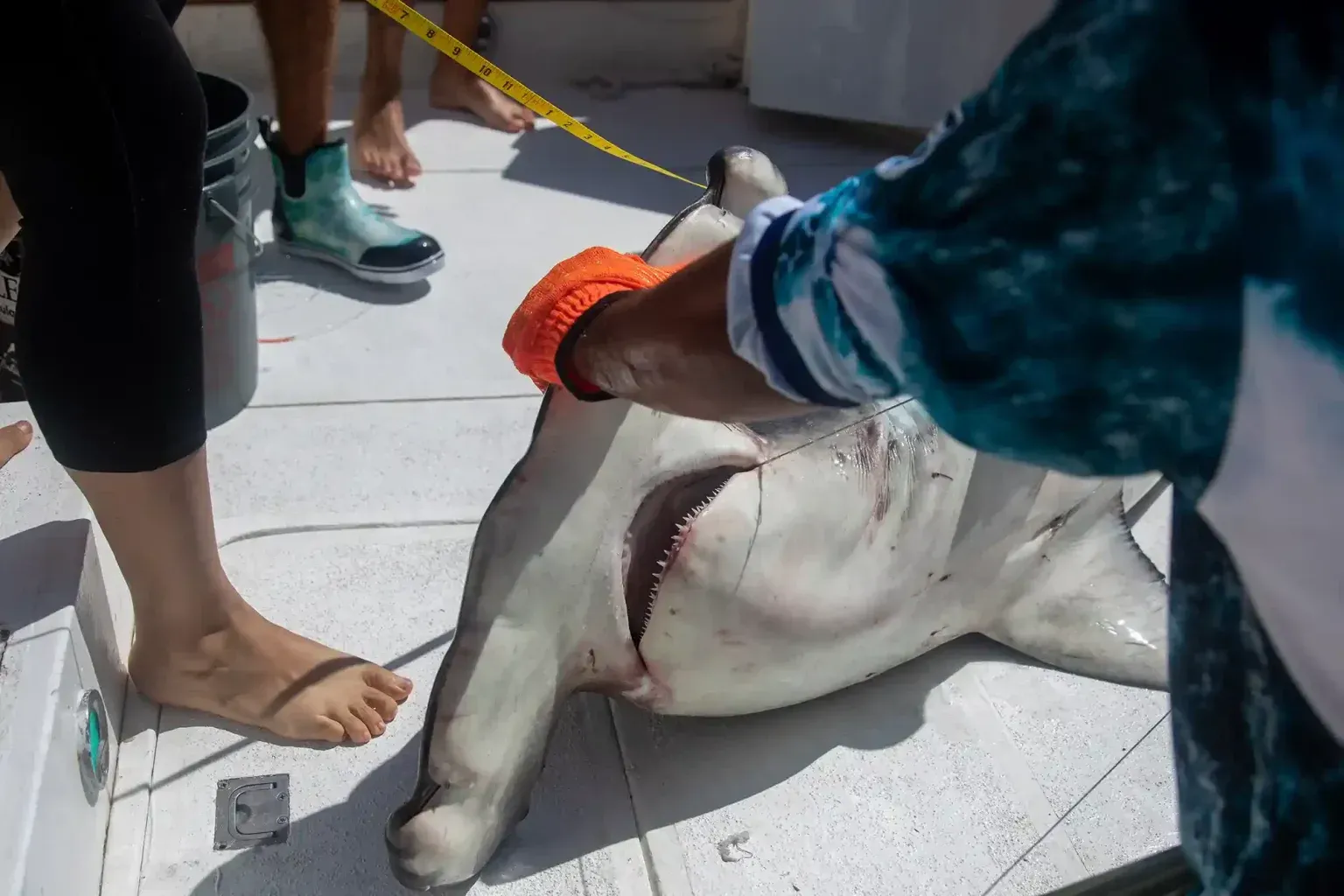
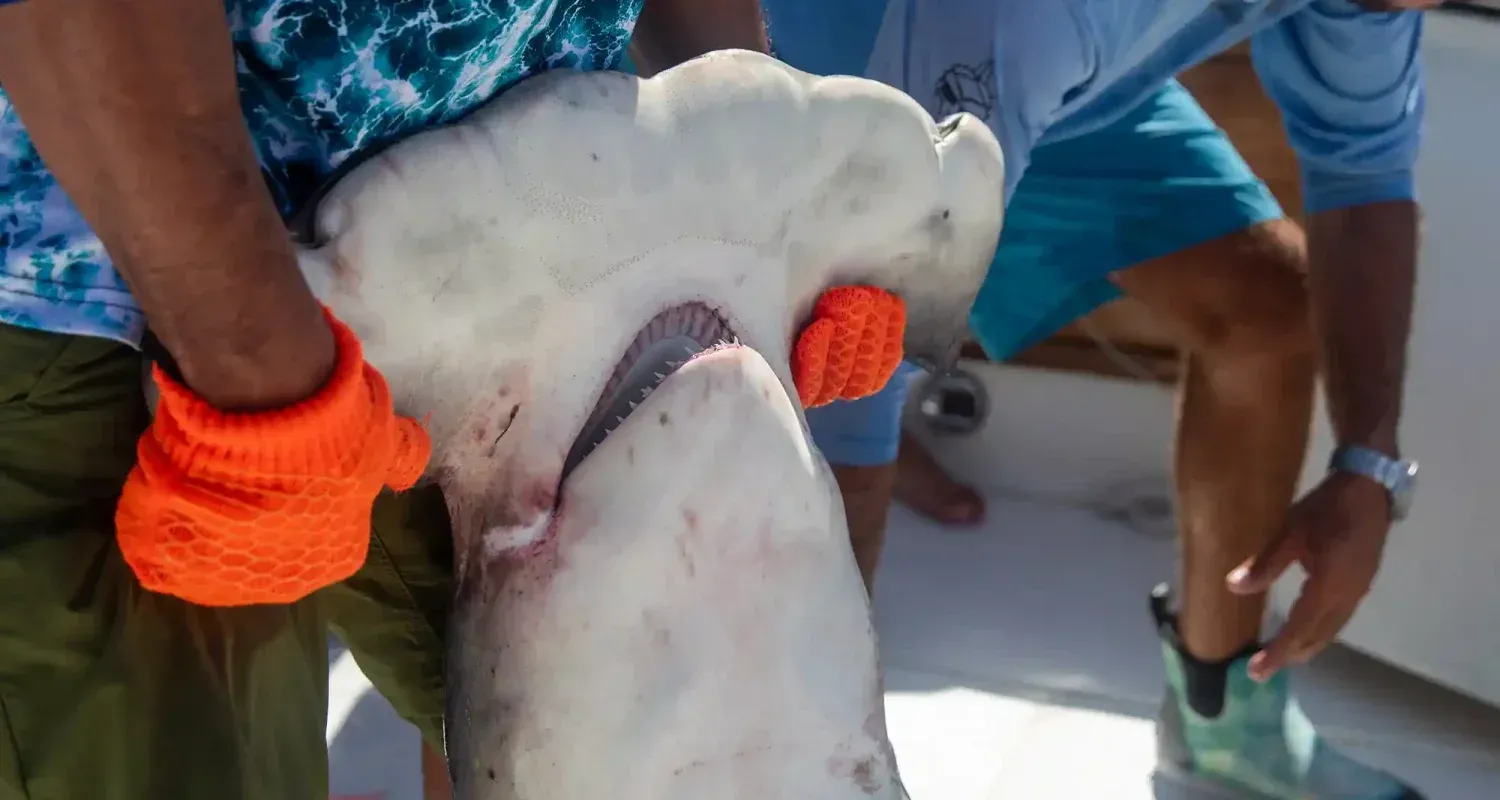
“Rápido! Hágalo rápido!” said McGuiness-Guevara, urging the group of scientists to hurry up. Uiena-Parin and his fellow mate hold the shark down as the marine biologists take the shark’s measurements. Madrigal-Mesen quickly pokes into the flesh of the shark near the dorsal fin with a Passive Archived Transmitter (PAT), which is a type of tracking device that is attached to an aquatic animal with the purpose to collect data. Then the fishermen slide the giant fish back into the ocean where it belongs by Costa Rican law.
Not all hammerhead sharks are as lucky.
“There is no such thing as bycatch,” Arauz said. “Bycatch is a word invented by the fishing industry to not do anything about it.”
Bycatch is the incidental capture of fish or other marine life while fishing.
In June of 2023 the Costa Rican Supreme Court decreed that hammerhead sharks are wildlife; therefore, they cannot be commercialized or exported out of the country. They are protected under Appendix two of Convention of International Trade in Endangered Species of Wild Fauna and Flora (CITES) which states that trade of species is allowed by regulated permits. But hammerhead shark fins and the fins of other endangered shark species continue to be exported out of Costa Rica and other parts of the world with some fishermen and other powerful players in the fishing industry profiting from this illegal act.
This is because bycatch has become a loophole in the illegal trade.
Near the coastline
A fisherman named Michael, whose last name is being withheld because of risk of fishing license being revoked and safety concerns, has been fishing along the coast of Paquera, a small fishing town located in Costa Rica’s peninsula, for over 25 years. Although he retired seven years ago, he still takes his beat-up blue motor boat to go diving for mollusks regularly.
“If you have your fishing license, everything is fine,” Michael said. “The shark without fins is not a problem. The problem is to bring the fins without the shark.”
Vivienne Solis-Rivera, a biologist and member of the CoopeSoliDar, a cooperative focused on human rights for small-scale fishermen and coastal communities, said that eight out of 10 artisanal, or in other words, skilled-traditional fishermen like Michael, do not have their fishing license.
This is because small-scale fishing lacks studies that support sustainable practices, so Costa Rica is often not authorized to issue fishing licenses under the law. Her colleague Marvin Fonseca-Borras said there are small-scale fishermen who are cutting fins from endangered shark species, but they should be handled separately.
“You cannot treat a community as if they were a group of criminals,” Fonseca-Borras said.
“And that is a problem of the society.”
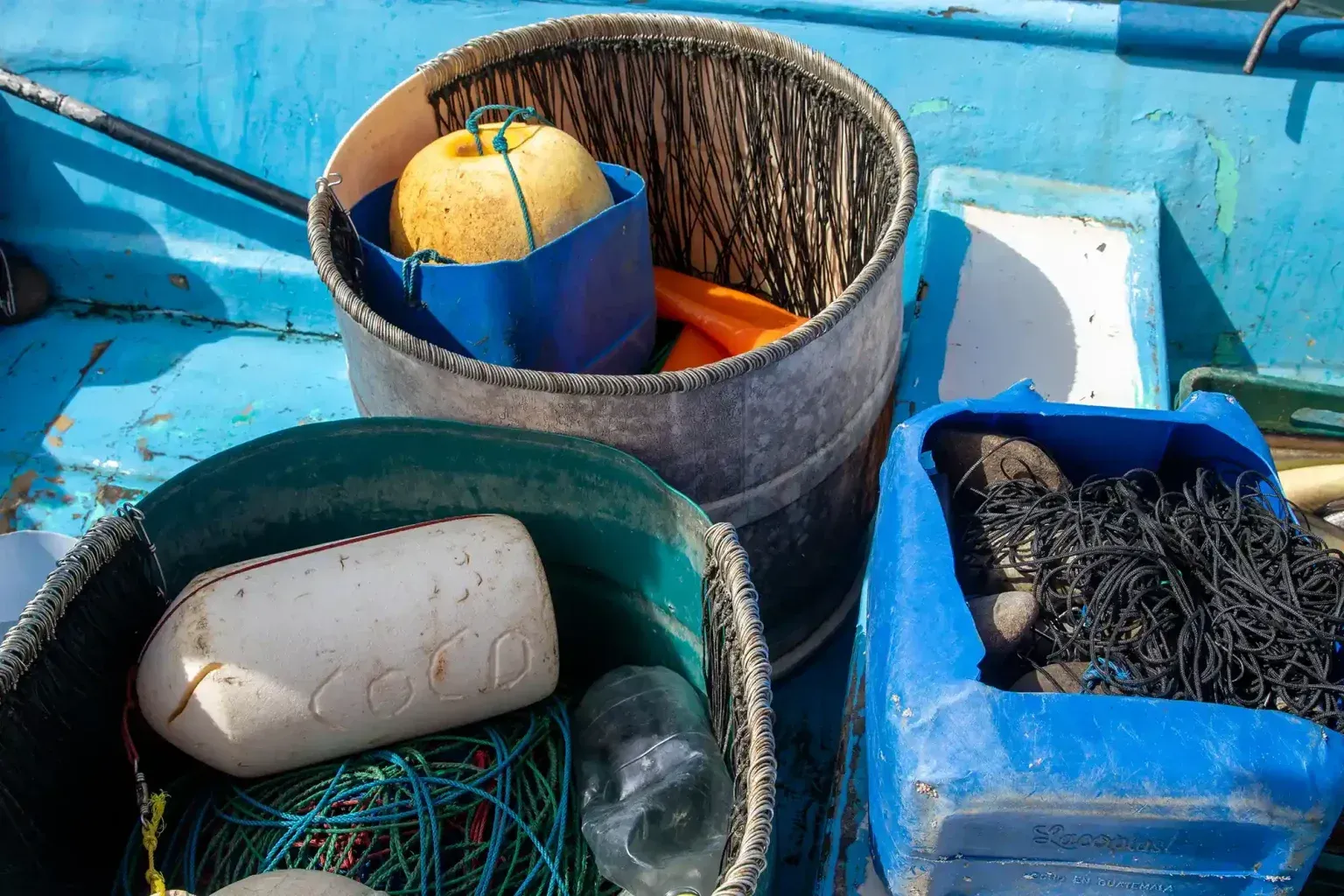
Despite it being illegal to fish for hammerhead sharks, other shark species, like the blacktip, are still commercialized and allowed to be hunted. Solis-Rivera said that this fact is often overlooked, so when people see fishermen catch a blacktip, they often assume that they are violating the law.
While adult hammerheads can be found deep within the ocean, baby hammerheads, or pups, are often raised near the coast and can be a common collateral damage during a regular day on the job for local fishermen. According to the Save Ours Seas Foundation, a non-profit organization, hammerheads have a high mortality rate when being caught and released if not handled with the proper care.
Michael said that many local fishermen have stopped intentionally hunting sharks in general because there are few along the coast and the investment to go hunting into the open water has become expensive.
Hammerheads sharks, like most shark species, are apex predators, meaning that they are at the top of the food chain. Madrigal-Mesen said hammerheads are vital to the ecosystem and can indirectly affect fishermen’s wallets.
“These animals that they eat, they become out of control and eat these other species that are of commercial interest,” Madrigal-Mesen said. “So the fishermen will have seriously affected their economic activity.”
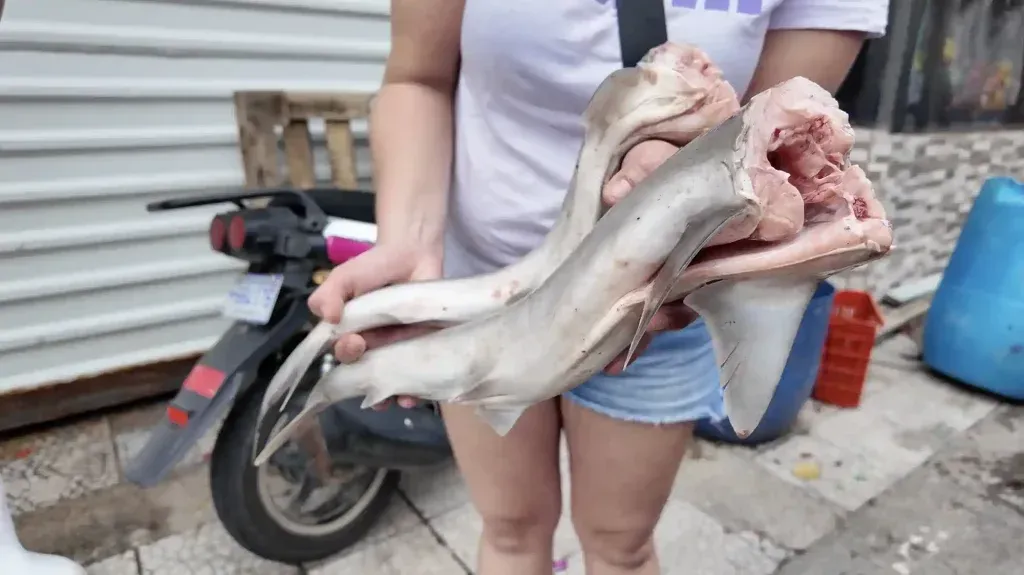
“In Costa Rica, we live with our backs to the sea.”
The biggest hub for shark trade is a one-hour ferry ride from Paquera to another small fishing town called Puntarenas. There, it is common for fishermen to take advantage of the numerous fishing markets, but that extends more than making a profit. In Puntarenas it is common for locals to include shark meat into their daily diet.
“Costa Rica definitely has a targeted shark fishery, and it’s been made to supply the demand of shark fins in the Asia market,” Arauz said. “As a byproduct, we have all the meat. All the meat gets pushed to Costa Ricans.”
Edwin Salazar-Serrano, the head of the Protection and Registration Department at Costa Rica Institute of Fisheries and Aquaculture (INCOPESCA), said it’s mainly poor coastal communities that consume the most shark protein. Hammerhead shark fins are one of the most highly sought after delicacies with prices ranging from $100 to $135 per kilogram according to Save Our Seas Foundation. However, the body of the shark is not worth as much, so it often gets consumed by Costa Rican coastals.
“I think that the disconnection of leaving everything in the hands of the people of the coast is very unfair because they are the most impoverished people in the country,” said Zelina Fontana, an artist who uses her work to promote marine conservation.
Fontana said she believes it is important that everyone, whether they live in Puntarenas or San Jose, should be united in one marine identity. However, Madrigal-Mesen said that isn’t the case. Instead he said he feels like the government is putting up this narrative that they are putting in effort to create this marine identity, but the continued exports of hammerhead sharks don’t reflect this.
“In Costa Rica, we live with our backs to the sea,” Madrigal-Mesen said.
Solis-Rivera said that decisions are being made in San Jose, without knowing what is happening in the coastal communities. Back in February, members of the artisanal fishing communities signed a declaration asking to be recognized in ocean conservation legislation.
In June of 2023 Arauz’s lawyer filed a lawsuit arguing that Costa Rica’s INCOPESCA is in contempt of court for not taking effective actions to enforce the wildlife conservation law protecting hammerhead sharks, which the Supreme Court had ruled must be upheld earlier that year. As of 2025 enforcement remains inconsistent, and conservation groups continue to monitor INCOPESCA’s compliance with the court’s ruling.
Also, a case is going through the courts where back in February 2025 INCOPESCA authorized the trafficking of 12.6 tons of hammerhead shark to be exported to Hong Kong. Although the hammerhead sharks originated in Nicaragua, Costa Rica’s INCOPESCA authorized their export through the country to Hong Kong. Conservation groups say this violates Costa Rica’s Supreme Court ruling that hammerheads are protected wildlife, highlighting gaps in enforcement, even for transshipped fish.
“It’s illegal to export any of these threatened sharks that are listed under the CITES convention,” Arauz said. “And here we [Costa Rica] are doing it.”
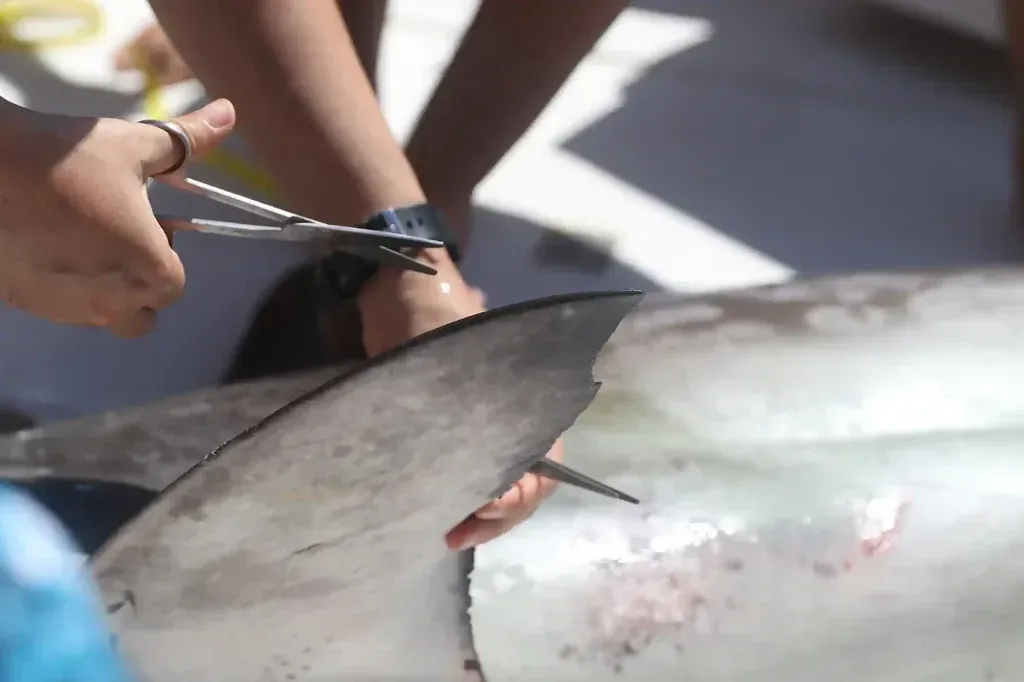
A long way from the long line
According to Salazar-Serrano INCOPESCA inspects every medium- and advanced-sized boat that is ready to disembark its cargo. However, this inspection policy does not include the almost 1,700 licensed small-scale fishermen who might have accidentally captured a hammerhead. Michael said that many fishermen will hide the hammerhead fins or unload them before reaching the ports.
“It’s logical to take advantage of it,” Michael said. “There is corruption. There are certain ways to evade the law.”
But Jose Miguel Carvajal Rodriguez, coordinator of INCOPESCA’s investigation team, said the total eradication of hammerhead capture is unrealistic.
“You can minimize the impact of fisheries, but you can’t do it all,” Carvajal-Rodriguez said. “To eradicate is to eliminate fisheries completely, and that’s impossible.”
He also added that INCOPESCA doesn’t have the resources or people to comply with the mandate: There are only 125 employees to oversee the 2,032 registered commercial fishermen, and that’s not even counting those without a license. Carvajal-Rodriguez said they are currently working to improve their system of having ship captains log what they capture and release.
Can a fisherman sell a shark they accidentally killed?
“No, not the hammerhead,” Carvajal-Rodriguez and Salazar-Serrano said within a second apart from each other.
“They have to release it,” Salazar-Serrano said.
What if it’s dead?
“They have to release it,” he said.
In 2023, the National Oceanic and Atmospheric Administration reported that Costa Rica had improved its practices to minimize illegal, unreported and unregulated (IUU) fishing, after being cited for IUU fishing in NOAA’S 2021 report. Madrigal-Mesen believes that these reports are only telling one side.
“It’s very different to see if only the number of hammerhead sharks is less because there are less of the sharks,” Salazar-Serrano said.
One of the biggest threats to hammerheads once they leave the coastal waters are long line boats, which are vessels that have up to 2,500 hooks cast out from one long line in order to catch as many fish as possible. However, many shark species, including hammerheads, can fall victim to this trap.
One strategy Madrigal-Mesen recommended is having the Costa Rican government promote the idea of having observers on boats to minimize shark casualties.
“It is very fragile, and it is an animal that dies very quickly when it is in a line,” he said. “Let’s say it has a hook and it’s captured. It dies very easily, very quickly. It does not resist. So you have to understand what is happening.”
Costa Rica abides by regulations established by the Inter-American Tropical Tuna Commission (IATTC), which requires 5% of fishing fleets that are more than 20 meters long to have an observer program onboard. That means if a fleet is made up of 100 vessels, only five of them are being monitored, leaving 95 left unchecked. This doesn’t even include vessels smaller than 20 meters.
Carvajal-Rodriguez said that INCOPESCA doesn’t have the people or money to employ someone on each vessel. Despite this, he said they are beginning to train an AI pilot program that will be attached to vessels and log what is being captured, brought on board and released, but INCOPESCA is not sure what the future of this program will look like once the preliminary report is due by the end of this year.
Also, Marvin Fonseca-Borras, geographer and member of CoopeSoliDar, said longline fishermen and people with money invested in the fishing industry are the ones who take advantage of these legal loopholes to allow incidental fishing, at the cost of small-scale fishermen.
Madrigal-Mesen said that perhaps changing what long line materials fishermen use could help minimize hammerhead fatalities. Switching from steel lines to nylon could help sharks free themselves more quickly.
As for Arauz, he spent over 10 years working on long line boats and said a lot of what long line fisherman hunt is seasonal. He used mahi-mahi, for example, which is common in Costa Rica’s waters between December to May. During that season, shark bycatch is typically minimal, but during June or July, Arauz said, capture skyrocketed.
“How can they be incidental if there is nothing else out there?” Arauz questioned.
Arauz argues that if most of what a mahi-mahi fisherman is catching during their off season is sharks, then it’s not incidental capture, which is why he believes that there is no such thing as bycatch.
But Arauz isn’t looking to completely eliminate long line fishing but encouraging fishing for a species that is active and can quickly recover like tuna. It takes tuna five years to reach sexual maturity and they can lay millions of eggs, compared to a scalloped hammerhead shark which takes 10 years to mature and can have from six to 42 offspring.
Madrigal-Mesen worries that hammerheads are just the beginning when it comes to illegal endangered species fishing. For example, in 2021 4,614 kilograms of thresher shark, which is a species protected under CITES, were exported out of Costa Rica, headed straight to Hong Kong and generated over $150,000 in revenue. Recently, in September 2025, Administrative Litigation Court formally ordered the halt of silky sharks and species of thresher sharks from their products being exported out of the country.
“All these animals find themselves waiting in a line,” Madrigal-Mesen said. “When someone leaves the line, they go to the next species.”
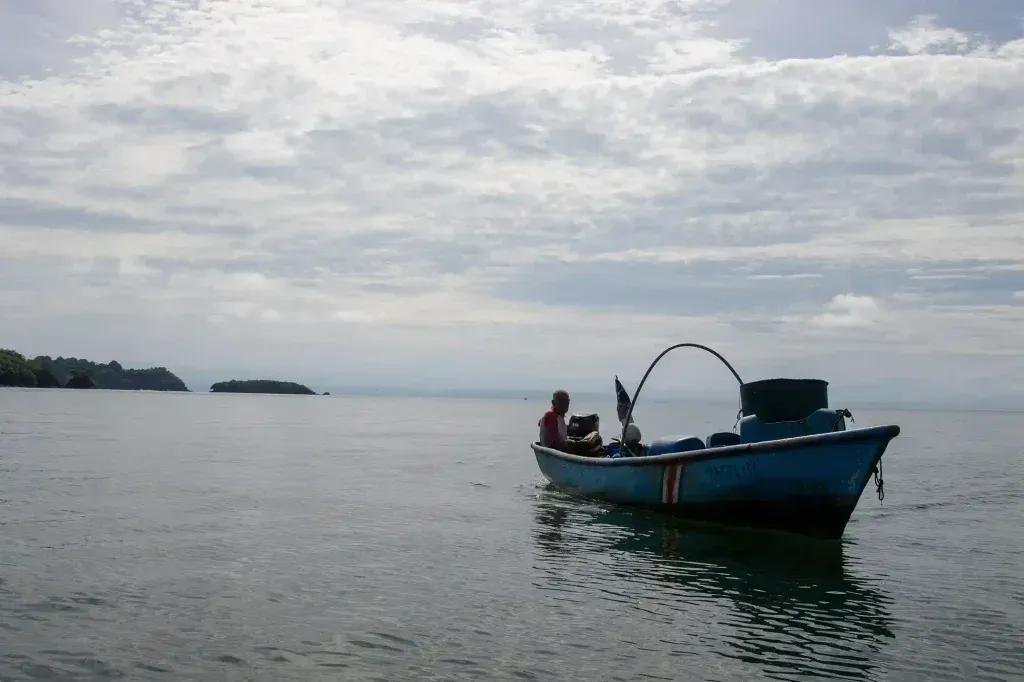
A new vision
Arauz said that Costa Rica needs to hurry up.
“I’m going to be gone within the next couple of decades,” Arauz said, who is 63-years-old. “By the time you are my age you are going to be saving silky sharks, because that’s the only shark that’s going to be left.”
With Instagram reels reaching up to 26,000 views, Arauz knows that he needs to be active on social media in order to get the message out about what is happening to hammerhead sharks and other endangered shark species in Costa Rica. But, he said INCOPESCA and the Ministry of Environment and Energy (MINAE) needs to be restructured. Arauz said that he feels like INCOPESCA is making decisions based on business rather than conservation.
“Unless we get rid of the conflict of interests, we have a total reform of INCOPESCA and decisions are based on science we’re going to keep on having this problem,” Arauz said.
But that doesn’t start within INCOPESCA’s headquarters in Puntarenas. Solis-Rivera said she doesn’t believe in completely erasing INCOPESCA. Without them, she said the coast would be completely privatized. But she thinks Costa Rica’s federal government needs to create a strong vision of what it looks like to be an efficient state from what is a weak one.
Nixon Lara-Quesada, a marine biologist who works for INCOPESCA’s investigation team, said that it’s the current vision that has allowed INCOPESCA to remain small.
“The vision of the country when the fishing office was created many years ago by the Ministry of Agriculture and Farming, I think, stayed the same,” he said. “When they created INCOPESCA the vision was very short.”
He said it’s not about restructuring INCOPESCA, but rather strengthening the institution with more resources and people.
“How do I do the stock assessment if I don’t have the chance to go to the field to capture data? To be able to estimate biomass?” Lara-Quesada said. “I can’t. Why? Because maybe I have to be here in the office.”
Madrigal-Mesen said INCOPESCA has little to work with but that bycatch has continued to be the excuse that hidden and powerful players within the fishing industry use to get away with making a profit.
However, marine biologists like Madrigal-Mesen and Arauz won’t stop advocating for hammerheads. This past summer, Arauz took his platform to Nice, France and attended the Third United Nations Ocean Conference (UNOC3) where he confronted the Minister of Environment of Costa Rica about not following the Supreme Court order that hammerhead sharks – and now silky and thresher sharks— are wildlife.
He is not alone. Nonprofits like Misión Tiburón also attended the conference, sharing their research and community outreach efforts to engage locals in Golfito in hammerhead shark conservation. Among their initiatives is Mujeres Martillo (Hammerhead Shark Ladies), a program that empowers women from the Golfo Dulce area to craft bracelets featuring hammerhead sharks, with proceeds supporting the protection of the Golfo Dulce Sanctuary that Misión Tiburón oversees.
As Madrigal-Mesen attached the tag onto the hammerhead, it simply laid there defenseless. With its bulky T-shaped head, the shark only has the capacity to writhe on the deck. That day fishermen on the Thumper captured two more hammerhead sharks and one thresher. Arauz and his team of marine biologists ventured out into the Pacific Ocean with the hopes to tag a total of five thresher sharks.
“They talk about it being incidental fishing, bycatch, but really no, we really know that is still important for the fishing sector,” he said. “It’s very sad to see how the fishing sector, with its economic strength, is bigger or has more strength than the government itself to protect a species in critical danger of extinction.”