Story
 December 9, 2025
Required Action Plans Missing, West Virginia Water Resource Panel Ditched Amid Toxic PFAS Threat
Country:

In West Virginia, water is a devastating stumbling block.
West Virginia has long lagged in measures to guard against toxic PFAS chemicals, making the state the epicenter for the industrial contaminants that stick in the human bloodstream and have been linked to cardiovascular and immune system harm, reduced birth weight and cancer.
The PFAS Protection Act was supposed to close the gap.
The 2023 state law, House Bill 3189, required the West Virginia Department of Environmental Protection to write action plans to identify and address sources of PFAS, short for per- and polyfluoroalkyl substances.
The law came 22 years after Robert Bilott addressed a letter to the DEP and the U.S. Environmental Protection Agency contending chemical giant DuPont knew that excessive exposure to PFOA, a common type of PFAS that regulators recently have found in drinking water samples from public water system samples throughout West Virginia, causes adverse health effects.
Bilott is the attorney whose work helped uncover West Virginia as what he told the Gazette-Mail has been “ground zero” for PFAS pollution, inspiring the 2019 legal thriller film “Dark Waters.”
Bilott said upon HB 3189’s passage he viewed the law as a “first initial step” West Virginia should have taken decades earlier.
“For the state to just now be doing the initial step of trying to collect data about which water supplies have been impacted, that should have been done a long, long time ago,” Bilott told the Gazette-Mail in a 2023 phone interview.
West Virginia’s PFAS pollution problem dates back to 1951, when DuPont began using PFOA (perfluorooctanoic acid) to make Teflon-related products at what is now the Chemours-operated Washington Works facility near Parkersburg and still a PFAS hot spot.
The chemical discharged into drinking water supplies. People living in the area experienced increased rates of testicular and kidney cancer, thyroid disease, ulcerative colitis and pregnancy-induced hypertension.
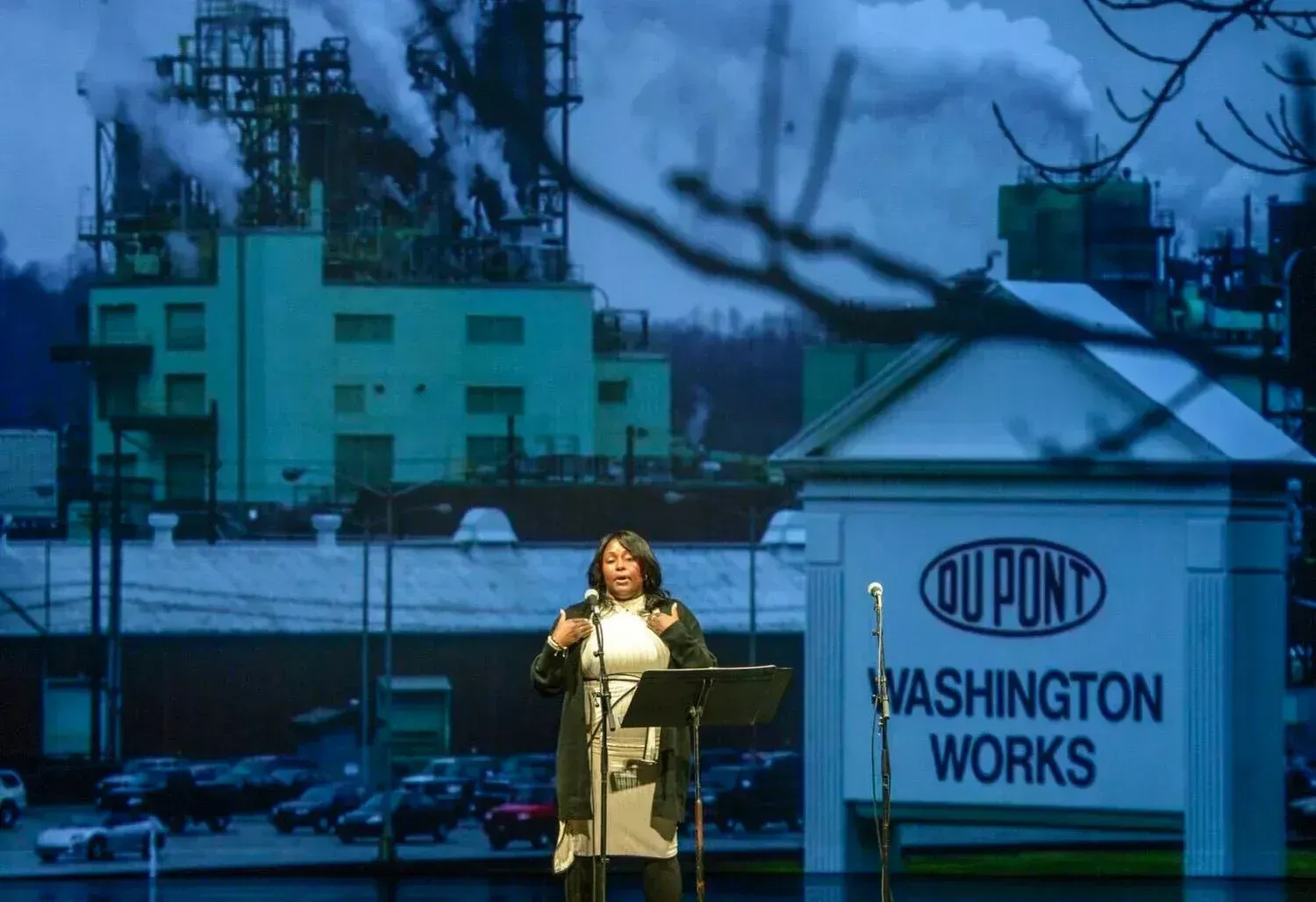
Speaking nearly two decades since she experienced preeclampsia, a condition that develops during pregnancy often marked by high blood pressure, excessive protein in urine and severe swelling, Charlise Robinson told the Gazette-Mail she still didn’t trust the tap water at her home in Lubeck, just outside Parkersburg.
Robinson’s water utility, the Lubeck Public Service District, was one of 19 public water systems with a PFAS detection above at least one regulatory standard proposed by the EPA in West Virginia found in testing results released by state officials in May 2023.
“I feel like, with those chemicals still in the water, that’s not safe for me or my children to drink,” Robinson told the Gazette-Mail in December 2023.
The bipartisan HB 3189 required the DEP to write an action plan to identify and address sources of PFAS by July 1, 2024, for each of the 37 raw water sources for which a U.S. Geological Survey study published in 2022 that found prominent PFAS above the EPA’s applicable drinking water human health advisories and above practical quantitation limits.
The law also required the DEP to write an action plan to identify and address sources of PFAS for each public water system for which measured prominent PFAS above the practical quantitation limit and what was then the EPA’s then-applicable drinking water human health advisory. The first 50 such plans were required to be finished by the end of 2025.
But West Virginia remains without the action plans mandated by HB 3189 as 2025 nears its end, and the state Legislature has repealed state code providing for an oversight commission to investigate water resources to which HB 3189 required the DEP to report its work to identify PFAS sources.
That panel of state lawmakers, the Joint Legislative Oversight Commission on State Water Resources, had been broadly empowered by state code to “regularly investigate and monitor all matters relating to water resources.”
Meanwhile, other states have been more aggressive in combating PFAS despite lacking West Virginia’s especially toxic legacy stemming from the chemicals.
West Virginia was not among the 30 states in which attorney generals have initiated litigation or settled lawsuits against PFAS manufacturers for contaminating water supplies and other natural resources as of December 2024, according to Safer States, a national alliance of environmental health groups and coalitions.
West Virginia is not among the 22 states with PFAS state action plans or strategy documents, nine states that have enacted maximum contaminant levels for PFAS, or 26 states that have regulations or guidance for PFAS in soil, according to the Environmental Council of the States, a nonprofit, nonpartisan group of state and territorial environmental agency leaders.
“[W]e know that communities need stronger protection and faster action from state and federal regulatory agencies and lawmakers,” said Maggie Stange, communications manager for the West Virginia Rivers Coalition. “Investments in treatment and monitoring must be prioritized.”
'Widespread' contamination remains after panel discarded
Alluding to the delay in action plan development, DEP Chief Communications Officer Terry Fletcher cited HB 3189’s lack of funding for the PFAS action plan development it required of the agency. Fletcher noted the DEP applied for an EPA grant to fund plan development in April 2023, a month after the law’s passage.
The DEP was selected for the award in October 2023, but Fletcher says funds weren’t made available until April 2024.
In October 2023, the EPA selected the DEP to receive $1 million for development and piloting of a community engagement process to inform PFAS action plans. The EPA said then the DEP would work with community groups, local businesses, water utilities, county health departments and other stakeholders to design and implement a community engagement process for areas with PFAS contamination.
But in March 2025, the EPA, newly operating under the Trump administration, told the DEP it was terminating the grant through the agency’s Environmental Justice Government-to-Government program, which provides funding at the state and local levels to support government activities in partnership with community-based organizations that result in environmental or public health impacts in communities bearing disproportionate environmental harms.
The EPA told the DEP in a March 12 memorandum the grant was inconsistent with its priorities because it funds programs that promote diversity, equity and inclusion, environmental justice or other initiatives that conflict with its policy under the Trump administration of not funding such measures.
The Gazette-Mail obtained the memorandum via a state Freedom of Information Act request.
In July, the West Virginia Rivers Coalition, a project partner, announced the grant was restored after the DEP had appealed its termination.
Fletcher said the DEP prepared a presentation earlier this year for a planned Joint Legislative Oversight Commission on State Water Resources briefing but that the meeting was canceled. The DEP hasn’t received a follow-up request to provide an update on HB 3189, Fletcher said.
The last formal presentation on HB 3189 to the full commission was in 2023, Fletcher noted. A verbal update was provided to commission leadership in June 2024, Fletcher said.
A copy of the May 2025 presentation meant for the commission shows the results of the 2022 USGS drinking water study that included 27 “hits” above what was then a new EPA PFAS health advisory, with 19 detections above what was then the proposed maximum contaminant level.
In 2024, the EPA announced final, legally enforceable maximum levels for six PFAS, including PFOA, in drinking water. But under Trump, the EPA has proposed rescinding regulations for three of them, including GenX chemicals that have been frequently polluted into the Ohio River above permit limits from Chemours’ Washington Works facility.
The presentation would have informed state lawmakers that the Trump administration had frozen the grant award, thus delaying the DEP’s ability to do outreach needed to complete PFAS action plans, and that the DEP had appealed the grant’s cancellation.
In a DEP-overseen study of treated water published by the USGS in July, at least 11 of 109 sites throughout the state yielded detections above the enforceable limit for PFOA, with five above the enforceable limit for PFOS (perfluorooctanesulfonic acid), another common PFAS linked to serious health impacts like high cholesterol, negative reproductive and developmental effects and cancer.
Forty-six sites had PFOA detections, while 50 had PFOS detections. The EPA has set a non-enforceable health-based goal of zero for PFOA and PFOS, reflecting the latest science indicating there is no level of exposure to those PFAS without risking health effects.
“The report shows that PFAS contamination remains widespread and persistent,” Stange said, “and we know that communities need stronger protection and faster action from state and federal regulatory agencies and lawmakers.”
DEP 'ready to present updates'
House Bill 3411, passed with bipartisan support by the Republican-supermajority Legislature in April, repealed state code establishing not only the Joint Legislative Oversight Commission on State Water Resources but a wide array of other panels, including a toll road study commission, a committee on outcomes-based funding models in higher education and an equal pay commission created to study the methodology and funding for implementing gender discrimination prohibition.

HB 3411 was led in sponsorship by House of Delegates Speaker Roger Hanshaw, R-Clay, an attorney at Charleston-based law firm Bowles Rice who has represented gas and other industry companies and lobby groups.
Commenting on Hanshaw’s behalf, Ann Ali, West Virginia House of Delegates chief of staff and communications director, told the Gazette-Mail that HB 3411 was not crafted specifically to eliminate the Joint Legislative Oversight Commission on State Water Resources but to “clean up state code and remove redundant or stale sections.”
When asked what state standards related to PFAS should be strengthened by the Legislature or DEP, if any, Ali said in an email that “the Legislature relies on the technical expertise of the DEP for that.”
The DEP “remains ready to present updates” on its HB 3189-related work to the repealed Joint Legislative Oversight Commission on State Water Resources, Fletcher told the Gazette-Mail in an email.
Ali said the Legislature “maintains the same structure and jurisdiction over water quality standards it has in recent memory,” citing other committees like the Judiciary Committee that she noted “from time to time take up questions related to water quality.”
W.Va. leaders noncommittal on suing over PFAS
Asked whether West Virginia should consider suing Chemours, DuPont or other manufacturers over PFAS pollution in the state, Ali said that would be a decision for the state’s attorney general.
In 2023, Ohio state officials announced a proposed $110 million settlement — 80% of which they said would address pollution from the Washington Works plant in West Virginia — Chemours said it, along with DuPont and Corteva, reached to resolve the state’s claims relating to the manufacture and sale of products containing PFAS and other PFAS-related harms.
Although Ohio officials indicated DuPont’s manufacture of Teflon products stopped after 2013, PFAS contamination from Washington Works has remained an environmental health concern.
In December 2024, the West Virginia Rivers Coalition filed a federal lawsuit seeking to stop reported discharges from Chemours’ Washington Works facility into the Ohio River exceeding permit limits.
The Little Hocking Water Association, Inc., a southeastern Ohio nonprofit water provider serving 12,000 people, later joined the lawsuit as an intervenor-plaintiff after telling a federal court its 45-acre well field is the catchment reservoir for “the mother lode of PFAS contamination” coming from Chemours’ Washington Works facility, 1,300 feet across the Ohio River.
John “JB” McCuskey took over as attorney general in January, succeeding now-Gov. Patrick Morrisey, a fellow Republican who did not bring PFAS manufacturer-targeted litigation akin to other states during his 12-year tenure as attorney general before becoming governor.
West Virginia Attorney General’s Office spokeswoman Kallie Cart told the Gazette-Mail in August the office was “conducting a comprehensive review of PFAS contamination sources and responsible parties, working closely with environmental scientists and public health experts.”
Cart did not respond when asked for an update on that review.
Morrisey spokesman Drew Galang has been noncommittal when asked Morrisey’s stance on suing manufacturers for PFAS pollution in West Virginia and whether state officials should have sought recovery for damages for PFAS contamination while Morrisey was attorney general.
'People want to trust their tap again'
Stange noted the EPA’s termination of funds intended to support PFAS action plan development caused “significant challenges” in the work’s early stages.
“[W]e lost five months of time where we could have been more intentional about reaching and educating community members who are historically left out of the decision-making process,” Stange said.
Any delay means more time of possible exposure to toxic PFAS in drinking water sources — three years after the detections that shaped HB 3189 were documented.
“We understand that administrative and funding challenges can arise, but clean water and public health can’t wait,” Stange said. “These action plans are the roadmap for identifying where PFAS are coming from and stopping the pollution at its source.”
Stange called the first round of PFAS community meetings in the Eastern Panhandle last month “a strong start” in getting residents to come together to discuss PFAS contamination in local drinking water sources and what’s being done to address it.
The DEP has been working with the Rivers Coalition, Pittsburgh-based nonprofit law firm Fair Shake Environmental Legal Services and other local groups to host the community meetings, which have since commenced in the Northern Panhandle, with a virtual session scheduled for Thursday at noon. Registration is available at wvrivers.org/pfas.
Nearly three-quarters of a century since DuPont began using PFOA to make Teflon-related goods near Parkersburg, water quality advocates say now is the moment for West Virginia to get a PFAS game plan — and stop losing faith, protection and time.
“People want to trust their tap again,” Maria Russo, policy specialist for the West Virginia Rivers Coalition, said. “These PFAS action plans are an important step, but they need to be followed up with action — identifying sources, stopping pollution at the source and keeping residents informed every step of the way.”