Story
 December 4, 2025
My Misjudgment of South Korea’s Obsession with White Skin
Country:

Use of the antioxidant raises questions about safety, identity, and the cost of beauty.
When I first landed in Seoul, I thought I knew what I was chasing: a story about South Korea’s obsession with pale skin. I expected to find a culture consumed by whitening products and procedures. What I found instead was a nation negotiating its identity through beauty, history, and survival.
My first interview was with “Judy,” a young Korean woman who adores Seoul but said the city’s beauty standards made her painfully self-conscious. She
requested to go by “Judy” due to the hesitance of sharing opinions that would be deemed controversial in South Korea. She’d battled acne and felt rushed to “fix” her skin. She mourned the way her friends compared themselves to pale-skinned K-pop music stars, referred to as “idols,” and sank into depression. “I know I’m not the only one feeling this depressed about it when I did,” she told me. Her frustration wasn’t just personal; it was a societal issue. Why, she asked, can’t we accept the skin we’re in?
That question echoed through every stop I made. At every Olive Young store, I asked for whitening products and was offered glutathione. The language was coded, but the intent was clear.
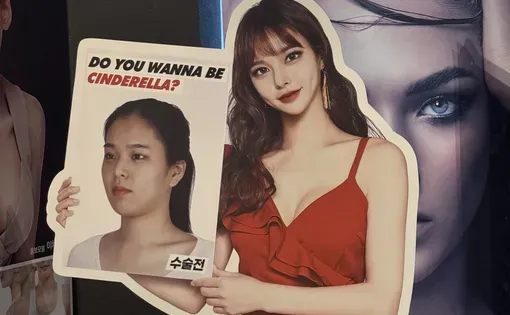
Then came Cinderella Hospital. We were successful in inquiring about its services, but it was initially eerie. Empty halls, abandoned computers, and no staff in sight after we asked about how they market glutathione as a skin whitener. A receptionist reappeared only when a pale-skinned Korean woman arrived. Suddenly, the nurse and doctor materialized. We showed them the website advertising whitening services. They dismissed it and redirected us to Abijou Clinic, saying dermatologists handle injections, despite offering the service on their website.
At a pharmacy, I was offered over-the-counter hydroquinone, despite its ban in the United States. The box read “bleaches melanin,” after translation. The pharmacists verified that IV glutathione wasn’t sold in-store but was available through dermatologists.
Abijou Clinic was sleek and foreign-friendly, offering translators for English, Vietnamese, and more languages. My assistant, Maya Dawson, and translator, Gwen Allen, were taken back for consultations after removing their makeup. When Allen asked about IV glutathione, the doctor said whitening was merely a side effect, visible only after multiple sessions but claimed there were no risks.
Then I met Olivia Choi, CEO of Seoul Beauty Global. She was magnetic. She’d used IV glutathione for energy, not whitening, and stopped due to fear of getting addicted and time constraints. She wasn’t surprised that her doctor hadn’t disclosed the risks to her.
Her perspective, shaped by years in Australia, was refreshing: Beauty doesn’t need a standard. She hopes people stop trying to become someone else and embrace their own uniqueness.
Professor Gooyoung Kim, of Cheyney University, who teaches communication arts, conducted one of the most profound interviews with me. “The strive toward pale skin is not personal. It is social, economic, political, historical, and so much more,” he said. He urged me to spend two-thirds of my time on research to deepen my work. We discussed how V-lines, a sharp upward jawline, and large eyes were Western imports that have stuck, while whiteness is gaining interest from other communities, as the world is increasingly chasing Korean culture. His connection of beauty standards to Confucianism was a key element of my story.
At VP Plastic Surgery Clinic, the staff emphasized “brightening” over “whitening,” though they admitted patients still request whiteness. They encouraged healthy habits and discouraged misleading marketing. Their stance was clear: Beauty standards are problematic, but brightness is often seen as a marker of health.
A student who takes oral glutathione was candid. She’s aware of her desire for pale skin but is trying to move away from it. She values diversity of thought and feels disturbed by the uniformity of Korean beauty ideals. “As long as I live in Korea,” she said, “I’ll keep craving prettiness.” The emotional toll was palpable.
I began noticing a visual pattern: tan male imagery paired with pale female imagery. Gendered skin tone norms were everywhere.
At Yonsei University, Professor Hyun Mee Kim explained that in a homogeneous society, competition will always exist, and beauty standards are part of that race. Dr. Park Ji-Youn, author of Is Skin Whitening Dangerous?, admitted lying in her Singapore article about glutathione risks due to legal bans. She contradicted herself repeatedly, claiming Koreans don’t want to be whiter, just brighter, then equating brightness with whiteness. Her final comment, “Is that what you want me to say?” felt like a performance of denial. In hindsight, however, the conversation with her was crucial in the turning point of my story.
Tony Medina, CEO of Seoul Guide Medical, reshaped my project. He argued that Korea’s desire for whiteness is vilified due to misinterpretation. “Whitening” means different things globally. Korea’s use isn’t inherently harmful, unlike in countries where it’s banned. Still, the pressure to be flawless remains intense. Medina believes feminist movements and generational shifts may erode these standards over time.
Shin Dainn, a social media influencer known as “Haroo,” conforms to beauty norms but wishes they weren’t so rigid. She wants outsiders to approach Korea’s whitening culture with empathy. Classism plays a role, and whiter skin is aspirational. She’s received backlash online for discussing glutathione, often from people who misunderstand its cultural context. She appreciated my effort to understand Korea’s nuance.
I met Nakitah Vogt, a South African teacher and administrator of Brothas & Sistas of South Korea, a group of expats. She offered a paradigm shift. “Why do Koreans want to be white?” is the wrong question. Instead: “Why do we think Koreans want to be white?”
She challenged Western assumptions and emphasized cultural relativism. Korea’s skin care boom isn’t about mimicry. Her insights on the competitive beauty culture within a historical context were essential to include in my story as a key voice.
My trip to South Korea was more than a journalistic pursuit. It was a personal reckoning with the layers of beauty, identity, and cultural translation. I arrived with questions about skin whitening and left with a mosaic of perspectives that challenged every assumption I had.
From the eerie silence of Cinderella Hospital to the warmth of Choi’s transparency, I witnessed a nation negotiating its self-image in real time.
Skin whitening in Korea isn’t a monolith. It’s a spectrum of meanings shaped by history, media, class, and global perception. Some view it as brightening, while others see it as whitening, and many consider it a means of survival in a society that demands perfection. What struck me most was the emotional toll: the depression, the conformity, and the quiet resistance. I met women who were exhausted by the chase, professors who traced its roots to Confucian ideals, and influencers who asked for empathy, not judgment.
This journey reminded me that beauty standards are never just about aesthetics. They’re about power, belonging, and the stories we tell ourselves to feel worthy.
My role as a storyteller is not to simplify but to honor complexity. And in doing so, I hope to create space for truth, healing, and a more compassionate lens on what it means to be beautiful.