Story
 May 2, 2025
Legacy of Luckey: For Decades, Officials Downplayed Risks of Cold War-Era Weapons Site
Country:


Project
The Legacy of Luckey
Workers and residents were told a Cold War weapons plant was safe. It wasn't.
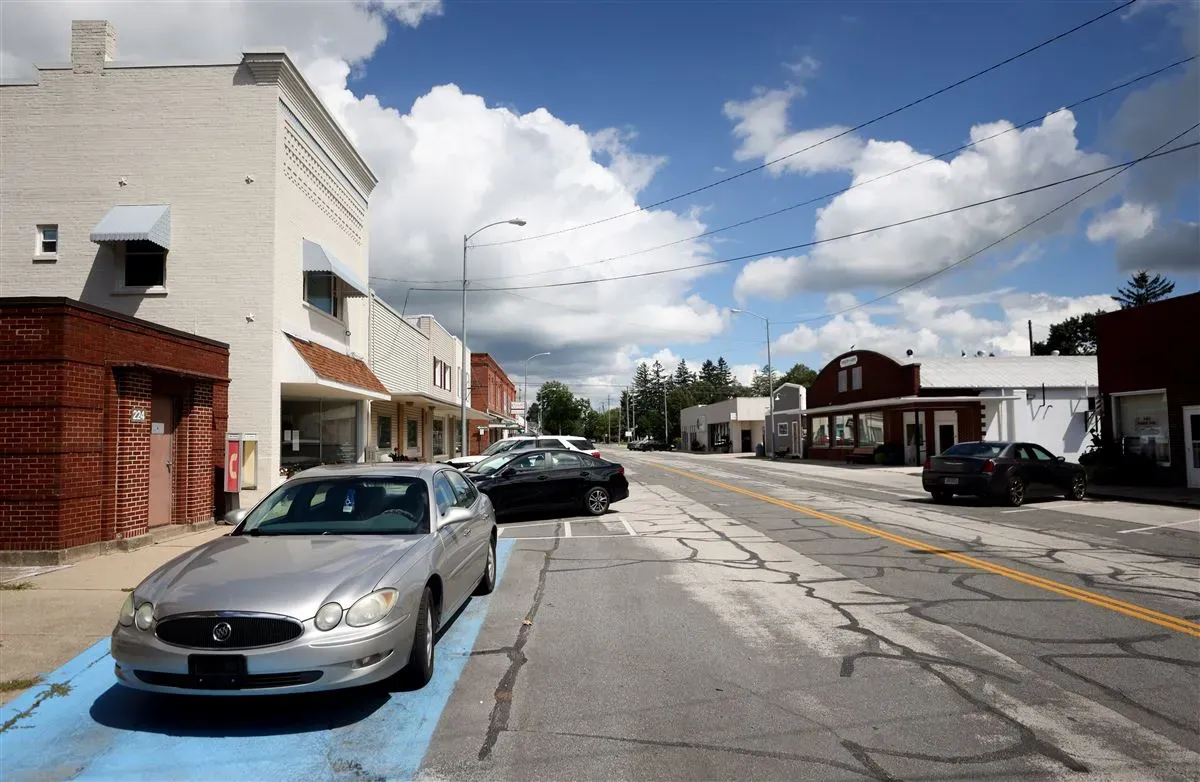
LUCKEY, Ohio — America's Cold War buildup was facing a major health crisis, and the problem was centered in the tiny village of Luckey, Ohio.
There, on the edge of town, adjacent to farm fields and country roads, was a sprawling facility processing so much highly toxic beryllium metal for nuclear bombs and other weapons that the plant was saturated with deadly dust. Every day, dozens of workers were being overexposed.
Officials from the Atomic Energy Commission called an emergency, secret meeting at the government-owned plant, and, according to minutes of the 1951 gathering, the chief topic was whether the facility should be shut down to protect workers.
The AEC's chief of industrial hygiene, Bill Harris, favored closing the plant: “If you are deliberately exposing men, you must shut down.”

As a nonprofit journalism organization, we depend on your support to fund more than 170 reporting projects every year on critical global and local issues. Donate any amount today to become a Pulitzer Center Champion and receive exclusive benefits!
But the AEC's Edmund Velten, in charge of obtaining beryllium for the U.S. military, disagreed: “To the best of my knowledge, there is only one reason for this plant, and it is because I have been instructed to get beryllium. Unless I am instructed otherwise, production comes first and then health.”
AEC colleague Richard Smith tried to find common ground: “We must run the plant without killing people.”
In the end, the officials agreed not to shut the plant. Instead, they relaxed the rules, allowing workers to be exposed to five times as much beryllium dust.
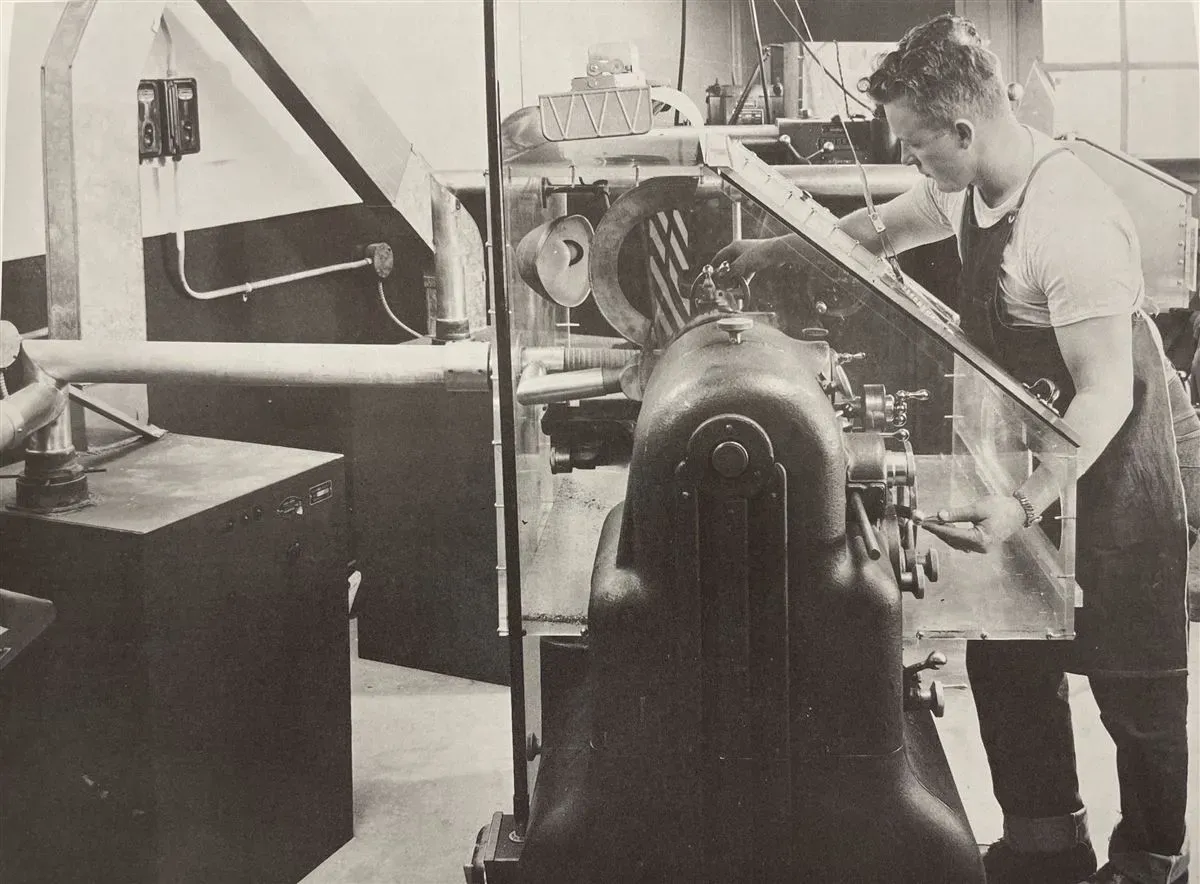
Several workers, records show, contracted beryllium disease — an often-fatal lung condition — at the plant, and at least one died.
Such is the legacy of Luckey, the scene of deception, misconduct, and a decades-long pattern of neglect.
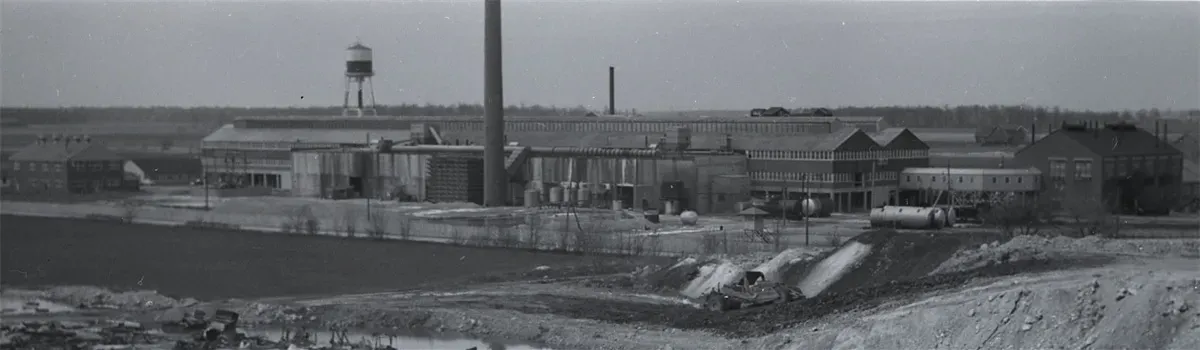
For 80 years, the town has been home to a 44-acre tract of land that once was one of the most critical defense sites in the nation and now is one of the most toxic.
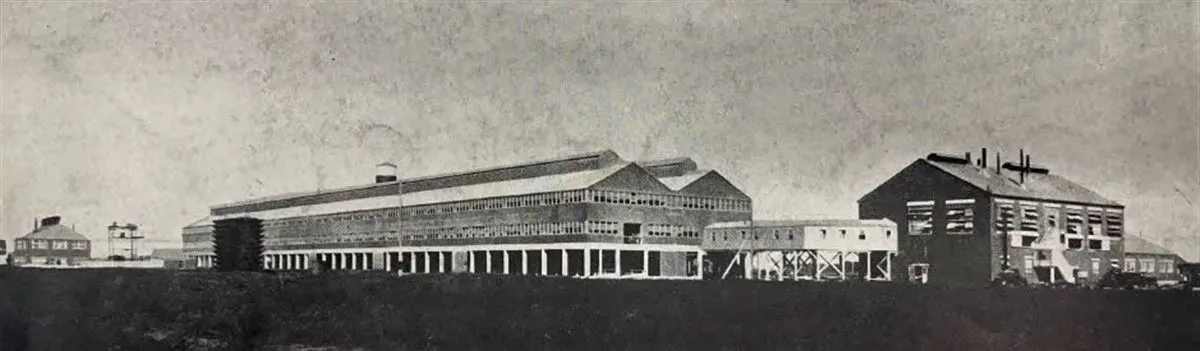
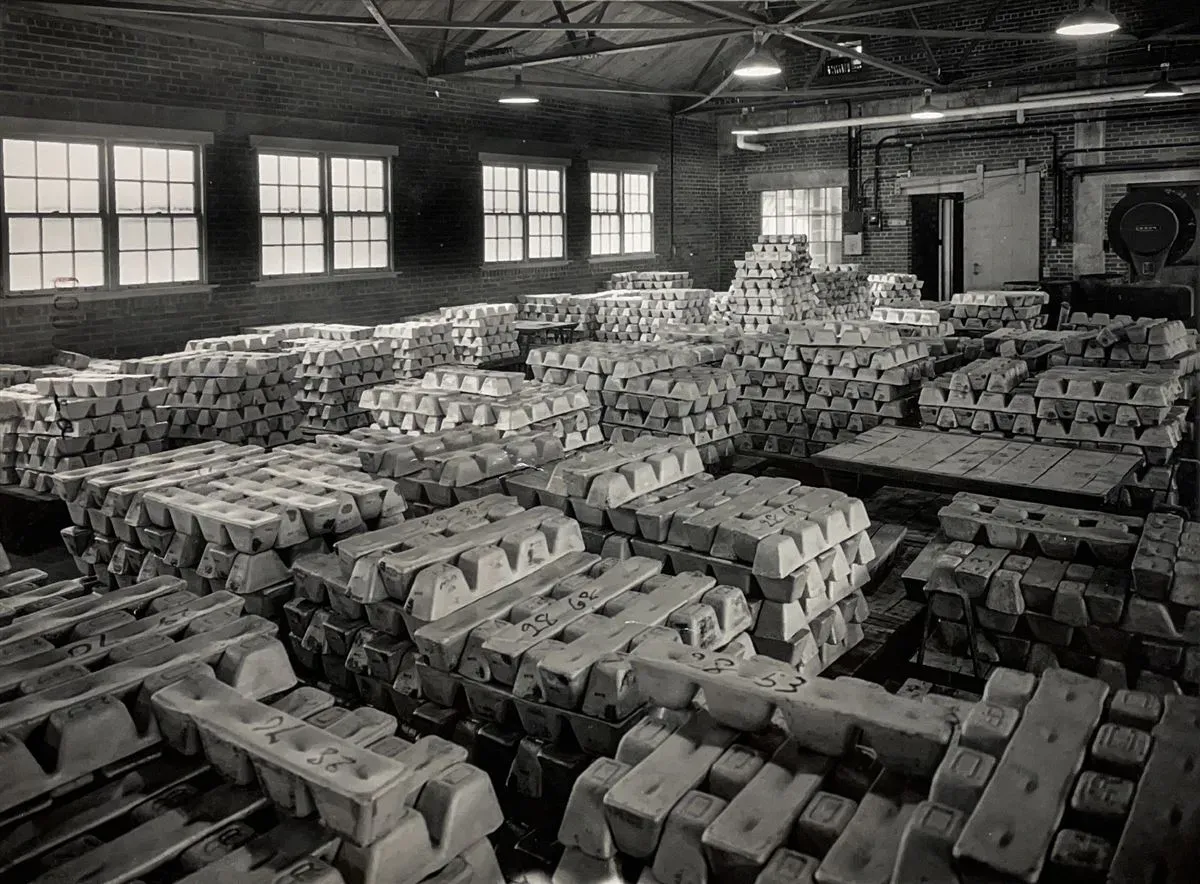
Built by the War Department in 1942 in the wake of Pearl Harbor, the property has housed a magnesium plant for the Manhattan Project, a beryllium production facility for the Cold War and Space Race, a plastics company, a mattress foam factory, and three massive makeshift, improperly lined waste lagoons.
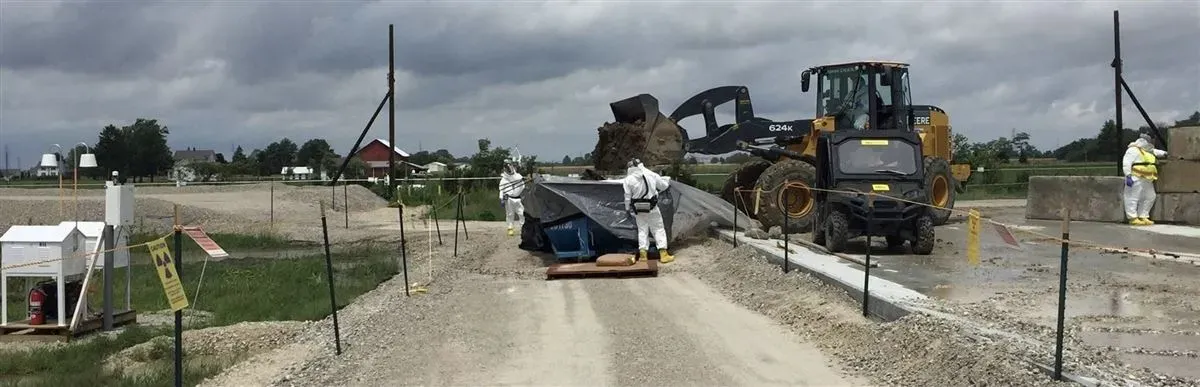
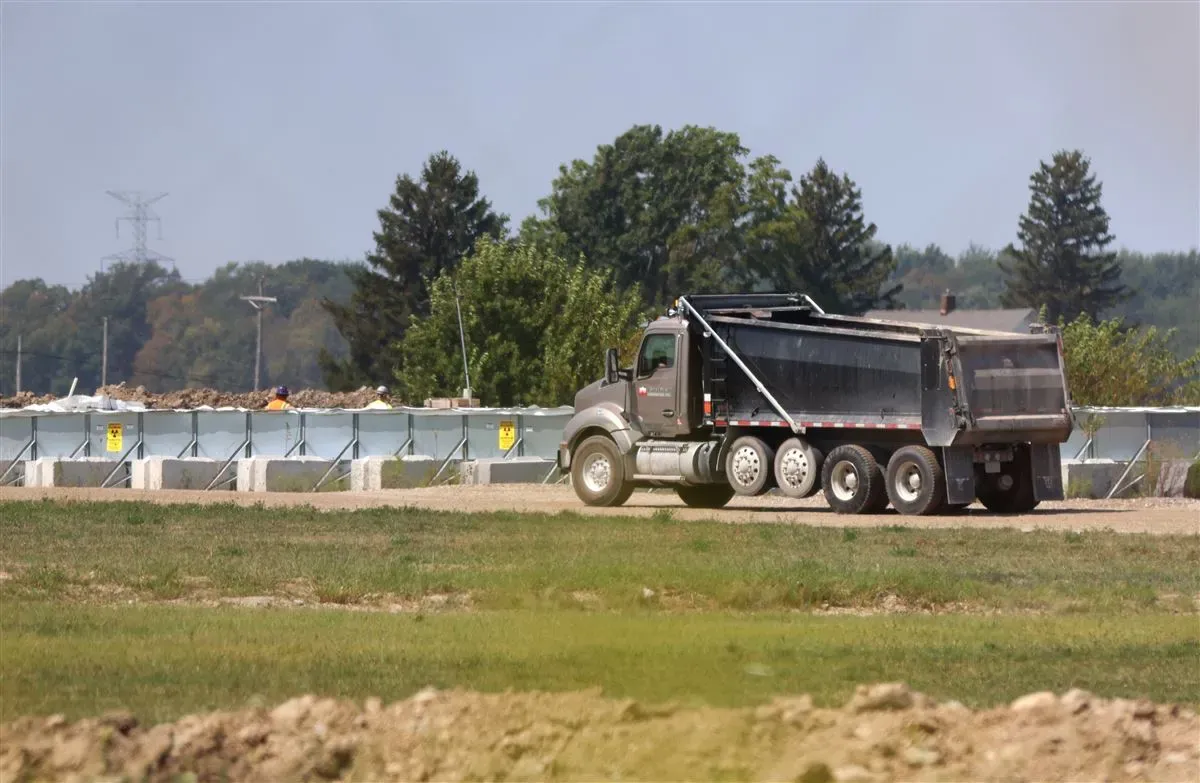
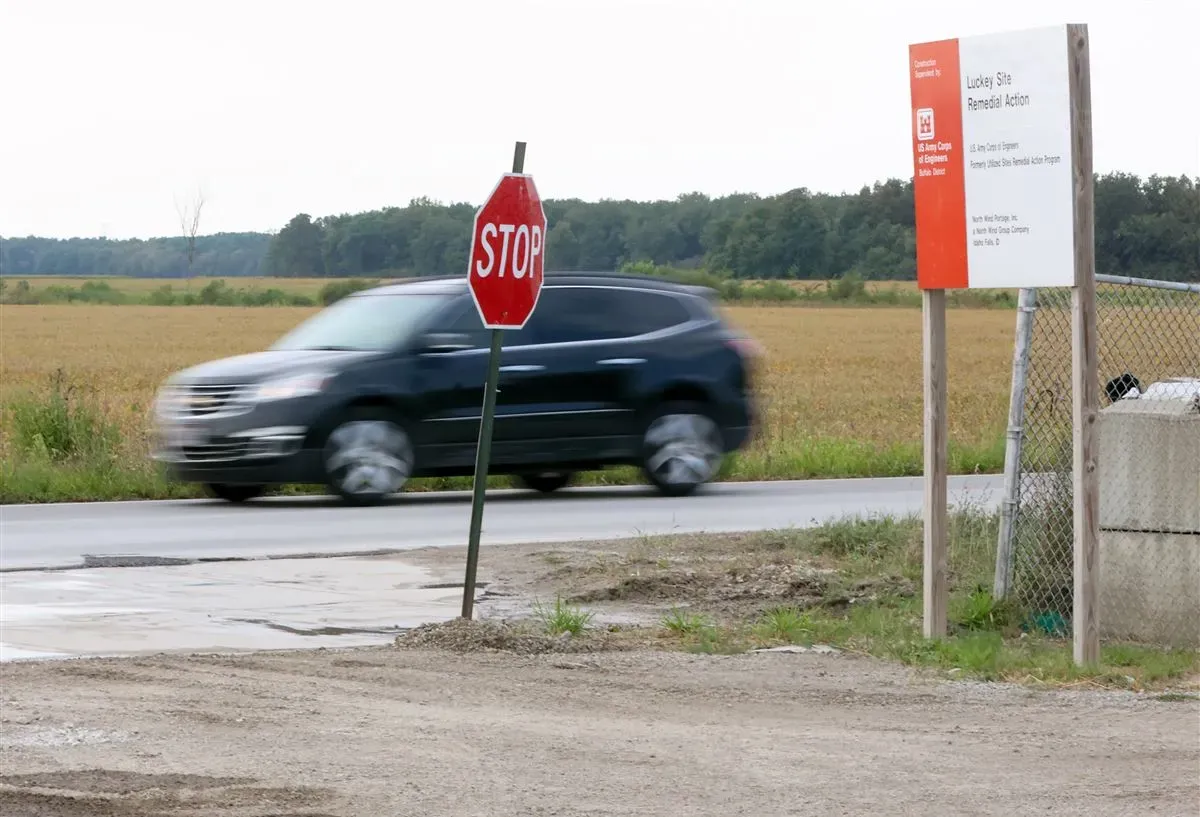
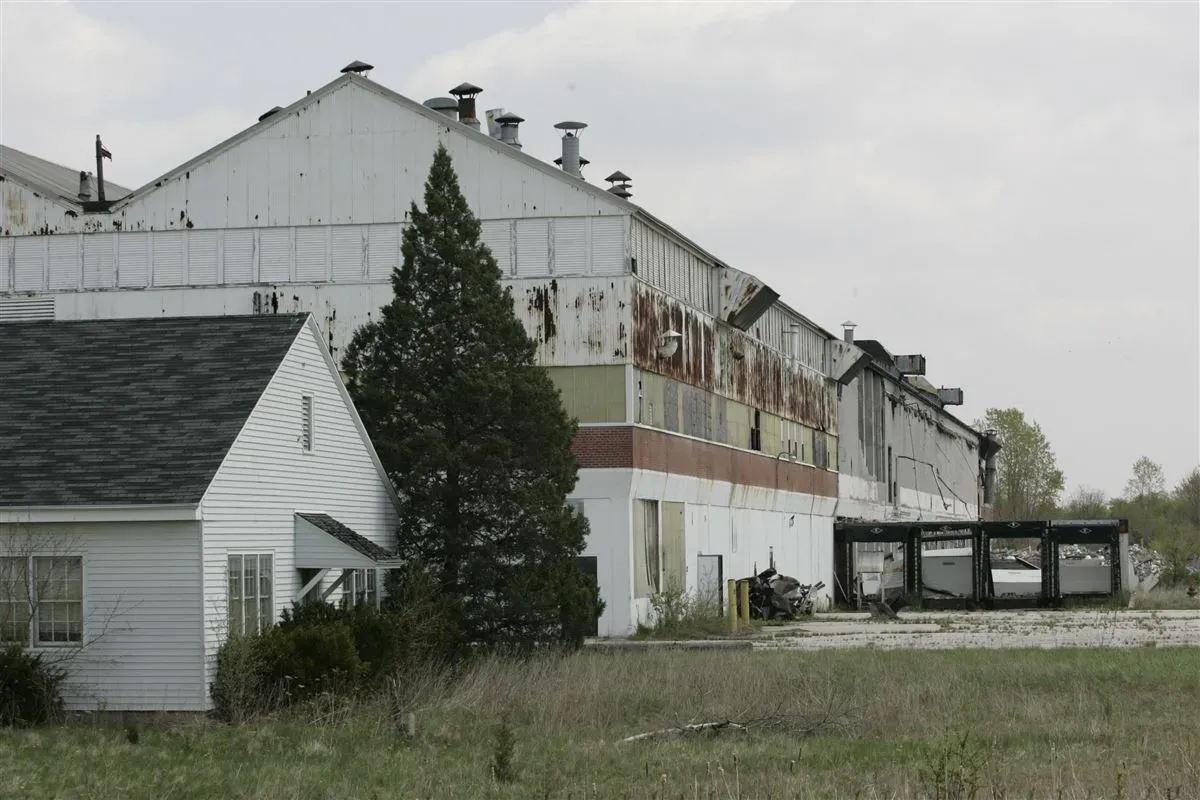
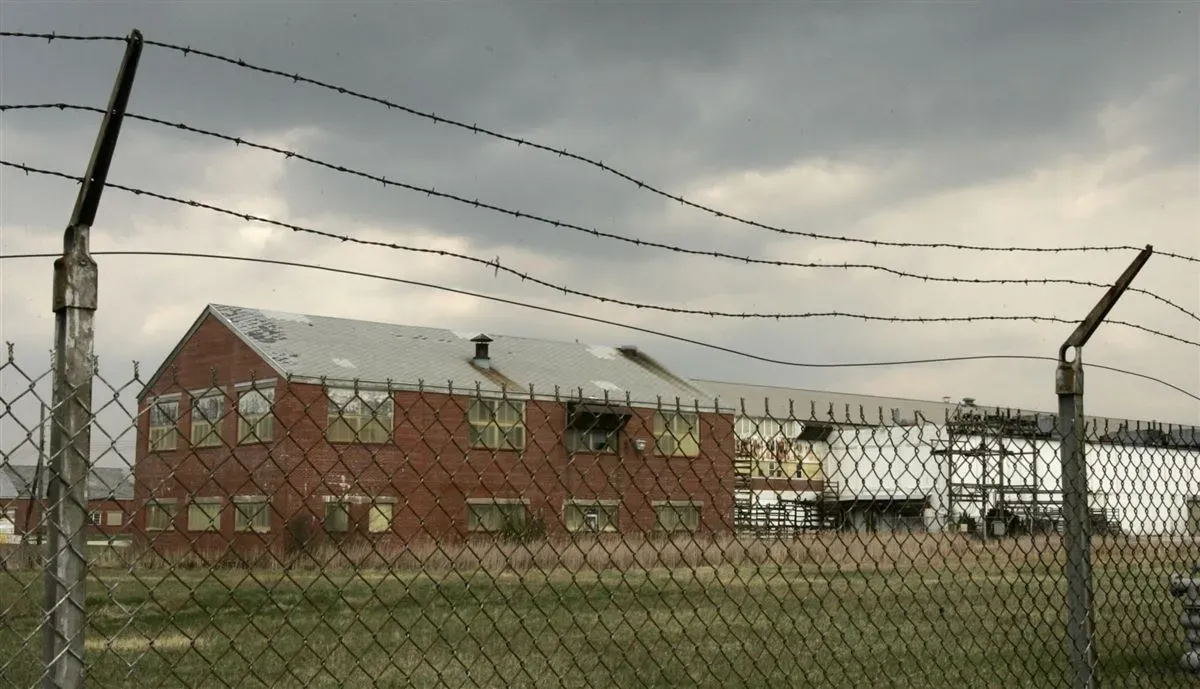
Today, almost all of the old buildings are gone, and U.S. Army Corps of Engineers workers and contractors, some in hazmat suits, are removing thousands of tons of tainted soil, some buried 18 feet deep.
For the people of Luckey, what has transpired at the former weapons site has long been shrouded in secrecy, with many activities there designated as classified.
But a year-long investigation by The Blade, based on thousands of government and industry documents, many of them declassified, shows that authorities repeatedly misled the public about the dangers of the site.
Officials downplayed hazards, ignored safety recommendations, and knowingly put workers and the public at risk, according to exposure data, Brush Beryllium Co. documents, and correspondence between defense officials.
During the Cold War, government and beryllium industry officials boasted to the media about how the Luckey beryllium plant would use the most modern ventilation when, in truth, they relied on old ductwork.
Officials also offered tours of the site to high school students and hosted 1,100 adults and 300 children at an open house at a time when deadly beryllium dust counts were out of control.
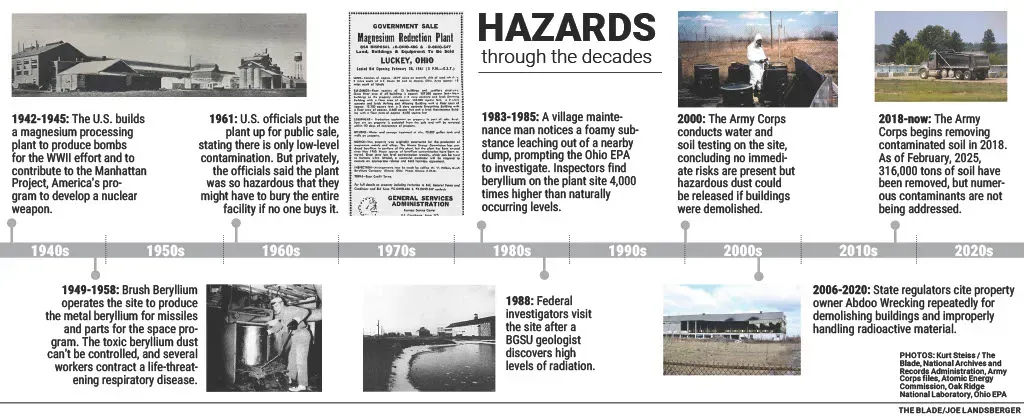
At one point, in 1961, the government put the plant up for public sale, taking out ads in local newspapers, claiming that major sources of beryllium had been removed and that only “some low-level contamination” remained.
But records show that six months earlier a government inspection had determined the property was “worthless" and a “toxic hazard,” particularly from the “sludge lagoon menace” that was drying up fast and would soon result in airborne beryllium dust.
The facility was so hazardous, government officials privately wrote, that if no buyer were found, it might be best to bury the entire facility.
The site's current owner, Industrial Properties Recovery, has repeatedly ignored government orders to stop demolishing buildings on the property because it could stir up beryllium dust.
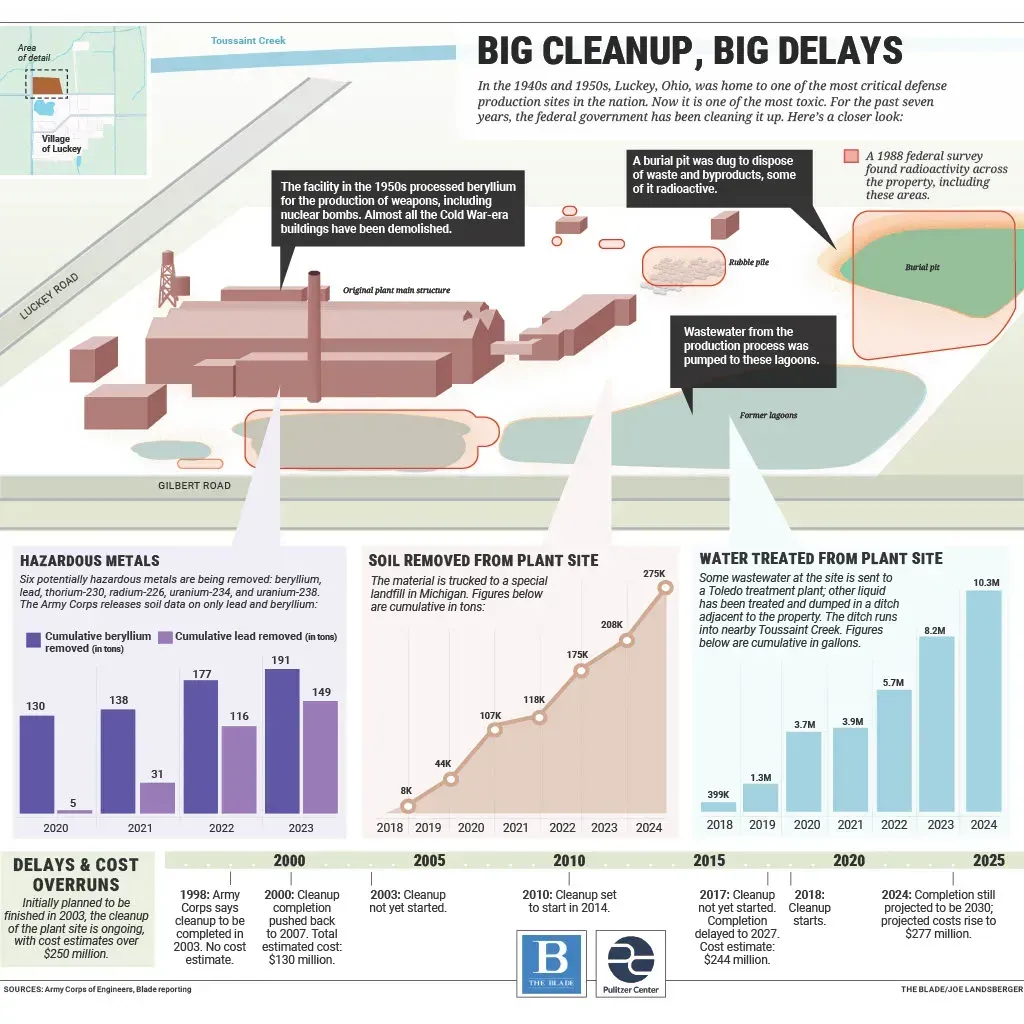
The Army Corps has been cleaning up the site, but that effort was supposed to be finished 22 years ago. Now, officials say, the projected completion date is 2030 at a taxpayer expense of $277 million, four times the original estimate.
The Blade's investigation was supported by the Pulitzer Center, a nonprofit organization offering investigative reporting grants.
Exactly how much the property has affected the village of Luckey, population 1,000, is unknown. Detailed sampling of the groundwater, air, soil, and radiation on the actual site has not been published in 24 years, making it difficult to assess potential threats to residents.
And testing around the site — in the town of Luckey and on farms and in residential areas — has been virtually non-existent.
Over the past year, The Blade collected well water samples from Luckey-area homes, businesses, and public places and sent them to a certified lab for analysis. Nineteen of the 39 samples tested for radioactivity showed levels at least 10 times greater than what the Army Corps has said is normal and naturally occurring in the region. Environmental radiation experts said the levels were potentially harmful and urged authorities to act.
The newspaper published its results on April 25. Prior to publication, The Blade shared the results with the Ohio EPA and the Ohio Department of Health and requested interviews with the agencies' directors. Those requests were denied.
Instead, the agencies responded with nearly identical email statements, saying they "cannot comment on third-party sampling or results."
Only after The Blade shared the results with the Army Corps, which then contacted the Ohio EPA and the health department, did the state agencies reverse course and agree to test some Luckey wells. Those tests were to begin this past week.
The Army Corps is the main federal agency involved in the site. The Atomic Energy Commission dissolved in 1974, with its functions assigned to multiple government entities.
Army Corps officials have long maintained no contamination has moved off site and that workers have carefully monitored the property to assure residents are safe.
“Safety is paramount,” said Lt. Col. Robert Burnham, commander of the Army Corps’ Buffalo District office, which oversees the cleanup. “Public safety, personal safety — that is baked into our processes. That is in our DNA.”
Brush Beryllium was the principal Cold War tenant of the government-owned plant, processing the metal throughout the 1950s. It left Luckey in 1960 but continued operating a plant in nearby Elmore. The company, now called Materion Corp., based in Mayfield Heights, remains America's leading beryllium producer.
Materion declined a Blade request to interview president and CEO Jugal Vijayvargiya and did not answer numerous written questions.
In a written statement, the company said its predecessor, Brush Beryllium, operated the Luckey plant "under the full control and oversight of the Atomic Energy Commission" and that Materion has not been involved in the site since the late 1950s.
"Materion is a world leader in beryllium safety," the company wrote, and Materion officials "utilize a disciplined environmental, health, and safety management system to protect people, communities, and the environment."
From the beginning, a one-way conversation
In spring of 1942, Ernest Miller and his wife, Mable, were living on a 77-acre farm north of Luckey and had just celebrated their 25th wedding anniversary.
The next month, the Miller farm would be taken over by the U.S. government.
With America fully engaged in World War II, the War Production Board needed a large swath of land to build a defense plant. Three families, including the Millers, were ordered to sell their land for the war effort.
The defense plant would produce magnesium metal, locals were told, and it would be used exclusively for aircraft parts and bombs.
One farmer viewing the construction noticed an old chicken coop and offered to pay $100 for it — an amount worth nearly $2,000 today.
The government replied that they were not interested in any kind of a deal, according to records detailing the interaction. A few days later, one of the government workmen destroyed the coop, dragged it to a corner of the property, and burned it.
Residents grew suspicious of the project and wondered: Why Luckey?
Authorities told them the region had good limestone to extract magnesium, and Luckey's limestone was exceptional. Geologists described it as the purest in the country.
The government ended up buying 199 acres of farmland, of which 44 were used for the plant. The remaining acreage was leased for farming. Fourteen brick and eight wood-framed buildings were quickly erected, including a two-story smelting building longer than two football fields and containing 20 massive furnaces.
Security was paramount. A 7-foot-tall wooden fence with three strands of barbed wire surrounded the plant, punctuated by three guard towers. A 16-member guard force patrolled the site, and several rifles and revolvers and hundreds of rounds of ammunition were stored in a vault in Building #13.
And when confidential sources told U.S. defense officials that a top manager of the National Lead Company, the global firm operating the Luckey plant, was "a strong Nazi admirer," the matter went all the way up to FBI director J. Edgar Hoover, correspondence reviewed by The Blade shows.
The famed FBI leader personally wrote to defense authorities to say that a source reported that the manager, a prominent metallurgist and inventor, had many German business contacts and "was a typical international businessman, whose main interest is probably to keep his international business connections intact for the post-war period."
National Lead defended its manager, and, according to company correspondence, the nation's War Production Board allowed him to remain involved with magnesium production.
The Luckey plant became fully operational in December, 1942, running 24/7 and producing 15 tons of magnesium metal a day. When the facility struggled to find enough male workers, it turned to women. Soon, about a fifth of the 200-employee force were women, including a seven-person, all-female laboratory staff.
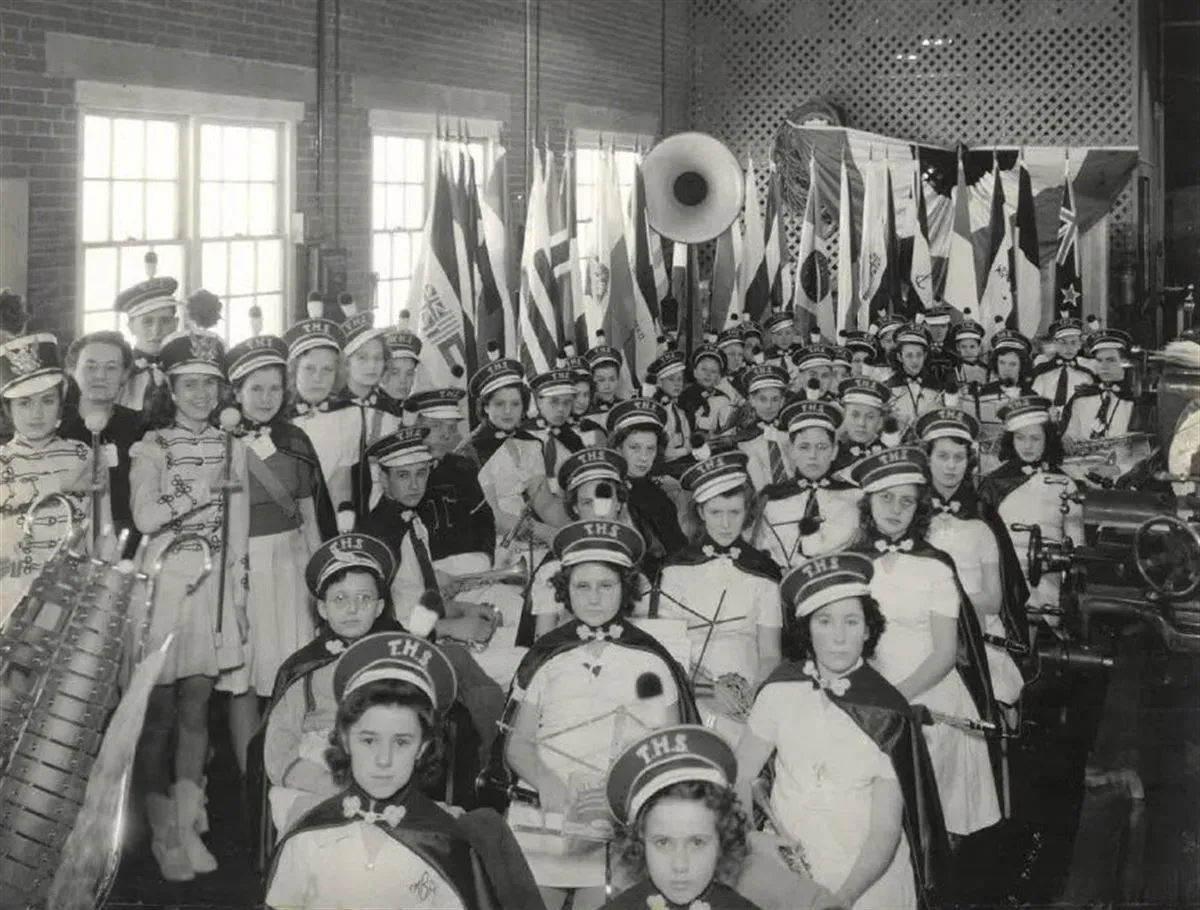
To improve relations with Luckey residents — and potential workers — the plant allowed the local Rotary Club to tour parts of the site as part of the group's "Farmer's Night" gathering. Authorities also showed a film on incendiary bombs at the local high school.
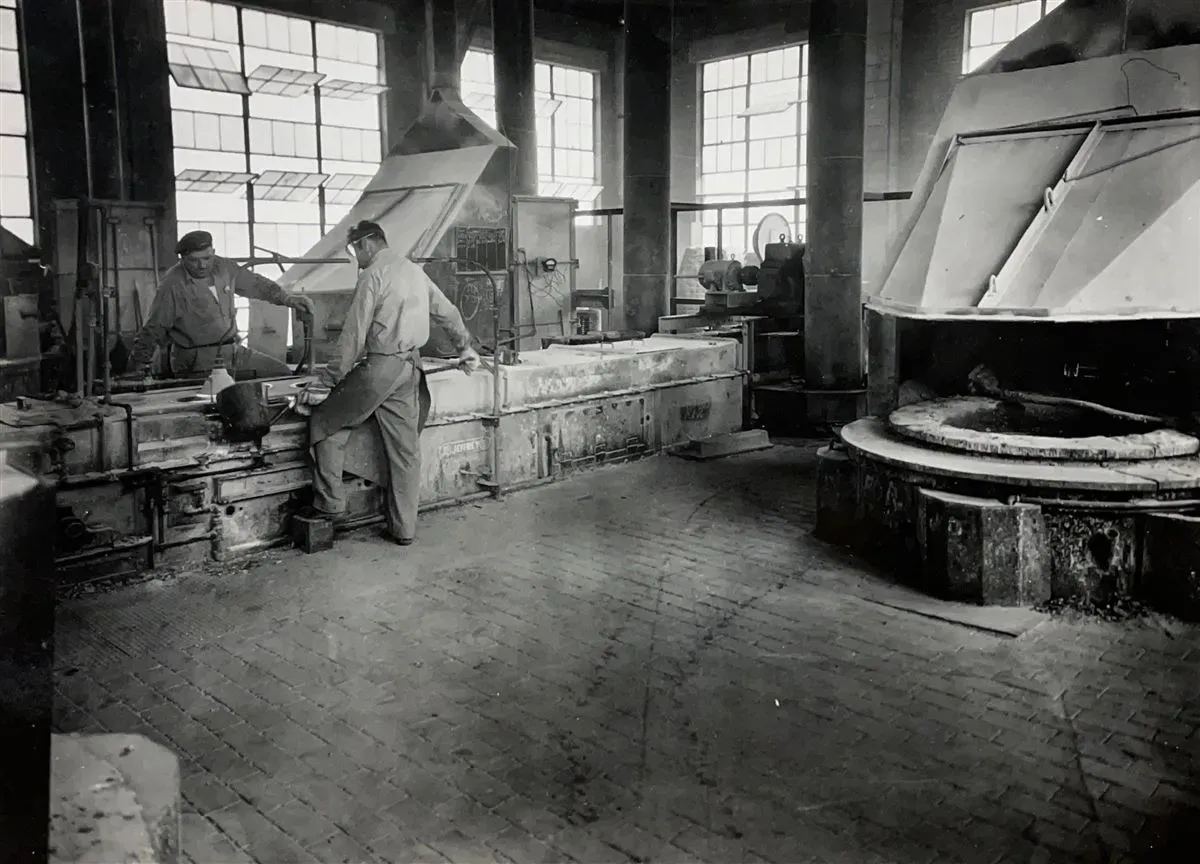
The facility in 1944 received an Army-Navy “E” award for excellence in production, an honor given to only the top 5 percent of defense plants in the country. A special flag was hoisted above the plant, a local high school band performed, and all workers received lapel pins for their patriotism.
In the flurry of activity, there wasn’t much concern about health risks.
That would eventually change.
After disaster in Lorain, beryllium comes to Luckey
Seventy miles to the east, another defense plant was producing a different metal few people had heard of: beryllium.
Lighter than aluminum and stiffer than steel, beryllium had tremendous applications in America’s World War II effort. The metal found use in radar systems, specialty aircraft parts, and X-ray tubes as well as in crucial components in the first atomic bombs.
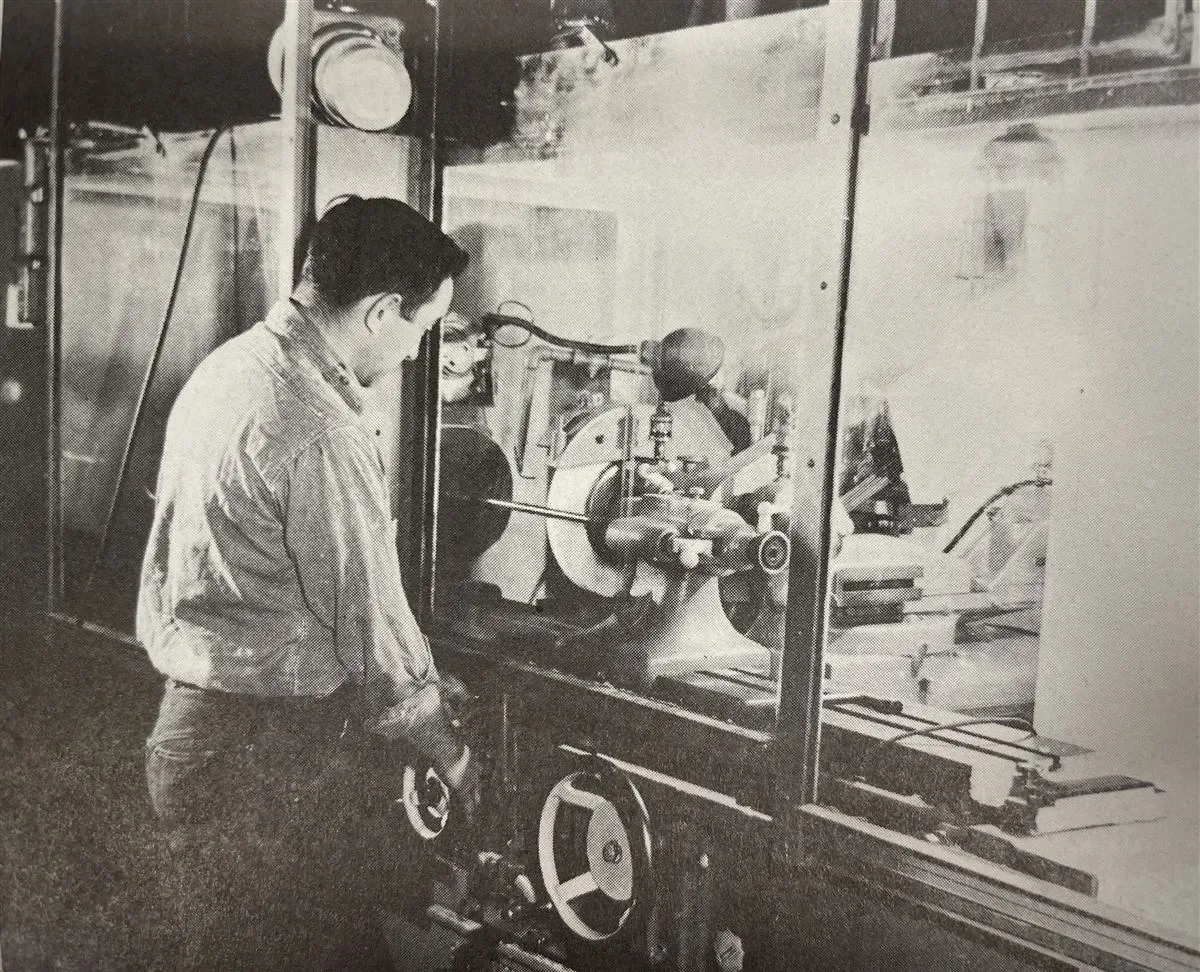
But this miracle metal had a dangerous downside: When it was machined, ground, or sanded, its dust could become highly toxic and cause a potentially fatal lung disease.
It didn’t take long for workers in the Lorain plant, managed by Brush Beryllium, to start getting sick. Some broke out in rashes almost immediately, while others didn’t develop symptoms, including coughing and shortness of breath, until months or decades later.
Atomic Energy Commission records show that of the 1,191 workers at the Lorain plant, 226 would be diagnosed with a form of beryllium disease.
By the late 1940s, it was clear a health crisis was unfolding not just at the plant, but in the city of Lorain: Residents who had never worked at the facility were contracting beryllium disease — a development that stumped even some of the nation's top experts.
Eventually, health officials concluded residents living near the plant were getting sick from air pollution from the facility, identifying 11 such cases of beryllium disease.
Facing a PR disaster, lawsuits from stricken residents, and damage from a major fire at the plant, the government and Brush decided to get a fresh start and move beryllium production to a less populated location.
They settled on Luckey — then with a population of 750 — and the former magnesium plant site. It seemed like a good match. The location was large and remote, with few homes nearby, except for a handful of farmhouses. The magnesium facility was also available: It had been in stand-by mode since the end of World War II.
When the new beryllium plant was announced, rumors spread among residents that the plant would damage crops and cause women to become infertile.
A top atomic commission official, Wilbur Kelley, assured reporters that authorities would be "taking every possible safeguard," and the new plant "will be provided with the most modern ventilation and exhaust gas cleaning equipment."
Plant manager Henry Schaffner told village officials, "We are planning to have the cleanest plant, chiefly from the standpoint of air pollution, in the world."
And help wanted ads in local newspapers promised job seekers “excellent working conditions.”
But none of that would be true.
'Production comes first and then health'
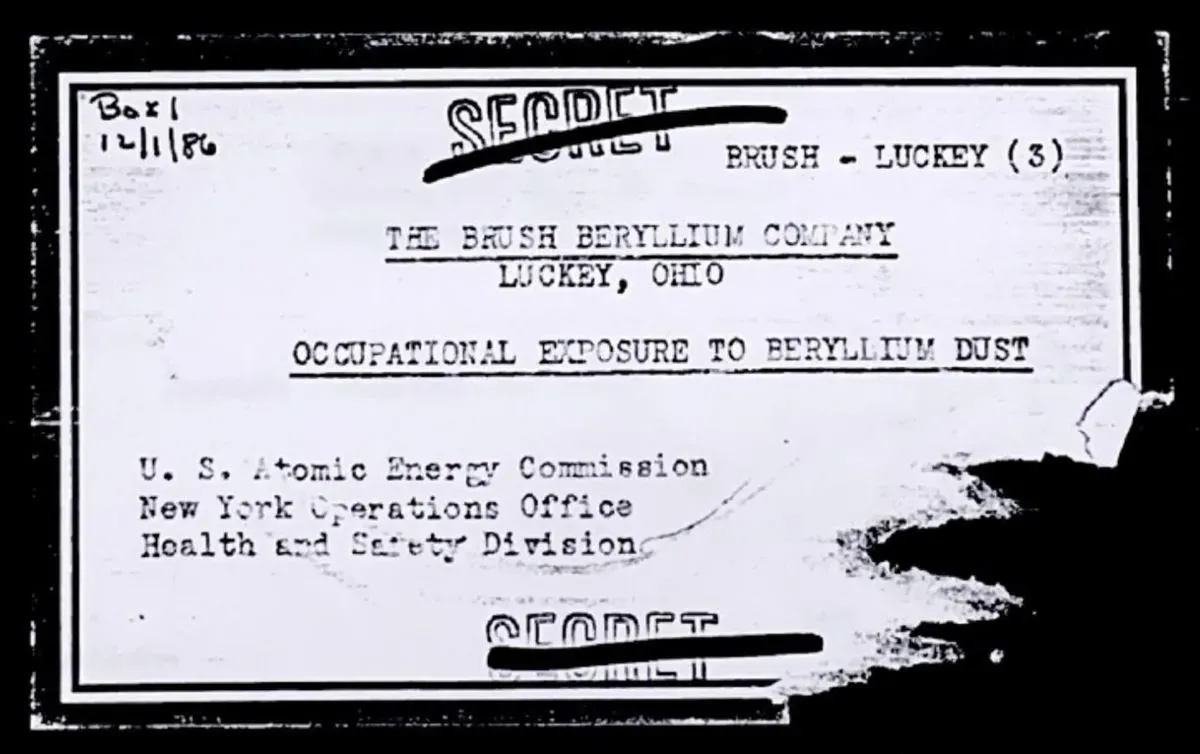
Unsafe conditions began almost immediately: Government health surveyors in the spring of 1950 recorded beryllium dust counts in the plant over the safety limit — even in the lunchroom, a previously classified government report states.
The safety limit was 2 micrograms of beryllium per cubic meter of air, a level so minute that health officials compared it to the amount of beryllium on the head of a pin distributed evenly in a box 10 feet high, 60 feet long and 60 feet wide.
Surveyors warned that about 15 percent of the 185-member work force was exposed to amounts greater than this level and that "sickness can be expected."
Both Brush Beryllium and the government, they wrote, "have an obligation to provide a safe working environment for all persons engaged in their projects."
Surveyors returned to the plant in six months, hoping to see improvements.
They did not.
Dust counts were now far higher, up to 3,600 times the permissible exposure limit.
In a scathing 1951 report, Frank Thomas of the AEC's health division wrote that most worker groups were overexposed to beryllium, caused by "poor housekeeping," "sloppy operating methods," poor ventilation, and inadequate engineering.
"Another discouraging factor," he wrote, "is the seemingly lack of respect for beryllium and its compounds as health hazards by some personnel."
He also said the plant ignored safety recommendations from his office and had "a strong emphasis on meeting production schedules."
Shortly after, top AEC officials called a secret meeting at the plant with Brush leaders to discuss whether to close the facility for safety reasons.
According to minutes of the meeting, AEC physician Dr. Joe Quigley asked whether the plant had ever operated under the 2 microgram beryllium safety limit.
Brush officials said no.
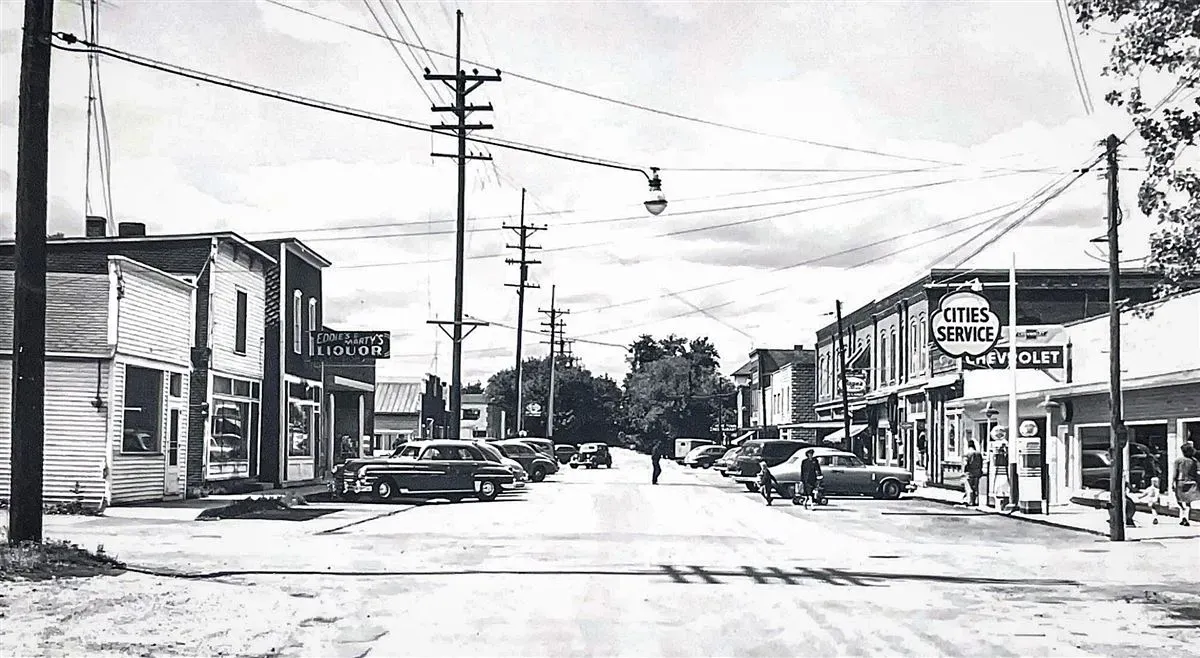
“Gradually the plant gets saturated with beryllium,” Brush president Bengt Kjellgren said. "But since it was not really made so that it can be kept clean, gradually everything in the plant has a film of beryllium dust or some beryllium compound.”
Though officials had publicly said at the time the plant opened that it would use the most modern ventilation, behind closed doors they said something much different. According to the meeting's minutes, plant manager Schaffner said that “during the construction period when we came here, we used a lot of old duct work.”
The AEC's chief of industrial hygiene, Bill Harris, favored shutting down, and Richard Smith said officials must operate the plant "without killing people.”
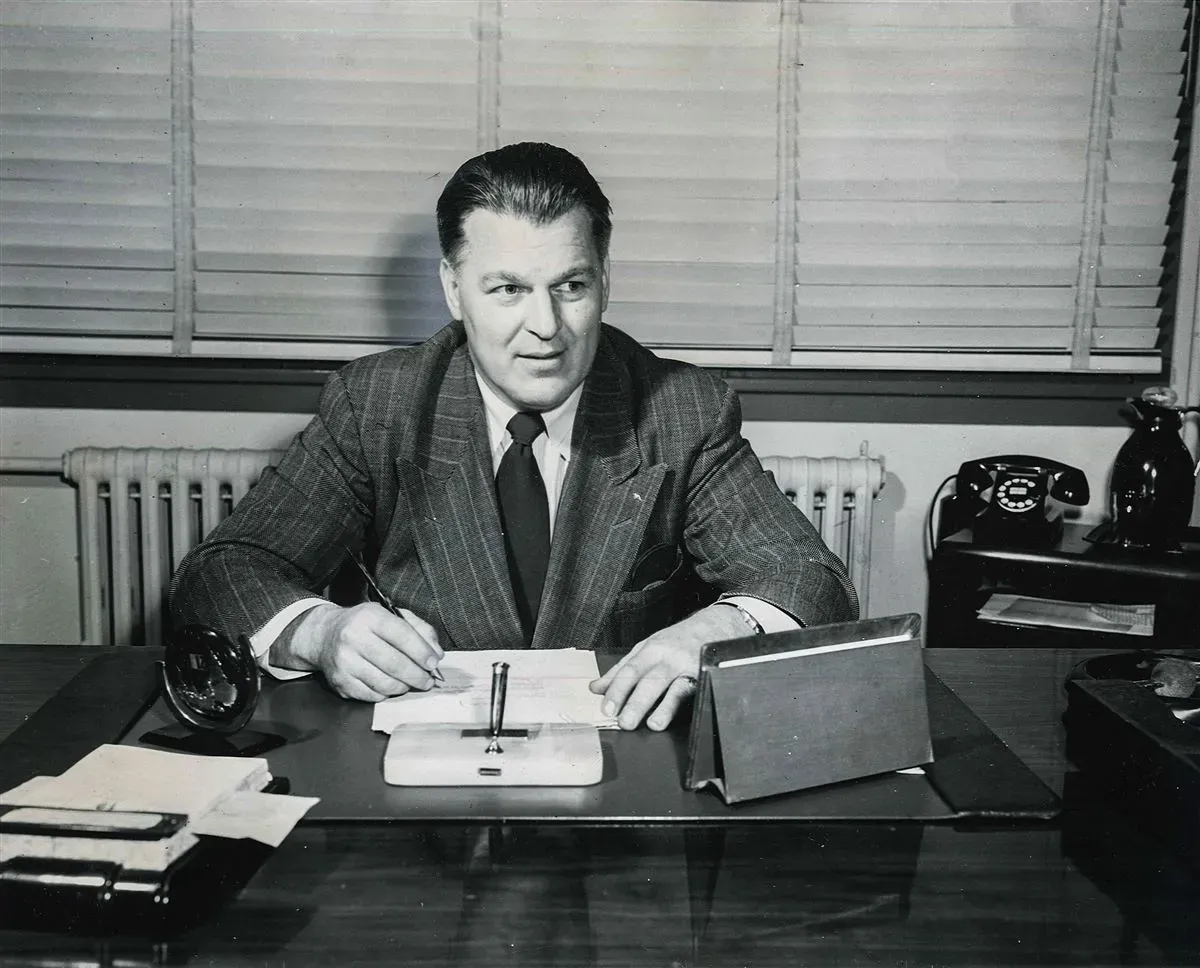
The AEC's Edmund Velten, a beryllium procurement officer, expressed a cold reality, saying the government needed beryllium for weapons and that "production comes first and then health.”
The government eventually decided not to close the plant but to weaken the rules on exposure limits to "make it possible for Brush to operate the plant without continually taking the risk of being put in a legal position," according to a journal entry by company president Kjellgren.
Brush kept claiming the plant was safe and continued inviting in tour groups, government and company records show.
In fact, the very same day the AEC and Brush met to discuss whether to close the plant for safety reasons, the company gave a tour to a local high school physics class.
Over the next several years, air counts remained high. Nearly 1,000 workers from 1950 through 1957 were exposed to levels over the 2 microgram standard, the AEC’s Mr. Harris later wrote in a 1961 report.
In one year alone, in 1950, 370 instances of respiratory illness were documented among workers, according to AEC medical records.
At least six Luckey workers contracted beryllium disease, with one death.
But the true numbers were likely much higher as modern screening tools to detect early signs of the disease weren't yet available, and the ailment was sometimes misdiagnosed as other lung conditions.
A ‘desperate measure’ that grew out of control
Outside the plant, problems were equally dire.
Brush needed a place to dump its chemical wastes, and so it built three large makeshift lagoons, none properly lined. Every day, 5,000 gallons of wastewater was pumped directly into the lagoons, forming a toxic sludge on the bottom as the liquid evaporated. The company nicknamed one of the lagoons “Lake Brush.”
Soon, government records show, the situation spiraled out of control: The lagoons were filling up faster than expected and overflowing.
The AEC’s top health and safety official, Merril Eisenbud, visited the plant in 1950, shortly after it opened, and was alarmed. He wrote in a report that he was worried the waste would seep into the groundwater, calling the lagoons a “desperate measure” that was “probably more pressing than the disposal problems” at the dozens of other AEC sites nationwide.
He said the wastes should not be stored in the open or dumped into a nearby creek — warnings the government and Brush would repeatedly ignore.
The problem was so serious, he wrote, that the government might have to “ship the wastes to the coast and dump them at sea, or even abandon the site.”
No significant action was taken on the lagoons. In fact, Brush did the opposite of protecting the community: It began dumping waste directly in nearby Toussaint Creek, company records state.
A farmer 10 miles downstream sued Brush in 1953, saying the pollution from the Luckey plant sickened his cattle. And whenever the creek flooded, he said, it left behind a layer of fine beryllium dust, rendering the area unusable and dangerous. The suit was settled for $12,500.
To assess its impact on the environment, Brush conducted an unusual experiment. With the Toledo Zoo supplying some fish, Brush chemists gradually added lagoon water to six-gallon tanks containing goldfish, minnows, and snails to see how much they could tolerate.
The minnows and snails were dead within three weeks, and one surviving goldfish developed a “black deposit” over half its body, according to a paper Brush presented at an industry conference in 1953.
The paper concluded with Brush stating that it frequently tested the creek where it was dumping waste, an effort that “added to the company’s prestige in the community.”
Eventually, in 1959, the Atomic Energy Commission decided to close the plant and shift beryllium production to Brush’s new and larger facility in nearby Elmore.
When the government put the Luckey plant up for public sale in 1961, it took out ads in local newspapers, including The Blade, claiming that major sources of beryllium had been removed and that only “some low-level contamination” remained.
That wasn’t true.
Six months earlier, a government inspection had determined that the property was “worthless" and a “toxic hazard,” particularly from the “sludge lagoon menace” that was drying up fast and would very soon result in airborne beryllium dust, according to records.
Leaving the lagoons in place would be a “definite disservice to the community,” the report said, but it recommended that no more money be spent “except what is necessary in protecting the government from liability now and in the future.”
And if a buyer could not be found?
The government inspectors said they might have to resort to a drastic measure: bury the entire plant.
A mysterious dust, tons of tainted dirt
For the next 20 years, the lagoons — and much of the rest of the plant — went unmonitored and unchecked. It wasn't until 1983 that the government offered any significant oversight.
That's when a village maintenance man noticed a mysterious, foamy substance in a dump adjacent to the plant. He informed a village councilman, who contacted the Ohio EPA.
EPA officials, according to agency records, discovered that only one of the three lagoons at the plant had been capped, and none of the sludge had been removed.
Inspectors also saw that that lagoon area was “laden with a white, chalky substance” and that “dust blows visibly from the lagoon areas," records state.
But investigators concluded in 1984 that because the area was rural with few people, the issue was considered low priority for further action.
Four years later, in 1988, the owner of the property, Motor Wheel, a maker of car wheels, took air samples in a former Cold War building on site and detected radioactive beryllium and numerous man-made radioactive elements — even though the federal government and Brush had previously maintained that radioactive material had not been handled at the plant.
Several months later, U.S. Energy Department investigators found widespread beryllium and radioactive contamination in soil at the site and adjacent farmland. But it took four years, until 1992, for Energy officials to add the site to its list of Cold War weapons sites nationwide to be cleaned up.
Even then, several more years passed with little action and no shutdown: Dozens of Motor Wheel workers remained at the site. Motor Wheel had been a division of Goodyear, which declined to comment.
Finally, in 1999, investigators for the Army Corps — now overseeing the cleanup of former nuclear weapons sites — visited Luckey to fully assess the scope of the mess.
They discovered that in the late 1960s, private contractors had removed tons of tainted soil near the waste lagoons and used it as fill-dirt at area homes. Local developer Charles Bostdorff told investigators he had removed 10 dump truck loads. An unspecified person at the plant, he said, encouraged people to take the tainted soil to make the waste someone else’s problem, Army Corps records of the conversation show.
He recalled how the soil was so sloppy that one of his dump trucks got stuck in it. He also told Army Corps officials that it was common practice for farmers to take dried sludge and use it as gravel on their driveways.
The Army Corps determined that tainted soil had been relocated to at least three homes near Luckey. Investigators sampled the soil at the homes and found all three had elevated levels of beryllium.
But the Army Corps told the property owners it would not remove the dirt because private residents — not the agency — brought it there in the first place, according to a 2003 Army Corps letter to the residents.
The letter assured the homeowners they should have nothing to worry about if the ground wasn't disturbed. If it was, "the concentrations of beryllium found in these soils may have the potential to cause health risks, especially to children."
Facing mounting questions from residents in meetings with Army Corps officials, agency investigators in 2000 and 2001 took samples of well water from 39 residential locations. The investigators concluded that they did not find anything of concern.
But the Army Corps never sampled the water for radioactivity. When The Blade did in recent months, it found high levels throughout the community.
In recent years, warnings ignored
Since 2006, according to the state, the owner of the site has been Industrial Properties Recovery, also known as Abdoo Wrecking, a Fremont-based company; Mike Abdoo is the owner.
Health and environmental regulators have given Mr. Abdoo one specific warning: Do not tear down the Cold War buildings because doing so could stir up beryllium dust.
But that's what Mr. Abdoo has done without penalty, records show.
From 2006 to 2020, the Ohio EPA and the state health department have issued orders against the companies for a variety of activities, ranging from demolishing buildings to digging up sewer lines to open burning. In none of those cases was Abdoo Wrecking or Industrial Properties Recovery fined, according to state regulators.
A review of records from a single month — December, 2013 — helps tell the story.
On Dec. 9, Mr. Abdoo told the Ohio EPA that he planned to demolish buildings but would be taking all necessary safety precautions.
But the following day, EPA inspectors found that the water and sewer lines had been illegally dug up, removed and sold to local scrappers. The agency ordered Mr. Abdoo to stop demolishing buildings and check all material leaving the site for contamination.
The orders were ignored, and Mr. Abdoo resumed removing metal and building debris from the site one week later. On Christmas Eve, regulators noticed that large portions of the former beryllium production building were missing.
The Ohio Department of Health stepped in three days later and took the rare step of declaring the situation an emergency, ordering Mr. Abdoo to stop demolition immediately. This time, he complied.
Mr. Abdoo, through a family member, declined to comment for this story.
When asked why Mr. Abdoo hadn’t been fined or penalized, Ohio EPA spokesman Katie Boyer wrote in an email that the agency and the state health department successfully worked with him to address the problems.
“The goal of state regulations is to ensure the protection of the environment, not to issue fines or penalties,” she wrote. “If an entity consistently fails to come into compliance or otherwise continues to harm the environment, that is the point at which we would look to issue fines and/or file a lawsuit.”
Since 2018, the Army Corps has been removing thousands of tons of tainted soil from the site. Massive trucks filled with dirt frequently rumble out of Luckey and head 66 miles north to Belleville, Mich., where the soil is deposited in a special landfill.
But records show the agency is not removing all contaminants.
That's because the Army Corps has a narrow definition of what qualifies for cleanup. The agency is only addressing six materials used at the site between 1949 and 1958 during the manufacture of beryllium for the U.S. weapons program: beryllium, lead, uranium-238, uranium-234, radium-226, and thorium-230.
There are numerous other chemicals and pollutants that are not required to be cleaned up.
Belinda Brooks, 57, a family counselor and former village mayor, said residents are tired of the government letting Luckey down.
“Obviously, it’s not lucky,” she said, “living next to that site.”
Slideshow