Story
 June 20, 2025
How Big Brands and Foreign Money Prop Up Chinese Forced Labour
Country:

Project
China's Hidden Workers
For years, China has subjected Uyghurs and other ethnic minorities to forced labor in the eastern...

From pension funds to global businesses, investors and consumers are handing over cash to companies using Xinjiang workers.
In March 2021, the UN Office of the High Commissioner for Human Rights sent a letter to the South Korean government. The UN was gravely concerned about allegations of forced labour at Chinese factories in the supply chains of Samsung, LG and other major Korean brands.
LG quickly defended itself in the press. LG had been buying from one of the Chinese factories, it said, but it had stopped the previous year. The company prohibits “any form of forced labour” at its supplier factories, it said.
But that wasn’t the full story.
That same month, a video clip uploaded to Douyin, Chinese TikTok, showed LG was running its own factory in China linked to forced labour. The clip was posted by a herder from the Ili Kazakh region of Xinjiang, who had moved thousands of miles east, and was now working on a washing machine assembly line at LG Panda Appliances in Jiangsu province.

As a nonprofit journalism organization, we depend on your support to fund more than 170 reporting projects every year on critical global and local issues. Donate any amount today to become a Pulitzer Center Champion and receive exclusive benefits!
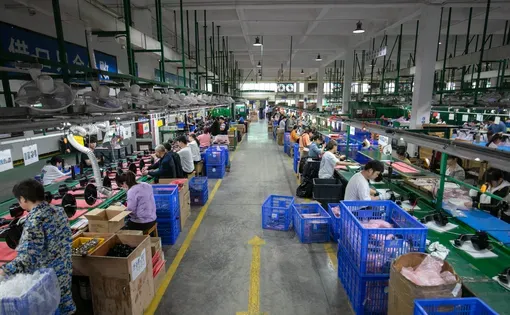
He’s one of thousands of Xinjiang natives pushed by the Chinese government’s transfer scheme into leaving their home to take up vacant jobs at factories across the country. But in his case, he wasn’t just working in a distant part of a multinational’s hard-to-trace supply chain. The washing machines rattling past looked ready to ship. And the plant is owned by LG directly.
The Bureau of Investigative Journalism can reveal for the first time that global brands like LG now directly own factories receiving workers from China’s so-called labour transfer scheme, exposing how some have a hand in the oppression and exploitation of ethnic minorities in the country.
A joint investigation by TBIJ, the New York Times and Der Spiegel has connected 100 global brands – including Apple, Samsung and Volkswagen – to China’s state-imposed forced labour scheme.
Apple and Samsung said its suppliers are regularly independently audited and that recent audits found no instances of forced labour. However, Apple said it is investigating the alleged links to forced labour. Volkswagen also said it was investigating but couldn’t comment until this was completed and “against the background of the contractually agreed confidentiality obligations”. LG didn’t respond to numerous requests for comment.
Major Chinese companies, including some of the world’s leading appliance manufacturers, also operate factories taking Xinjiang workers.
These businesses, as well as some of the lesser-known factories further back in the supply chain, are financed by state pension funds from Europe and North America, as well as a string of other major financial institutions. Taken together, the investigation brings to the fore the deep connection between global capital and the forced labour that is woven throughout much of China’s manufacturing economy.
The joint venture bargain
LG Panda, which runs the Jiangsu plant, is what’s known as a “joint venture”, a collaboration between an international company and a local Chinese business. In this case, the US has imposed sanctions on the Chinese partner for its ties to the Chinese military.
In many cases, international investors need to set up a joint venture with a local partner in order to access the lucrative Chinese consumer market or to run a factory.
It’s an arrangement, research shows, that helps the government exercise control over foreign companies. Kirsten Asdal, a China risk advisor for investors and corporations, said that joint ventures are about embedding Communist Party leverage over foreign investments, through measures like requiring committees of party members in companies, acquiring board seats and controlling licensing.
Beijing has “built up arms of control into these foreign companies systematically over the last 20 years,” Asdal said. “They can no longer say no.”
International companies have far more questions to answer about forced labour in their own assembly lines. Reports connecting Chinese companies to the Xinjiang labour transfer programme have up to now only focused on supplier factories, not the plants owned by the brands themselves.
In 2022, LG Panda held a recruitment event at one of the internment camps in northern Xinjiang, known for its indoctrination by loudspeaker, overcrowded cells and guards who used electric batons to beat prisoners speaking Kazakh. The company wanted to fill more than 100 jobs.
A labour recruiter involved in transfers from Xinjiang to LG Panda told Der Spiegel earlier this year that they were approved by LG’s South Korean HQ.
LG operates a second plant in Jiangsu, making refrigerators, that has also taken transfer workers. The two plants first started participating in the labour transfer programme in 2019 and 2020, and one site continued to host workers from Xinjiang as recently as 2024, evidence from social media and local government announcements show.
Omar*, a Kazakh worker at LG Panda, posted a video of other Kazakh workers being bussed in to LG’s new year celebration and then, in mid-2024, a still of himself in front of a washing machine inner drum being assembled on an overhead gantry. An audio clip accompanying the photo says: “We can’t transcend our abilities and escape our fate. Everyone has sad tears, and every family has difficult sutras to recite.”
Trade data shows that since Xinjiang workers were deployed to each factory, they have shipped more than 90,000 consignments to dozens of world markets. Thousands of exports went by train to Poland and Germany, tracing the northern route of the old Silk Road, via the snow-capped mountains of Ili Kazakh – the same region the farmer working LG’s washing machine assembly line had to leave behind.
Other foreign-owned multinationals, mostly from Taiwan, South Korea and Thailand, also work with the Chinese government to take Xinjiang labourers into factories making shoes, cars, PC parts and chicken tenders.
Global reach, local values
Alongside LG, many Chinese brands have plants that take transferred Xinjiang workers. They include labels plenty of western consumers would recognise.
After all, China is no longer just the world’s factory. Home-grown companies have matured into global heavyweights, and appliance brands were among the earliest wave of Chinese labels to gain recognition in overseas markets.
“We’ve never seen the direct involvement of global brands in the Xinjiang government transfer program before,” said Laura Murphy, a professor focusing on labour and human rights. She previously advised the Biden administration on trade enforcement.
TBIJ’s investigation uncovered evidence of forced labour at plants owned by Hisense, Midea, Haier, and TCL. One of the five TCL facilities with Xinjiang workers is co-owned by Italy’s De’Longhi. Factories owned by Chinese footwear and car brands were also implicated.
More than 150 people were sent to Hisense in Guangdong from the infamous Xinye internment camp in Hotan, southern Xinjiang in 2018, according to Chinese state media. Operating under a “semi-militarised” system, with ideological assessments and “punishments”, the camp transforms farmers into factory workers, according to a government report on local labour transfer efforts. In 2018, state media claimed that “extremist ideas previously poisoned the minds of many trainees” at the camp.
As recently as last year, posts from seven different Douyin accounts suggest, Hisense was still taking Xinjiang ethnic minorities at the government’s behest.
In March 2024, Sukhrab*, a young Kyrgyz man, uploaded a Douyin clip of himself at a Hisense factory in Guangdong, fastening compressors and fans to refrigerator base frames. “One is tired of unsympathetic eyes, of words that sadden the heart, of people who don’t value us, of promises left unfulfilled,” says the Kyrgyz voiceover on the clip. Prior to this, Sukhrab had only ever posted scenes from his home in the Pamir mountains, herding fat-tailed sheep as they clambered up shifting scree.
“Drill the screws well,” says the first comment on the video, posted by another user in Guangdong.
Hisense said that the company has not participated in “any forced labour transfer or abuse activities”. Midea, Haier, TCL and De’Longhi didn’t respond to requests for comment.
Haier, which began as a Chinese fridge maker in the 1980s, has been the world’s best-selling appliance brand for 16 years running. As it expanded internationally, it bought Hoover, as well as Italy’s Candy and General Electric in the US.
TBIJ identified at least five factories in three provinces supplying Haier with parts for washing machines, refrigerators and air conditioners that had ethnic minority workers from Xinjiang. One of the five, in Shandong, is part-owned by the group and ships motors to Haier’s factories in India, Vietnam, and Thailand – as well as to Candy Hoover Group in Italy.
Articles in state media confirmed the Chinese government first started transferring Uyghurs to Haier’s Shandong factory in 2018. Social media pins Xinjiang workers there as recently as early last year.
A 2023 article from the United Front Work Department – the Communist Party apparatus that serves to ensure loyalty among various sectors of Chinese society – features photos of blue-uniformed Uyghurs pledging allegiance to the flag on a plaza outside the main office of the factory. One of the last pictures shows a young Uyghur woman in a blue traditional dress smiling as she holds up a huge painting of scarlet peonies in front of the factory sign. A Chinese man holds the other side of the painting, a gift.
Eight of the Xinjiang workers have married local employees at the factory, the propaganda piece notes approvingly.
Foreign investment
Half of the Chinese factories implicated in the investigation are controlled by publicly listed companies. Some of the world’s largest investors hold stakes in these Chinese companies — Vanguard Group has holdings in 16 of them. Sovereign wealth and state pension funds in Norway, South Korea and Canada, as well as Florida in the US, are all also exposed.
A Florida state government spokesperson said that the fund “complies with all applicable laws and regulations pertaining to its investments”. The Norwegian sovereign wealth fund “systematically screen[s] all companies in the portfolio and benchmark[s] for sustainability risks,” including forced labour, a spokesperson told TBIJ. They added that the fund “may divest from a company if we assess that its long-term market valuation may be adversely affected by its mismanagement of social and environmental issues”.
Canada’s pension fund said it does “not want to be invested in companies involving forced labour”, that it works diligently to avoid risks and that it regularly reviews its holdings. South Korea’s pension fund didn’t respond to a request for comment.
A spokesperson for the Chinese embassy in the US said “allegations of ‘forced labour’ in Xinjiang are nothing but vicious lies concocted by anti-China forces”. Members of all ethnic groups there “enjoy happy and fulfilling lives”, they said, adding that “Xinjiang-related issues are not human rights issues at all, but in essence about countering violent terrorism and separatism”.
While brands like LG and TCL are directly participating in the Xinjiang labour transfer program without disclosing this to investors, many supplier factories are also publicly listed firms.
One company’s value, the computer peripherals giant G.Tech, rose by a third to $431m in the year to May 2025. The business serves customers like Lenovo and Logitech from a Guangdong factory participating in the transfer program.
At least three implicated factories are owned by the multibillion-dollar company Kingboard Holdings, one of the world’s largest producers of printed circuit boards, as well as the raw materials used to make them.
Lenovo confirmed that some of the suppliers identified by TBIJ ship products to the company, but said that independent audits had not found any use of forced labour. Logitech said it is investigating the allegations and would “re-evaluate any vendor relationship that is in breach”. Kingboard Holdings’ subsidiaries and G. Tech didn’t respond to requests for comment.
But most investors are exposed through holdings in brands buying parts from factories involved in the government transfer program.
Rebecca DeWinter-Schmitt, associate director at the non-profit Investor Alliance for Human Rights, says that most investors are actively looking at forced labour risks both within and outside of Xinjiang. In 2024, Volkswagen buckled under pressure from investors to divest from a Xinjiang-based facility. But labour transfers east are harder to detect.
DeWinter-Schmitt says investors should exercise their leverage to require Chinese suppliers to urgently end participation in labour transfer schemes. “If a company fails to act promptly,” she said, “investors must consider divestment.”
In February, Wuhan Honghai Technology — a supplier to Haier, Midea and TPV, the maker of AOC, Envision, and Philips monitors — went public on the Beijing Stock Exchange.
A few months earlier, one of the Xinjiang workers at the factory uploaded a video set to soulful traditional music shot from an upper window of the onsite dormitory. The view pans to the northwest to show the setting sun, glowing red behind the high rises of Longwangmiao community on the outskirts of Wuhan.
TPV said “we firmly oppose all forms of forced labor and modern slavery”, and that it subjected suppliers to regular assessments. Wuhan Honghai didn’t respond to requests for comment.
Just after the company went public, Der Spiegel reporters asked the security guard at the factory gate whether there were workers from Xinjiang inside.
“Yeah,” he replied, “but why do you care?”
Reporter: Daniel Murphy
Editor: Franz Wild
Production: Frankie Goodway
Fact checker: Ero Partsakoulaki
Video editing: Oliver Kemp
Illustrations: Marta Kochanek. Some images courtesy of Xinjiang Police Files.