Story
 October 3, 2025
Filipino Nurse Who Became a Health Care Leader in Austria Gets Ready To Pass the Torch
Country:


Filipino-Austrians reshape what international recruitment can look like.
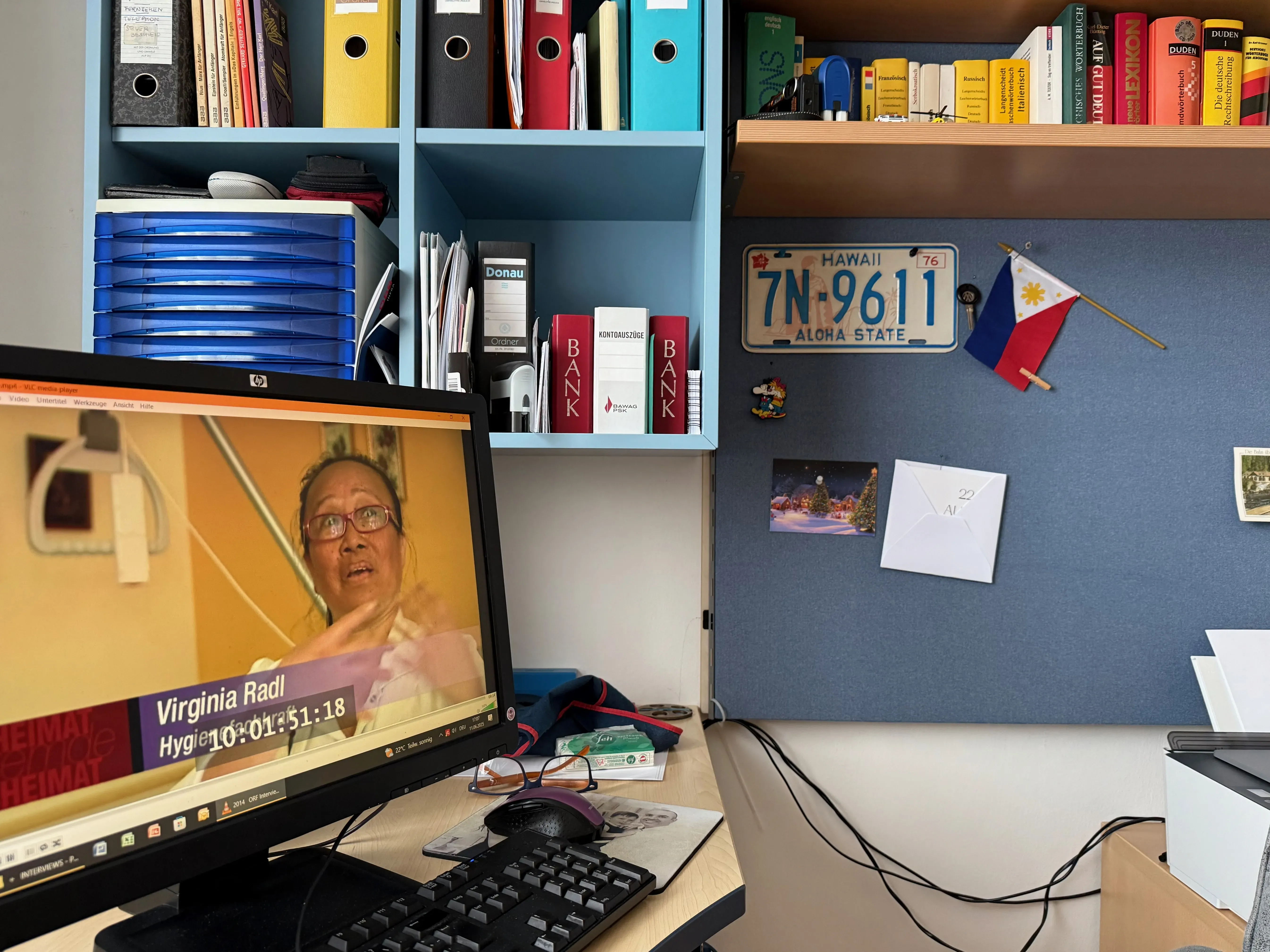
Virginia Radl’s journey from the Philippines to Austria began with a leap of faith—arriving on a tourist visa, barely speaking German, but determined to work as a nurse.
Over decades, she built a successful career in health care and became a pillar of support for Austria’s community of Filipino nurses, most recently serving as president of the Philippine Nurses Association–Austria.
As she prepares to step down from this leadership role, she reflects on her own legacy, and that of her community, shaped largely by resilience.

As a nonprofit journalism organization, we depend on your support to fund more than 170 reporting projects every year on critical global and local issues. Donate any amount today to become a Pulitzer Center Champion and receive exclusive benefits!
Transcript:
Cat Carroll: Virginia Radl never intended to study nursing—at least not at first. But she discovered it could be her path to building a life in Europe.
Her sister had already made the journey, working as a nurse in Vienna after leaving the Philippines. Inspired, Radl decided to follow in her footsteps.
After five years of nursing school, Radl arrived in Austria at just 23 years old. But unlike her sister—and many other Filipino nurses who came to Austria in the 1970s and '80s—she wasn’t part of the formal recruitment process backed by a government-to-government agreement.
Instead, she came on a tourist visa, landing in Austria on March 3, 1978.
She was determined to stay, and it worked out, because just two months later, on May 9, Radl had secured a nursing job at a hospital.
Virginia Radl, through translator: She invited me to come here as a tourist—that was March, and in May I had my job.
Two months isn’t much time to learn a language as complex as German, a necessity to live and work in Austria.
My brother-in-law was Austrian, and after two or three weeks he accompanied me to the hospital. He introduced me to the lead nurse, but she said she couldn’t hire me because I didn’t speak German.
Carroll: But Radl found a workaround.
To prepare for her interview, she spent hours memorizing answers to every possible question.
Looking back, she suspects the interviewer knew she didn’t speak German, even throwing in a few unexpected questions to test her.
Radl, through translator: The lead nurse definitely knew I couldn't speak German because she kept asking me more questions that I couldn't answer because I only knew the sentences I memorized.
Carroll: Still, Radl believes it was her confidence and courage that got her the job.
She tells me, “Du musst Mut haben,” German for “You have to have courage.”
Today, as proof of how far her German has come, Radl says she’s forgotten much of the English she formerly spoke fluently. She says the vocabulary and phrases once used daily have slowly been replaced by their German equivalents.
Though Radl began her career in a hospital, she later trained as an emergency medical technician and eventually moved into public health, where she stayed until retirement.
At the peak of her career, she led health education campaigns and gave presentations to government officials. This path helped her emerge as a respected leader and role model within Austria’s community of Filipino nurses.
But nowadays, Radl’s nursing looks different. Instead of caring for patients, she serves her own community—as president of the [Philippine Nurses Association-Austria].
Her leadership isn’t built on textbooks anymore. It’s grounded in life experience.
Every other month, Radl opens her apartment to members of the organization. They come together for open conversations about how they can support each other in the field.
More than just mutual support, they think about how to give back to the health care system that trained them in the Philippines through annual donation campaigns, and by sending delegations to a hospital in Manila.
Now, with new groups of Filipino nurses arriving under a renewed government-to-government agreement—one modeled after the one that brought her sister to Austria—Radl is ready to step back.
She believes these new nurses should take the lead. They should be the ones guiding the conversation about the future of this community.
Radl, through translator: Right now, I’m busy looking for someone to lead after me, someone who is really devoted to PNA [Philippine Nurses Association].
Carroll: Radl’s term ends in October, but she knows she won’t be going far. After years with this chapter of the PNA, she plans to remain an active member—offering a listening ear and tending to her community with the compassion that’s second nature to her.
Radl, through translator: I don’t want to ruin the PNA and my 15 years of work with the organization. I tell everyone I’m still going to be here, guiding all of them—for as long as I can.