Story
 July 9, 2025
Commentary: Trump’s Aid Cuts Have Broken Global Health — but We Can Fight Back
Country:


How pharmaceutical regulations in India impact South Asia and the Global South

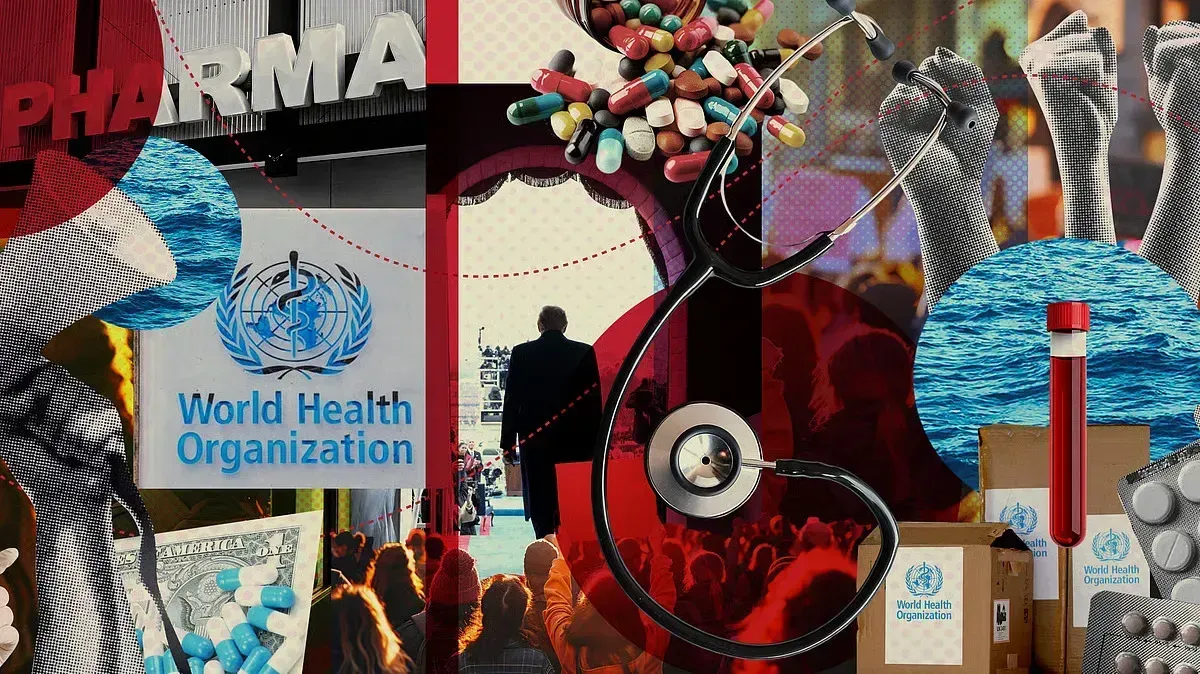
US and Western aid cuts expose global health’s rotten core and leave millions facing preventable deaths from HIV, TB, malaria and more — but the past and the present offer lessons in how to fight back.
THERE IS A commonly held belief in global health, an inside joke among veterans of the sector: the making of sausages and health policy are two things best left unseen. This has never been more true than right now as the US government under Donald Trump, with one executive order after another, accelerates the collapse of the global health order as we know it.
This is not hyperbole.
With Trump’s cuts to US funding, key initiatives like the Global Fund to Fight AIDS, Tuberculosis and Malaria and the US President’s Emergency Plan for AIDS Relief (PEPFAR) are faced with drastic reductions of resources, threatening health security especially in poor countries.
The supply chains that ensured access to reliable medicines for HIV, tuberculosis and malaria are up in flames. Numerous active clinical trials have been stopped, leaving study participants in limbo — a breach of medical ethics as well as human decency. A pioneering transgender health clinic in Hyderabad was shut down after USAID, the United States’ international development agency, pulled funding to it — part of an effort to align US foreign assistance with “America First” values. HIV patients in Botswana are staring at the possibility of running out of life-saving medicines. Funding cuts have also halted health screenings at airports and other transit points meant to control the spread of infectious diseases such as SARS, Ebola, Nipah and MRSA.

As a nonprofit journalism organization, we depend on your support to fund more than 170 reporting projects every year on critical global and local issues. Donate any amount today to become a Pulitzer Center Champion and receive exclusive benefits!
As per the World Health Organisation (WHO) — itself reeling after the United States withdrew its membership of and funding for the body — millions of people most vulnerable to tuberculosis, the world’s deadliest infectious disease, are now at “grave risk.” Tens of millions of them are in South Asia. The region is among the worst affected by the US funding cuts, with health programmes in Nepal, Sri Lanka, Pakistan, Bangladesh and Myanmar being slashed.
A tuberculosis researcher at Harvard’s T H Chan School of Public Health told me the Trump administration’s decisions could undo two decades of progress, leading to millions of deaths. “It feels like being dragged by my hair back into the Stone Age,” was this scientist’s apposite phrase.
As things fall apart, the WHO is mulling “terrible choices” such as trimming 21 percent of its budget for 2026-27. It has already frozen hiring, significantly cut back on travel, laid off temporary staff and offered early retirement packages. In April, at a meeting of WHO staff, senior officials reportedly revealed a funding shortfall of over USD 1.8 billion even to meet the organisation’s already slashed budget, and a looming deficit of USD 600 million this year. The organisation’s health emergencies budget, key to responding to emergencies particularly in low- and middle-income countries, is to be severely reduced.
But as easy as it is to blame Trump for everything, the truth is that his executive orders have simply pushed ineffective and failed structures of global health off the proverbial cliff. As patients run out of medicines, doctors lose jobs and researchers lose grants, the question is this: How could decades of what the powers of global health insisted on calling “sustainable” progress be so swiftly undone?
TO TRULY UNDERSTAND the unravelling of global health, we need to start with the birth of global health as we’ve known it. The aid that global health has depended on so much and for so long was never purely humanitarian. It was always strategic: It came with strings attached.
One brutal example is India’s population-control policy, which saw its darkest chapter with mass sterilisations in the 1970s. It was forced upon the country by the United States. In 1966, under the presidency of Lyndon B Johnson, the US government made its foreign aid conditional on recipient countries adopting family-planning programmes. The Johnson administration was concerned that population growth, especially in black and brown nations, was a global threat.
This view was popularised by the Stanford University professor Paul R. Ehrlich’s best-selling The Population Bomb, which incited an anti-population-growth crusade. Advertisements told Americans that overpopulation would lead to chaos, riots and war — and create a breeding ground for communism. The International Planned Parenthood Federation, the Population Council, the World Bank, the United Nations Population Fund and other institutions embraced and globalised the population-control agenda.
The Population Bomb opens with a cab ride that Ehrlich and his family experienced in Delhi. In an “ancient taxi,” its seats “hopping with fleas,” the Ehrlichs entered “a crowded slum area.”
The streets seemed alive with people. People eating, people washing, people sleeping. People visiting, arguing, and screaming. People thrust their hands through the taxi window, begging. People defecating and urinating. … since that night, I’ve known the feel of overpopulation.
At the time Ehrlich took that cab ride, in 1966, Delhi’s population was 2.8 million. As the writer Charles C. Mann later pointed out, Paris’ population was then 8 million, but the French capital did not attract Ehrlich’s censure.
“In Egypt, Tunisia, Pakistan, South Korea and Taiwan, health workers’ salaries were, in a system that invited abuse, dictated by the number of IUDs they inserted into women,” Mann wrote in The Smithsonian in 2018. “In the Philippines, birth-control pills were literally pitched out of helicopters hovering over remote villages. Millions of people were sterilized, often coercively, sometimes illegally, frequently in unsafe conditions, in Mexico, Bolivia, Peru, Indonesia and Bangladesh.”
Such aid defined global health assistance, and it supported structures of dependency rather than promoting self-sufficiency. In the Indian example, it meant funding was available only for specific programmes such as population control, and not for overall investment in the country’s threadbare health systems. Most funds were tied to short-term targets — a set number of vasectomies, for instance. The same was true of aid for other countries in South Asia and the world. Meanwhile, economic bailouts from the International Monetary Fund for Pakistan and others demanded austerity measures that throttled public funding for health.
Things started to change, to a degree, in the 1980s, as a new pathogen labelled HIV — then considered a “gay disease” — started ripping through communities across the planet. The HIV activists of the 1980s and 1990s organised themselves into a sophisticated, global protest movement. When they saw Western pharmaceutical companies, and their friends in government, guarding access to new antiretroviral therapies to manage HIV/AIDS, with profits placed above poor people’s lives, these activists demanded better, together.
In 1987, the American writer and activist Larry Kramer co-founded ACT UP — the AIDS Coalition to Unleash Power. Five years later, Gregg Gonsalves co-founded the Treatment Action Group, or TAG. By 1999, Alan Berkman and colleagues had co-founded the Health Global Access Project, or Health GAP, and Zackie Achmat had co-founded the Treatment Action Campaign, or TAC, in South Africa — the hottest of hotspots for HIV. Achmat publicly declared his HIV-positive status and refused to take treatment until Nelson Mandela, the former president of South Africa, confronted Thabo Mbeki, his successor, over his denialism regarding HIV and its scientific treatment.
The HIV movement left a deep mark on the global health order. It created two key funding mechanisms to tackle major epidemic diseases — PEPFAR and the Global Fund, born in the early 2000s. Unlike the top-down, donor-recipient models prevalent earlier, as with the population control crusade, these took cues from the HIV movement to shift to results-driven, partnership-based mechanisms involving multiple governments, civil society groups, and, most important of all, patients.
People living with HIV, for instance, were now directly involved in the planning, implementation and oversight of HIV/AIDS policies. The Global Fund’s board included seats for civil society and affected communities — an unprecedented example in global health governance. This approach, with the trust and cooperation it fostered, allowed for rapid scale-up of HIV treatment in some of the world’s most resource-limited settings. Other lessons from the HIV movement were evident in how many health programmes started to pool procurement and negotiate bulk prices with pharmaceutical companies for vital drugs.
While PEPFAR and the Global Fund became major financiers and implementers, the WHO served a critical role keeping science at the centre of global health responses. In the HIV example, it set standards for HIV-related diagnostics, drugs and care quality, and led the push to scale up HIV intervention around the world, working with individual governments. In the 1980s, it received 80 percent of its funding from governments. When the Covid-19 pandemic hit, that share had dropped to 16 percent, reflecting how little governments have invested in international health systems. They left it instead to wealthy private donors such as the Gates Foundation to pay for the majority of the WHO’s work — and, by extension, to dictate the organisation’s priorities.
The lessons from the HIV movement have largely remained limited to disease-specific efforts like the fights against tuberculosis and malaria, with little effort in the decades since to further reform and democratise global health. The aid mechanisms inspired by the movement were not widely applied to build up health systems, or to end the reliance on aid delivered or withheld at the pleasure of the rich world.
This became glaringly obvious during the Covid-19 pandemic. Without systems in place for global health equity, the United States, Canada, Europe and others hoarded millions of vaccine doses, at the cost of possibly more than a million lives, instead of sharing them with the world. Black and brown nations, most of them with weak and aid-dependent public health systems, were disproportionately hit by the coronavirus. The WHO’s unsustainable funding structure was badly exposed. In 2022, global health leaders wrote in a letter to the WHO’s executive board that “the funding problems of the WHO are not new, but rather have been playing out over decades … They are symptomatic of an overall failure to invest sufficiently in global public health. This must stop now.”
Clearly, not enough had changed since the early days of HIV.
TWO THINGS have remained constant at the rotten core of “sustainable” global health development: the dominance of for-profit medical corporations with Western backing, and of Western governments and philanthropists still wedded to colonial-era hierarchies. The human costs also echo the injustices of colonial times. A recent study in The Lancet estimates nearly 14 million excess deaths to come because of USAID cuts. Its authors note that for many poor countries “the resulting shock would be similar in scale to a global pandemic or a major armed conflict.” With other Western countries — including Germany, France and the United Kingdom — having followed the US example to cut their own aid budgets as well, the final toll of excess deaths may well be higher than what The Lancet has estimated.
For the large majority of the world’s people, health has gone from being an inviolable human right to a concession granted or withdrawn by whimsical, ostensibly benevolent Western gods. As Trump’s America withdraws into its vast privilege, the only consolation is that pretences of global solidarity have been permanently shattered. The fundamental task for the Global South is not simply to replace the lost Western aid. It is to dismantle the architecture that made health systems reliant on aid to begin with.
There are already some examples to learn from. Bangladesh has created large-scale and affordable domestic drug manufacturing based on explicit defiance of the global pharmaceutical establishment, showing the way for other poor countries to follow. The African Medicines Agency, under the African Union, is working to reduce dependency on drug imports and improve drug quality control across the continent, addressing key failures of the prevailing global health order. South Africa now has an mRNA hub as part of an effort to disseminate mRNA vaccine technology worldwide — a direct response to rich countries’ hoarding Covid-19 vaccines. Another bit of not-bad news is that the sums to be raised to keep the WHO afloat — USD 600 million this year — are not outlandish; governments have spent orders of magnitude more over the years bailing out failing multinationals. The way forward is to strengthen the WHO by making it less reliant on Western philanthropists.
And it’s time to take the battle to the streets again, like the HIV movement did. In April, activists piled 200 coffins outside the US State Department in Washington DC to protest the Trump administration’s cuts to AIDS funding. The titans of the HIV movement — Achmat, Gonsalves and others — are stepping out of retirement. “It’s all-hands-on-deck time,” Gonsalves recently wrote in The Nation. “From unions, to religious groups, to those of us in higher education, to civil rights organizations, we need a mass mobilization — a united democratic front — to push back before it’s too late. Too many lives are at stake.”


