Story
 February 12, 2026
Cancer Drugs Are Being Scrapped at Huge Scale After Quality Failures in Peru
Country:


Project
Chemotherapy at Risk
When controls fail, the risk is transferred to the patient.
The Pulitzer Center's support for this reporting was made possible through the Stavros Niarchos Foundation.
Tens of thousands of vials have been pulled from shelves at the last minute because the country keeps buying dangerous drugs
In Brief
- Failing regulatory systems means Peru has repeatedly bought drugs that have been destroyed after failing quality tests
- At least 118,000 vials of government-bought chemo medicine have been scrapped since 2019
- Pharma companies have secured contracts with Peruvian government even after their drugs have failed quality tests
On 22 May 2024, a freight plane made its descent through mottled grey clouds above the Peruvian capital of Lima. The cargo it was bringing into the country could hardly have been more precious: thousands of glass vials filled with cisplatin, a life-saving cancer drug.
After touching down and clearing customs, the medicines were eventually dispatched to 16 hospitals around the country, from Arequipa near the southern border to San Martin in the Amazonian north. At least 5,000 of the vials were sent the short distance to the National Institute of Neoplastic Diseases (INEN), Peru’s leading cancer care centre.
But days after the medicine arrived, staff at the hospital were told not to administer a single dose. Instead, every vial was to be incinerated. The drugs had been found to be unsafe – and every hospital was told to urgently take them off the shelves.

As a nonprofit journalism organization, we depend on your support to fund more than 170 reporting projects every year on critical global and local issues. Donate any amount today to become a Pulitzer Center Champion and receive exclusive benefits!
In one hospital, the news came too late. Patients had already been given the bad drugs. At INEN and elsewhere, vital medicines were destroyed at the last minute.
With lives on the line, the incident was disastrous. And yet it was neither the first of its kind nor the last. In fact, we and Salud con Lupa can reveal that since 2019, at least 118,000 vials of chemotherapy drugs have been imported by Peru only to be scrapped after failing quality tests. All were bought with public money.
The reasons for these failures are shocking: some medicines were contaminated with glass or bacteria; others contained so little of their key ingredient that they were deemed useless.
Peru’s regulatory systems are so beleaguered that for years state authorities have waived the checks required for foreign drugs manufacturers. State contracts have been given to pharma companies with dubious track records – including one whose drugs had already been linked to the deaths of children in Colombia. As a result, the country is stocking its medicine cabinets with bad drugs that end up binned.
Keeping risky drugs away from patients is vital. But pulling medicines from frontline stocks at the last minute also leaves a dangerous shortfall. In a country where one in four cancer patients has their treatment held up by shortages, the import of unsafe drugs is compounding an already critical problem.
Fatal failures
As in many nations, cancer rates in Peru are rising, and keeping the disease at bay depends on a steady influx of medicines made abroad. But the quality of those imports is a problem.
Last year, we traced chemotherapy drugs that had failed quality tests to more than 100 countries — and Peru ranked second highest for imports of bad drugs.
Certain companies have also come up repeatedly. And indeed the thousands of vials of cisplatin stripped from the shelves of the Lima cancer centre bore the name of one of the manufacturers from our last investigation: Beta Drugs Limited.
The drugs were destroyed because samples from the same batch had been tested in government labs and found to contain particles they shouldn’t. So every vial from that consignment was ruled unsafe.
The presence of unexpected particles in a cancer medicine is something that should rightly “raise alarm bells,” said Paul Newton, who heads the Medicine Quality Research Group at the University of Oxford.
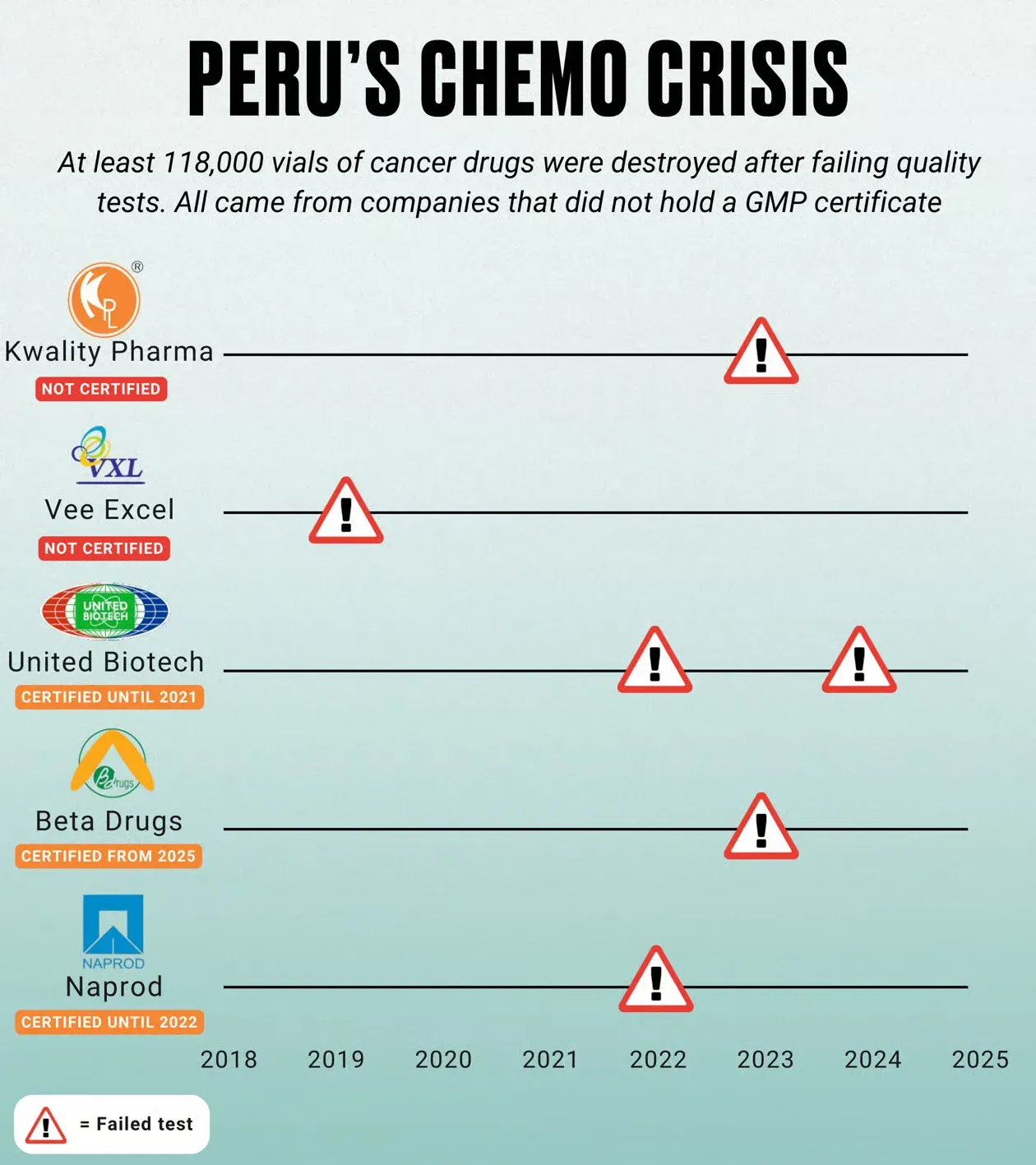
Other batches of chemotherapy drugs to arrive in Peru have shown the same problem. In 2022 and 2023, ifosfamide products made by United Biotech (also flagged in our last investigation) were found to contain lint, glass and black spots.
More alarming still were results from testing done in 2019 on cyclophosphamide, a drug used to treat lymphoma and breast cancer, which found some samples to contain a negligible amount of key ingredient and others to contain bacteria. The drugs were made by Vee Excel Drugs and Pharmaceuticals and part of a contract for 50,000 vials.
“If there is a sterility failure, it is a real concern,” said Ganadhish Kamat, former global head of quality at Dr Reddy’s Laboratories, one of the largest pharmaceutical companies in India. “It can even result in the death of a patient.”
Reviewing our findings, Kamat said that only one failed drug – the cyclophosphamide with low key ingredient — could potentially be linked to storage or transport. The rest would have been down to manufacturing. He explained that the issue of exactly who’s accountable for transit conditions — manufacturer, distributor, purchaser – is a “grey area” but said responsible manufacturers see to it that their products are transported properly.
Beta Drugs Limited and United Biotech did not respond to our requests for comment. Vee Excel’s CEO, Vipin Bansal, told us that he was only aware of one of five batches having failed and that the company had investigated and replaced the faulty batch. He said any issues with the batch were down to transit conditions.
Patients left bereft
The stocks of failed cisplatin sat on the shelves at INEN, the national cancer centre, for more than two weeks before the hospital received an email from government health authorities saying they should be removed. It appears no patients were given the drug during that time. But at Sergio Bernales hospital in north Lima, seven vials had been used before the warning arrived.
It’s unclear who the medicines were given to or whether it caused them any harm. Nothing was flagged formally, though doctors say the reporting system in Peru is far from foolproof. Of the 16 facilities that were sent the bad drugs, only Sergio Bernales hospital told us the medicine had been given to patients. But eight more ignored our question. The other seven said the drugs had gone unused.
Clearing dangerous drugs off the shelves is clearly better than physicians unwittingly administering them – but it still causes urgent deficits. While some hospitals have responded by scraping together stocks from other facilities, major shortages of key chemotherapy drugs have nonetheless become common in Peru. Last year, a government warehouse reported it was entirely out of cisplatin. And every time, it’s the patients who are left out in the cold.
Hugo* is an industrial electronics student in Lima, just about old enough to buy himself a beer. Last March, he was diagnosed with an uncommon tumour at the back of his abdomen. It was advanced and spreading, he was told, but with the right treatment his prognosis could be good. And at INEN, where around 17,500 new patients are seen every year, he would get that treatment.
When you have to return medicines or stop using them, the country is in a critical situation
José Gonzáles, director of Cenares
His first two rounds of chemo went without a hitch. But in October, as Hugo waited for his third, he got a call from the hospital staff telling him it had been delayed. The centre was all out of ifosfamide, one of the drugs on his regimen.
The same month, the Peruvian medicines regulator had held back a shipment of 10,000 vials of ifosfamide because it wasn’t sterile and contained visible particles. Its manufacturer, United Biotech, was the company whose drugs were found to have glass and lint in them two years earlier.
Hugo was left helpless. One doctor suggested he try to get hold of ifosfamide himself from a private pharmacy. But he couldn’t — there was a nationwide shortage.
“Honestly, it was very distressing,” said Hugo. “You’re already sick and on top of that you have to deal with these things.”
It was almost a month before he was called back to the hospital for the treatment, meaning 50 days had passed between doses he was supposed to receive every three weeks.
“It shakes you to your core,” he said.
Hugo’s experience was unnerving but it was not unusual. A 2024 survey conducted by a group of patient associations found that 25% of people with cancer in Peru had faced delays or suspensions of treatment due to lack of drugs.
As head of the Ministry of Health’s cancer department from 2018 to 2024, Víctor Palacios saw situations like Hugo’s over and over again. Sometimes the delays meant that patients were moved on to other, less effective treatments.
“That increased the risk that the disease would return, that it would progress faster or even that the patient would die,” Palacios said. “It was very hard. With the director of Cenares [the body responsible for buying medicines for the government] in those years, we looked at each other and said, ‘What else can we do?’”
Failing systems
On paper, Peru has better systems to protect the public from bad medicines than many other countries. State authorities do their own tests on imported cancer drugs, for instance, and carry out their own inspections of factories overseas. The Latin-American health agency, PAHO, said it has worked closely with Peruvian regulators to strengthen its systems. So how has it ended up importing so many bad drugs?
José Gonzáles, the director of Cenares who worked alongside Palacios, pointed to a “failure” by the country’s regulators, a body called Digemid. “When you have to return [medicines] or stop using them, the country is in a critical situation, because there are not many producers or marketers of cancer products,” he said.
According to the terms of purchase, imported medicines bought by the state should pass quality tests conducted by state-approved laboratories before being distributed. Yet the results for the failed cisplatin were not in hand until 11 days after the dispatch started. It was a further nine days before the authorities instructed hospitals to return the medicines. Why it took so long is unclear. But the result was unsafe medicines ending up in patients’ bodies.
Other checks have also fallen by the wayside. According to Peruvian regulations, overseas factories supplying medicines to the country must hold a certificate of Good Manufacturing Practice (GMP), which guarantees that production meets international standards.
Since 2013, however, Peruvian regulators have struggled to make the number of inspections required to award GMP certificates. And to prevent the market being paralysed, the Ministry of Health has waived the requirement for the certificate for anyone awaiting inspection, a policy that will stand until at least 2028.
This move has kept drugs coming into Peru, but it has done so with major risks. None of the manufacturers in this investigation held a Peru-issued GMP certificate for cancer drugs at the time their medicines failed quality tests.
United Biotech’s last GMP certificate, for example, expired in July 2021. The following year, the company’s ifosfamide started failing quality tests.
Kwality Pharmaceuticals, whose drugs were rejected by Peruvian authorities for failing quality tests in summer 2024, had its GMP certificate cancelled by the regulator that September (a decision related to a different product and which the company is appealing). Yet the following month, Peru put in another order for 25,000 vials of the company’s cyclophosphamide – the same drugs that had failed tests earlier that year.
Naprod Life Sciences is another company without a GMP certificate and whose medicines were also found to contain foreign particles. The company’s track record includes making contaminated cancer drugs that were reportedly linked to the deaths of four children in Colombia in 2020 and that failed sterility tests in India in 2023. (Two other manufacturers have also had their cancer drugs flagged in India, where all the manufacturers in this investigation are based.)
Despite this, Peruvian authorities have continued to buy Naprod’s cancer medicines, even after regulators reported having to destroy some that failed tests — including orders of the same medicine that was linked to the deaths of Colombian children.
Naprod told us it adheres to internationally recognised manufacturing practices and follows rigorous quality protocols. The company also reportedly said it responded appropriately to quality concerns with its products raised in Colombia and a number of other countries. Regarding the batch of failed medicine it supplied to Peru, Naprod said it engaged strictly with all regulatory procedures. It disputed that a quality test failure ever occurred. Kwality Pharmaceuticals did not respond to our request for comment.
One issue may be that mistakes are being repeated because the government does not publicly report all the bad drugs it finds (only five of the 19 batches in this investigation were reported publicly). Javier Llamoza, a pharmaceutical chemist and researcher at Action International for Health, said: “Without an alert, the risk is that the state will buy the same product again.”
Bansal, the Vee Excel CEO, said that when the company supplied chemo drugs to Peru, it was responding to an emergency purchase and there was no requirement for GMP approvals. He also said that the company had an application for GMP underway at that time and that the onset of the pandemic stopped the processes being completed. Vee Excel has not exported cancer drugs to Peru since.
The Peruvian Ministry of Health did not respond to requests for comment regarding issues with Digemid and Cenares.
A global issue
Peru is not unique in struggling to control the supply of drugs entering the country.
“Most countries have severe challenges with medicine regulation,” said Paul Newton, who has been researching substandard medicines for nearly 30 years. “Globally, there’s a major issue with regulatory authorities not having enough human and financial capacity to be able to do what they’re mandated to do.”
While the issue is most acute in poorer countries, wealthy nations can suffer similar problems. The US has seen major shortages in key cancer drugs in recent years and last year it was reported that its regulator was allowing imports from more than 20 previously blacklisted manufacturers to maintain the country’s supply. And the UK regulator, regarded as one of the most stringent in the world, is currently looking into arrivals of chemo meds that failed quality tests.
“It would be very naive for any country in the world to say they are not at risk [from substandard medicines],” said Newton.
The risks, as seen in Peru, threaten life and livelihoods. In 2017, the World Health Organization (WHO) estimated that more than 10% of medicines in low- and middle-income countries had quality defects. “Globally, we take billions of doses of medicines, and even if 10% of those are poor quality, that has major implications for people’s health,” said Newton.
The WHO estimates that countries spend a combined $30bn a year on substandard and falsified medical products.
Meanwhile, patients waiting for their dose of chemo drugs in Lima’s cancer centre can only hope that the next set of vials to hit the tarmac are sound. In a country where delayed diagnoses already puts cancer patients on the back foot, they have no time to lose.
* Name has been changed
Shipping data for this investigation was provided by Import Genius
 View this story on Salud con Lupa