Story
 December 10, 2025
A Blind Judo Athlete’s Quest To Create Paralympic History
Country:


Project
METTLE
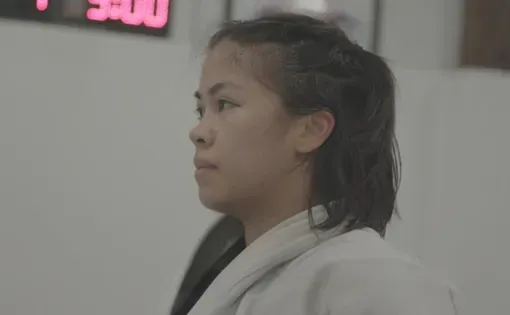
METTLE follows the journey of Liana Mutia, a blind judo athlete on a quest to create history at the...
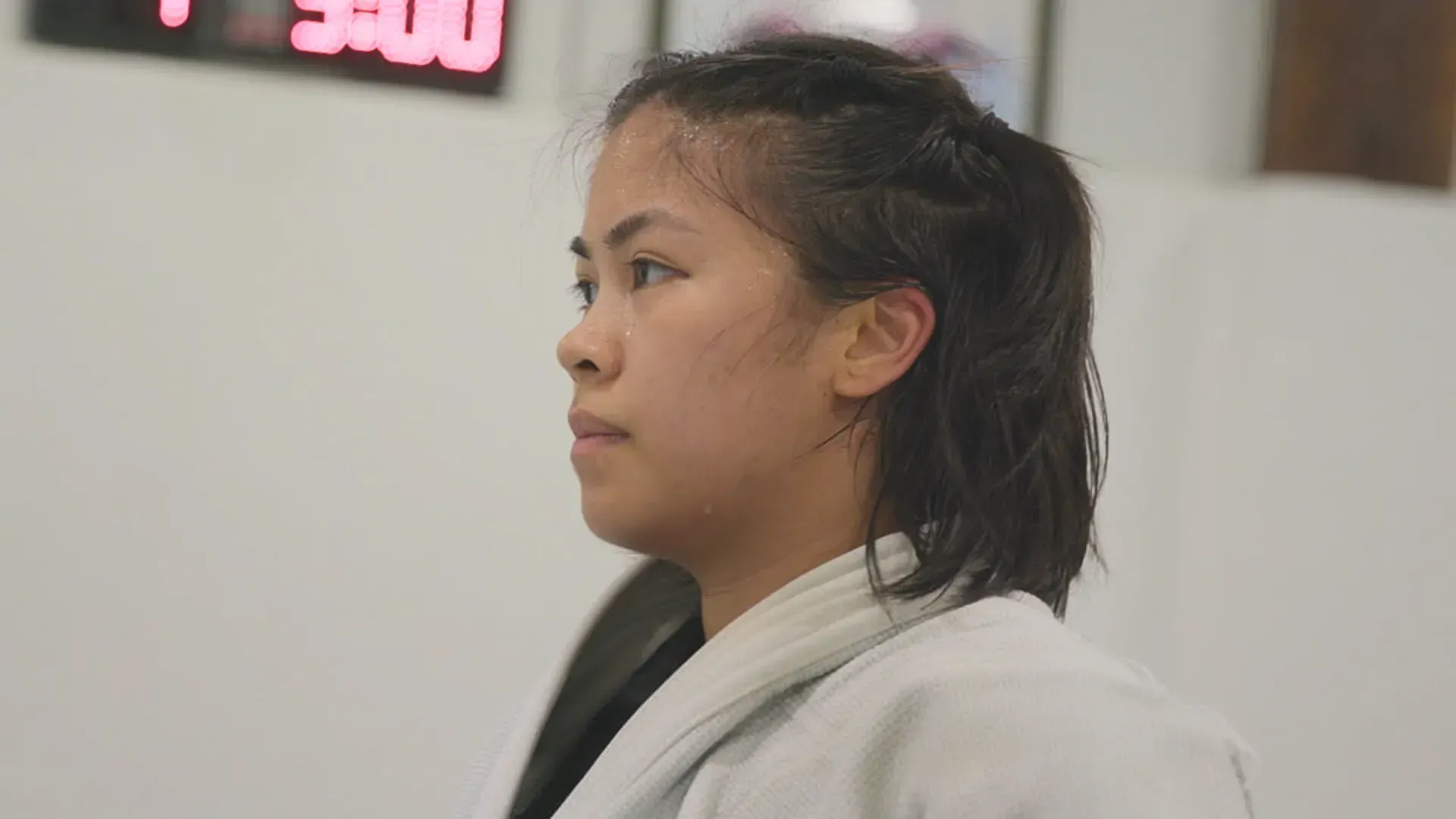
Maria Liana Mutia closes her laptop for the afternoon—it’s a typical work-from-home day at her job as an accessibility specialist. She navigates her high-rise apartment, a window-lined one-bedroom that overlooks the streets of Philadelphia, and packs up a pink duffel bag with her judo gi. She grabs her white and pink walking cane, adorned with a pink tassel, and heads for her post-9-5 ritual: judo.
Except Mutia is no typical athlete: She is a two-time Paralympian and recent silver medalist at the Paris 2024 Paralympics for judo.
Para judo was added as a women's judo event as recently as 2004 at the Athens Paralympic games. A few modifications were made to the rules to accommodate blind, visually impaired, and deaf athletes. One of the main modifications included starting the match with a grip on the opponent’s uniform—unlike in standard judo matches where athletes start apart. Over the years, para judo became increasingly popular and attracted individuals like Mutia.
As a nonprofit journalism organization, we depend on your support to fund more than 170 reporting projects every year on critical global and local issues. Donate any amount today to become a Pulitzer Center Champion and receive exclusive benefits!
“When I met Liana, she could see,” said Marc Vink, a team leader for USA judo. “Over the course of four or five years, she went totally blind.”
Mutia started learning judo as a young girl. But her life changed at the age of 15 when she was diagnosed with ischemic optic neuropathy, a condition that causes vision loss due to reduced blood flow to the optic nerve. Mutia, currently 26 years old, said she was initially in denial of her gradual vision loss and that she didn’t fully process her situation emotionally. Instead, she wanted to maintain a sense of normalcy and poured her time and energy into sharpening her fighting skills.
Vision loss is less common in children than in adults, according to the World Health Organization. Dr. Melody Merati, a neuro-ophthalmologist at NYU Langone Health, said that the process for vision loss diagnosis in children often takes longer than in adults due to the commonality of compounding factors. Merati also said that the psychological toll on children and their caretakers is more difficult than with adults.
“An older individual who has more experience may be able to cope with that [vision loss], but a child who's dealing with a vision loss at such a young age, you may need to gather help from other specialists. Psychiatry can be super helpful for these patients,” said Dr. Merati.
“I had to relearn how to function as a human being, but I also had to relearn how to fight again,” said Mutia.
Luckily for Mutia, judo is a sport that is very familiar with blind and visually impaired athletes. As per the latest statistics, there are a combined total of 504 judo athletes from the J-1 and J-2 classifications, representing 63 countries, according to the International Blind Sports Federation (IBSA). J1 and J2 are classifications for visually impaired athletes, with J1 referring to those who are fully or almost fully blind, and J2 for those with partial vision. Vink said that some of the reasons blind and visually impaired people are often drawn to judo is because it gives them self-defense skills and allows a space for socialization.
“If you look at a Judo mat area, it's usually a wide open space. And for those that are blind, wide open spaces are God's gift because you don't have to worry about walking into a wall or tripping or falling,” said Vink.
Heidi Moore, a national team coach for the U.S. Paralympic judo team said that judo is particularly important for women.
“[If] a woman's going to be attacked, she's not going to be punched,” said Moore. “She's going to be grabbed and judo teaches you to fight close in and have confidence in that close proximity to someone and be able to take someone down.”
The coaching techniques for blind athletes versus able-bodied athletes also differ to a great extent but many times, both categories train together. Mutia’s local coach in Philadelphia and the owner of the El Idrissi Judo Academy, Alaa El Idrissi, says that it’s all about “the feeling part.”
"It's always going through the class, teaching people, breaking it down, then going to the visit, breaking it down personally, step by step with the feeling part,” said El Idrissi.
Vink said that by and large, people who are totally blind are good at “linear learning.” But as soon as you start moving away from that linear line into other areas, the geometric portion of that is hard for them to do.
So while teaching, the coach has to give very precise commands. Those who can see can simply copy the techniques and repeat it on others, but a blind athlete has to have a description first, followed by “having someone do the movement on them and then having them do the movement on another person and then making constant corrections by using direct specific language that does that does a job for them,” Vink said.
Another reason that makes judo a very sought-after martial art for blind and visually impaired athletes is the financial gain. Sponsorships, prize money, bonuses for winning medals and salary opportunities in this sport offer financial independence and long term stability for many folks. According to Mutia, her accomplishments in judo and recognition as a Paralympian significantly improve her job prospects.

The benefits and inclusivity of the sport reflect the core principles of judo, according to Danny Gutman, an able-bodied judo athlete.
“Judo teaches you many different things as far as discipline, etiquette, morality and determination—how to not give up, how to be patient. There's a myriad of virtues that you learn that you can take with you to your daily life,” said Gutman.
Almost a year after her silver medal win at the 2024 Paralympics in Paris, Mutia reflects on a well-earned break.
“I haven't felt this free in a long time,” Mutia said.
After a recent heart operation, Mutia is now focusing on physical therapy to steadily rebuild her strength. But her mind is already strategizing for the 2028 Paralympics in Los Angeles. Balancing a full-time job and her own business, Mutia said that “every single decision made for LA 2028 would have to be planned years in advance.”
But this time, she said, “I will obviously be aiming for gold.”