

Project
Beset by Ice
As melting sea ice opens new Arctic shipping routes, who profits and who pays the costs?
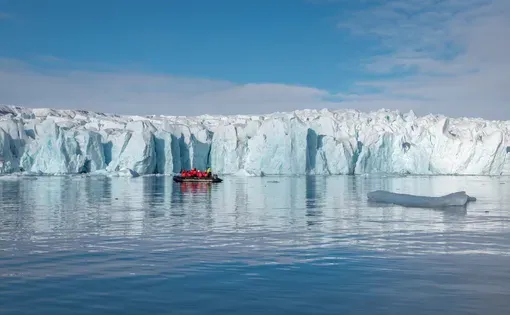
A year-long reporting project supported by the Pulitzer Center’s Ocean Reporting Network will reveal the complexities of shipping and icebreaking in the Northwest Passage.
Do you live in the North and have a story about how Arctic icebreaking and shipping affects your daily life? Are you a southern-based scientist whose research depends on access to icebound regions? Do you work aboard a commercial, cruise, navy, or Coast Guard vessel, and wish there was something more Canadians knew about your work?
When it comes to swiftly melting northern ice, we’re in a uniquely consequential moment in history — and Canadian Geographic needs your help. Supported by the Pulitzer Center’s Ocean Reporting Network, we’re embarking on a new project, aimed at painting a fuller portrait of the climate change-induced transformation of life in the North amid today’s geopolitical tensions.

As a nonprofit journalism organization, we depend on your support to fund more than 170 reporting projects every year on critical global and local issues. Donate any amount today to become a Pulitzer Center Champion and receive exclusive benefits!
A longtime science journalist, I became obsessed with this file last spring while talking with Arctic oceanographer Clark Richards in his office at the Bedford Institute of Oceanography. There, he shared a series of eye-opening anecdotes. I already knew the basics: the North is warming four times faster than the global average, and the region may see ice-free summers as early as 2030. But the picture Richards painted felt unfamiliar, almost dystopian.
He told me a story about a Canadian icebreaker rerouted from its scientific mission to escort foreign-flagged vessels through fog tinted red by distant wildfires, and another about stranded Argentine sailors warding off a polar bear with emergency flares. He detailed the myriad threats posed by increasingly unpredictable Arctic ice, made even more perilous by a rising number of vessels traversing frigid waters above under-mapped seafloor.
What I didn’t know about Arctic icebreaking, it turned out, could fill an iceberg’s bulk below the ocean’s waves. So I got to work, interviewing scientists, government officials, community members, and those in private industry, trying to make sense of this unfolding drama. Then, the U.S. president threatened, yet again, to take over Greenland. The Canadian Arctic and our country’s sovereignty now rest uneasily at the heart of this global furor.
The Pulitzer Center has chosen our project, Beset By Ice — a term used to indicate when a vessel is in danger of being trapped by freezing waters — to join its Ocean Reporting Network fellowship program. Alongside eight other journalists from around the world working on their own investigations, I’ll be diving deep into Arctic icebreaking and shipping, and the complex web of interconnected conflicts, issues, and potential solutions that surrounds this risky endeavour.
Luckily, I won’t be covering this story alone. Canadian Geographic, as the project’s host media organization, is investing staff time and funding. We will be backed up by the Pulitzer Center’s remarkable team of experts and editors, and will have a team of world-class filmmakers along for the ride.
Typically, journalists get tips, report, and research, write, fact-check, and then publish stories. But this series will attempt to go deeper as we make a concerted effort not to replicate mistakes journalists have made, specifically within Indigenous communities, in the past.
To start, Indigenous peoples of the North, including the Inuit, Yupik, Aleut and Sámi, know more about living in the Arctic and its rapid changes than anyone else. We regard Indigenous traditional knowledge as a form of science — as information gathered over time, used to support a nuanced understanding of the world — and will bring the Mi’kmaw concept of Two-Eyed-Seeing, developed by Eskasoni First Nation’s Albert Marshall, to our storytelling. In every email, interview request, and reporting trip, we will consider reciprocity, trauma-informed reporting, and how to conduct ourselves as journalists in a less extractive way than the craft is often practiced, particularly in the North.
I’m no stranger to reporting on the complexities of how global trade networks transform our world. In my first book, Kings of Their Own Ocean, I earned the trust of hardened, lifelong bluefin tuna fishermen whose professions had landed them in the crosshairs of international controversy. Work on ships, particularly in the north, is difficult, dangerous, and requires highly skilled expertise. Most of us rely on goods shipped from places we never think about. The companies trying to move those goods — and, increasingly, cruise-ship tourists — through the Northwest Passage aren’t villains. They’re just one player in this complex story. We will do our very best to be persistent, careful, and contextual as we strive to tell the whole of it.
And this is where you come in.
Below you’ll find a shareable and confidential tip form where you can share your stories and curiosities about the future of Canada’s northernmost regions. Have questions you’d like us to ask decision-makers and those in communities past the Arctic Circle? We want to hear from you.