Story
 June 5, 2025
AI App With Child Sex Abuse Content Finds Success on Google Play Store



Project
AI's Role in Child Exploitation
Investigating the scope and impact of AI-generated child sexual abuse material

With the SeaArt app, users are able to generate images with content that sexualizes children. The app has over 1 million downloads on Google Play Store.
SeaArt, a popular application with over 1 million downloads on the Google Play Store, allows anyone to produce and distribute AI-generated images containing child sexual abuse material, according to an investigation by Núcleo in partnership with the AI Accountability Network at the Pulitzer Center.
In addition to selling subscriptions, the platform — operated by China-based Haiyi Interactive Entertainment — also enables the free creation of such content in exchange for watching advertisements promoted by major multinational brands.
SeaArt has already surpassed 1 million downloads on the Play Store and carries a 14+ age rating. In Brazil, the exploitation, abuse, and sexualization of minors under the age of 18 — including through artificial media — is a crime under the Child and Adolescent Statute, a legal framework focused on child protection.

As a nonprofit journalism organization, we depend on your support to fund more than 170 reporting projects every year on critical global and local issues. Donate any amount today to become a Pulitzer Center Champion and receive exclusive benefits!
“As the platform operator, we have clearly stipulated in our Terms of Service that users must comply with laws and regulations, and refrain from engaging in activities that infringe on the legitimate rights and interests of others,” SeaArt’s legal team told Núcleo.
The company, however, did not answer specific questions raised by this report (details below).
Google did not respond to requests for comment.
Rising Searches
This phenomenon of child exploitation content is not limited to a single platform.
Searches for “AI pornography” on Google — the world’s most widely used search engine — have surged in the past three years. Among thousands of results are sites that produce not only child abuse images, but also deepfakes of revenge porn and manipulated images involving politicians.
This sudden surge of interest since 2022 coincides with the release of new open-source generative AI models — systems that users can modify and run directly on their own machines.
In October of that year, Stability AI launched Stable Diffusion 1.5, trained on billions of images, including real child abuse material.
Models based on variations of Stable Diffusion, and Flux by Black Forest Labs, are among the options SeaArt offers, alongside an extensive catalog of image-generation models.
On the SeaArt page that advertise their models, featured images are almost always AI-generated women — either realistic or animated — semi-nude and grouped into categories such as “realism,” “NSFW” (Not Safe For Work), and fetishes like “big-breasted Asians” and “thinspo,” a term glamorizing extreme thinness circulated in online eating disorder communities.

These models can be freely modified and republished by SeaArt users. At first glance, many show no explicit signs of criminal use.
One model identified by the investigation, for example, was described as being dedicated to creating images of “furries” — a fetish involving anthropomorphic characters with human and animal traits. However, this same model was used to generate dozens of AI child abuse images.
The platform also allows for the creation and sharing of LoRAs — small AI model extensions trained on specific data sets.
Núcleo looked into this technology in another investigation, detailing how dark web forum users employ real photos of children to train AI models to create exploitative child sexual abuse media.
Findings
Within this digital environment, the investigation cataloged 60 AI-generated child sexual abuse posts on SeaArt.
This number does not reflect the platform’s total content volume: at a certain point, the team encountered so many posts that it chose to stop counting and continue the reporting process.
To compile these findings, the team selected content involving explicit sexual scenes between minors and adults, as well as prompts and descriptions sexualizing children and adolescents. Even searches using only numbers led to images of children in lingerie or bikinis in sexualized poses.

The issue reached such grotesque levels that by late April 2025, administrators of SeaArt’s official Discord server — with over 200,000 users — created a specific channel for reporting child abuse content.
“We invite all users to actively participate in community monitoring. If you encounter any suspicious CP content, please submit the user ID here (do not post direct links to the violating content). We encourage everyone to help build a healthy, harmonious community — your reports are vital,” a server moderator wrote.
Yet this type of content persisted on the platform.

Digital Marketing for Child Abuse
These images do not appear on SeaArt’s homepage but were found through targeted searches on the platform. This “surface moderation,” limited to the most visible areas, seems designed to maintain a façade of safety and appease advertisers — while the illegal content remains available to those who know how to find it.
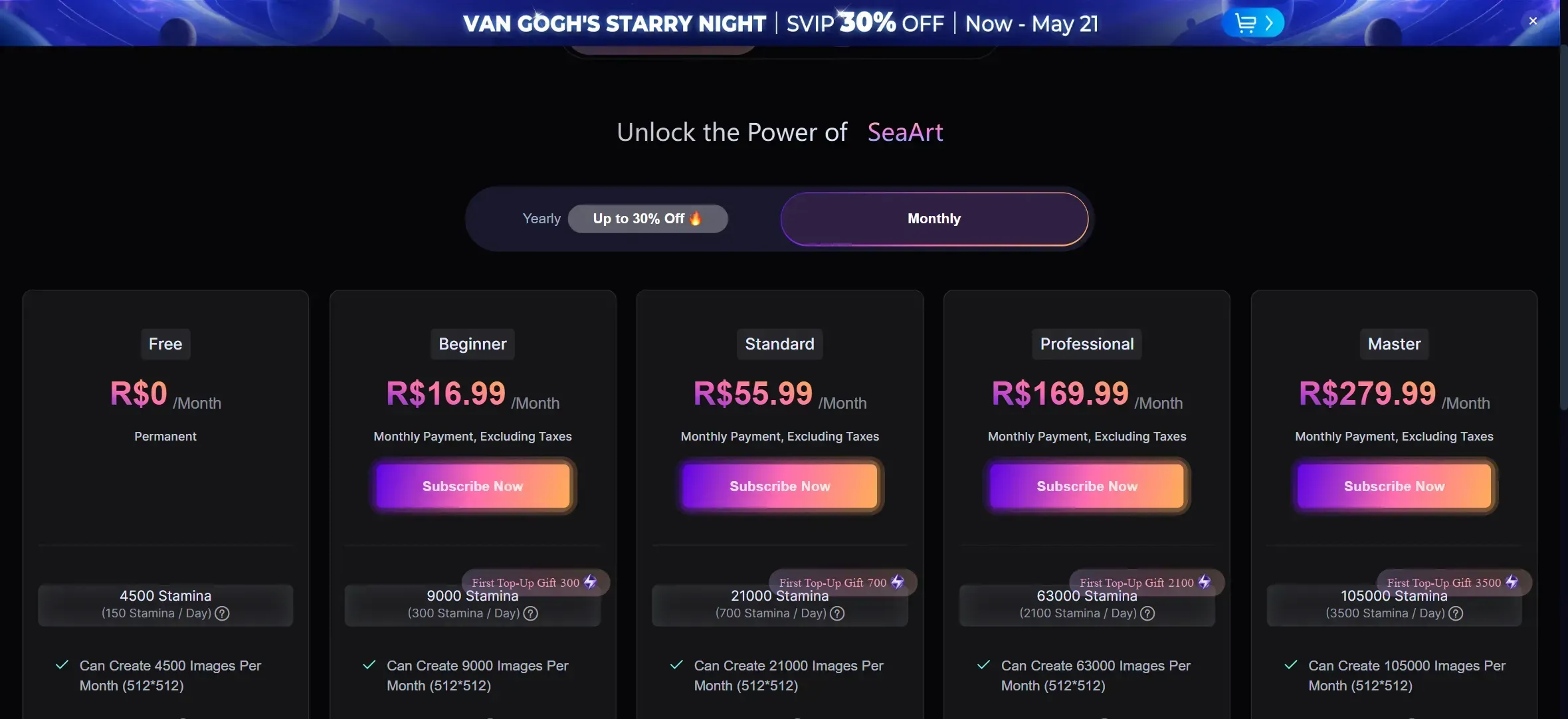
Moreover, SeaArt offers paid plans ranging from R$18 to R$280 (about US$3.50 to US$55) per month but is not entirely dependent on subscriptions for revenue, as many users access the service for free. On the free plan, users can generate up to 4,500 images per month, while the most expensive plan allows the creation of over 105,000 images.
For nonpaying users, the platform offers credits in exchange for completing tasks or watching ads — meaning advertisers may, even indirectly, be funding the distribution of criminal content through this ad system.
This business model, combined with superficial moderation, sustains the infrastructure that allows for the mass circulation of this illegal content.
Users can also earn virtual currency on SeaArt’s official Discord server. By checking in daily, users receive “shells,” which can be exchanged for credits on the platform. The top-tier R$280 plan allows users to generate over 105,000 images monthly.
In its investigation, Núcleo identified over 1,000 ad resellers linked to SeaArt. Only one company appears as a direct advertiser: StarFortune Interactive Entertainment Technology Co, based in Hong Kong.
But other companies maintain direct ties to SeaArt, helping the AI platform to monetize its content, attract users, and increase profits. These companies are AppLovin and AnyManager. The latter even appears as the official domain “manager” for SeaArt — which means it handles the platform’s technical and commercial management, business dealings, advertisements, and services directly.
AppLovin, founded in California in 2012 and listed on the U.S. stock exchange, specializes in monetization solutions for apps, earning part of its revenue through advertising.
It has become so powerful that even Google reportedly fears its growing influence in the digital market, according to The Information. In 2020, 49% of AppLovin’s revenue came from businesses using its software, with the remainder from user purchases within its app portfolio.
The company publicly maintains a policy prohibiting sexually explicit or adult content, especially involving minors, and claims not to collect children’s personal data or target advertising to them.
AnyManager, meanwhile, is part of Japan-based AnyMind Group — officially headquartered in Japan but with locations in tax haven Singapore — operating in digital advertising, e-commerce, and data analytics. As the technical and administrative manager for the SeaArt domain, AnyManager is responsible for hosting, maintaining, and managing the platform, including brokering and displaying advertisements.
Who Profits Behind the Scenes
By examining SeaArt’s Chinese domain, the investigation identified the company registration number and the name of its operator, Haiyi Interactive Entertainment, in Mandarin — details absent from the platform’s international version. These records confirm that the platform belongs to Haiyi Interactive Entertainment, based in Chengdu, southwest China, specializing in game, app, and software development.
However, this information does not appear on SeaArt’s international website or in its privacy policy and terms of service. These, in fact, explicitly prohibit users from uploading “defamatory, obscene, pornographic, vulgar, pedophilic, or offensive content.”
Other public sources also link the platform to the Chinese company. A post on Amazon Web Services (AWS) China’s blog highlighted that a partnership between the U.S. tech giant and SeaArt resulted in approximately 60% cost savings through cloud infrastructure, process optimization, and improvements in the security and quality of generated content.
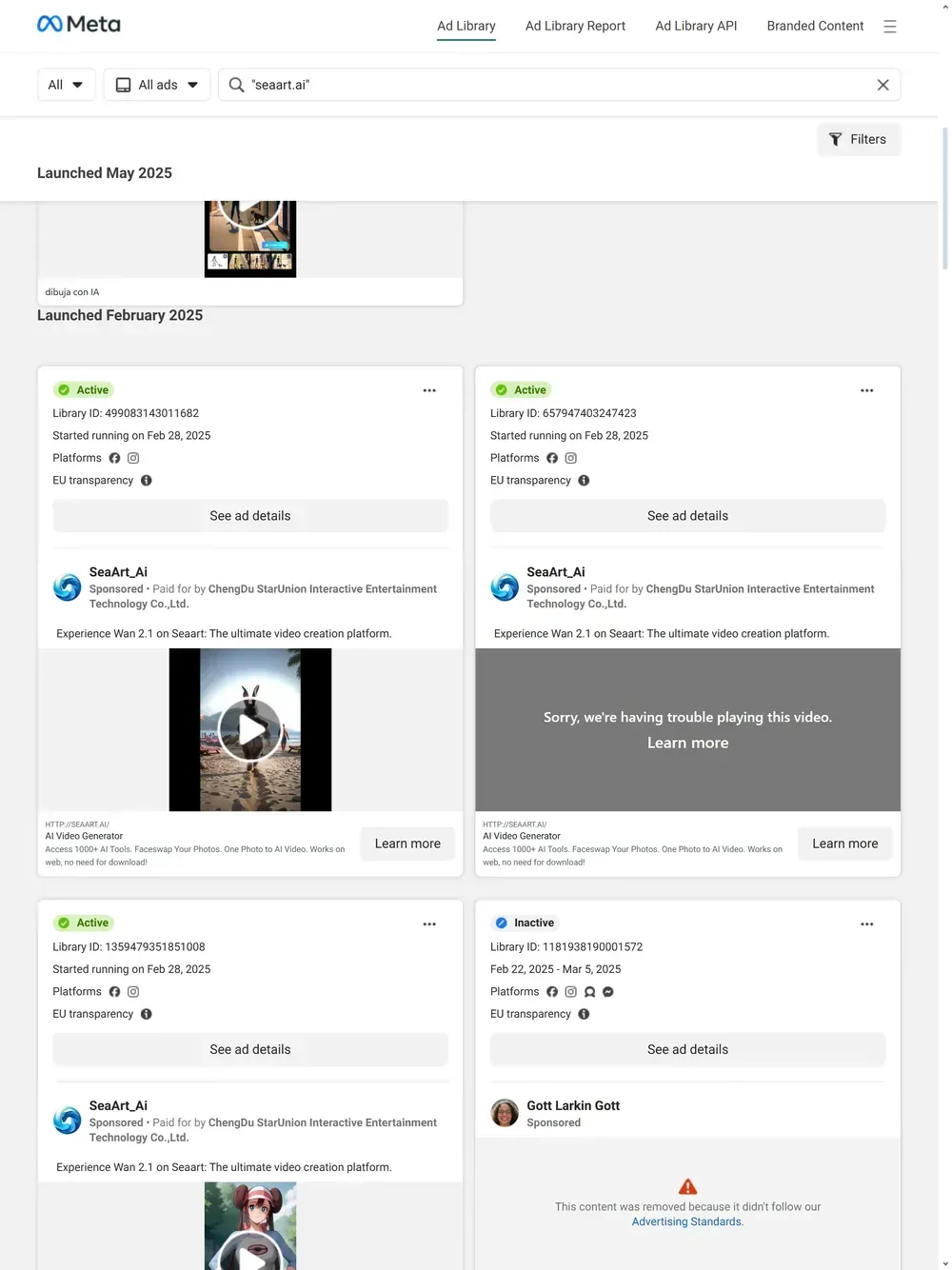
In Meta’s Ad Library — which gathers data from Instagram, Facebook, and Messenger — another company was promoting SeaArt: StarUnion, also based in Chengdu and a developer of games with over 50 million Play Store downloads.
Thanks to European Union regulations requiring digital platforms to disclose information about paid advertising, the investigation identified just over thirty SeaArt ad campaigns on Facebook and Instagram, all funded by StarUnion.
StarUnion’s website, however, does not list a press contact. After scanning the company’s domain, the only available contact was a legal inquiries email address. When the journalists conducting this investigation attempted to reach out and inquire about the company’s possible connection to SeaArt, Gmail notified that the company's server was not accepting messages.
Official Statements
An Amazon Web Services spokesperson told Núcleo that the company is committed to preventing child sexual abuse material across all areas of its business and that “AWS maintains strict terms of service that clearly prohibit illegal activities.”
“When we receive reports of potential violations of our terms, we act swiftly to review and take action to disable the prohibited content,” AWS stated.
Neither SeaArt nor AWS responded to the specific questions sent by these reporters.
AppLovin, AnyManager, and StarUnion did not respond by the time of publication.
Google also declined to comment on its advertising connection to SeaArt through Google Ads.
Reporters: Sofia Schurig and Leonardo Coelho
Technical research: Tatiana Azevedo
Art and graphics: Rodolfo Almeida
Editors: Alexandre Orrico and Sérgio Spagnuolo