Story
 December 2, 2025
AI and Migration: Big Business at the Border
Country:



The money trails of companies, agencies, and state actors cashing in on the EU’s AI tech push to...
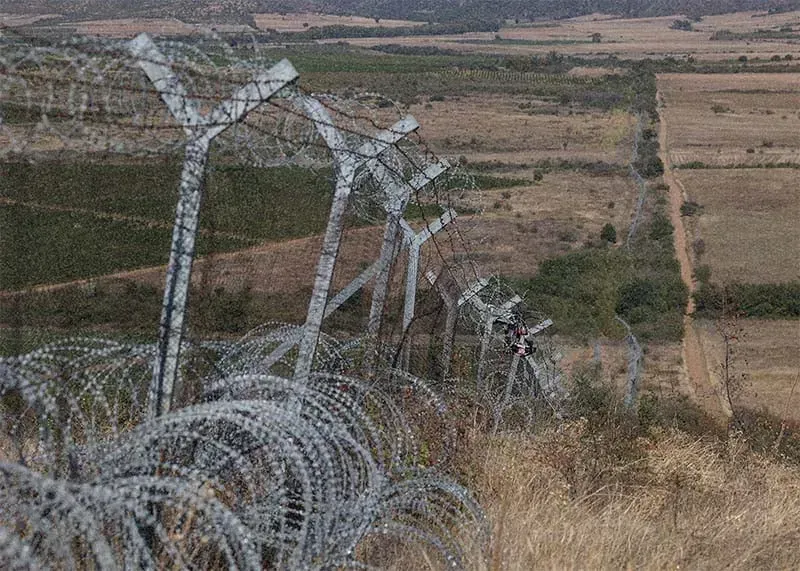
As Europe militarises its migration sector, a whole new ecosystem of lobbying, arms manufacturing and research emerges. And there is a lot of public money to be made for those involved.
Greek border guards on the border with North Macedonia used to rely on an unusual warning system: when storks flew up from their resting spots on the bridge over the Axios River, border guards knew someone was moving in the bushes – often migrants attempting to leave Greece and continue on to Northern Europe via the Balkan route.
Those birds will soon be replaced by cameras, radars and drones. Greece is replicating the ”Evros model” – the high-tech, AI-supported border wall to Turkey – all the way from here to Albania.
This is part of a broader shift: migration is increasingly being defined as a security risk across Europe. With that comes the push into defence AI – and a perfect business opportunity. Amid vague data regulations and little public scrutiny, arms manufacturers, security companies and research institutes benefit from this new AI ecosystem, backed by an influential lobby in Brussels.

Last September, senior EU border officials attended an internal meeting at the Warsaw headquarters of Frontex, the EU border agency. According to participants, a Frontex-tested drone surveillance network was presented.
It featured vertical-take-off (V-BAT) drones hovering along the Bulgarian-Turkish border, transmitting real-time video to a command hub, where the system alerted police to migrant-crossing attempts and “criminal activities.” The contractor? US defence company Shield AI – which declined to answer questions about the system, its deployment, costs, or how the collected data is used.
A corporate windfall and heavyweight lobbying
Defence and security companies are major beneficiaries of Europe’s border-security boom.
Shield AI also sells its V-BAT drones to the Netherlands and the US Coast Guard and Navy. Countless other companies manage to get public contracts – from defence groups to construction giants and smart tech providers.
Behind the contracts sits a powerful lobbying network in Brussels. It includes ASD (representing Europe’s aerospace, security and defense industries); EOS (the security-industry association); and ECSO (set up in 2016 as the European Commission’s cybersecurity public-private partner) – all pushing for a tech-first agenda and more public money for security research and development.
The UK's newest: facial age recognition
This lobbying also crosses EU borders. This investigation has managed to obtain the names of seven companies involved in a controversial trial run by the UK Home Office, which plans to use AI to estimate the age of newly-arrived migrants, many of them are from the US.
Facial-age-estimation AI is a process where an individuals’ age is determined through comparing their facial biometrics to a large dataset of faces with known ages to verify someone’s age.
Molly Buckley from the Electronic Frontier Foundation, a nonprofit, raises concerns: ”When used for age estimation, facial scanning is often inaccurate. It’s in the name: age estimation,” she says, pointing to potential error rates due to bias. Studies show such systems are more likely to misjudge the age of people of colour and women.
The Home Office did not respond when asked whether a human-rights impact assessment had been completed, which experts had been consulted, or any further details of the implementation process.
In a statement, it insisted that ”robust age assessments are a vital tool in maintaining border security.” Child protection advocates argue that these assurances fall far short of addressing the real-life consequences for misidentified people.
Frontex Grants for biometric research in Switzerland
The Idiap research institute is located in the small Swiss town of Martigny. It is financed by private and public funds and focuses on basic AI research. Its Biometrics Security & Privacy research group was awarded a Frontex grant in September 2025.
Their project aims to create a ”multispectral data set for gait and facial recognition at borders” – images captured across multiple wavelengths of the electromagnetic spectrum, including infrared or thermal imaging. The goal is to be able to recognise people not just from their facial features, but also from their movements and the way they walk.
The institute remains the data controller, says biometrics professor Sébastien Marcel, who leads the project. But what will happen to the dataset and the findings once the project is complete remains unclear.
”It will be used by Idiap and its partners for academic research purposes and for benchmarking technologies.” Who these partners will be is not yet ”exactly” known at this stage. ”Basically, they are research institutions that are willing to sign a licence agreement with us.”
This kind of research is generally exempt from the EU’s AI Act, which deals largely with high-risk applications, including AI-assisted biometric classification systems. Applications linked to national security are also exempt.
Athens delivers what Berlin wants – and Brussels pays
The push for ”innovation” in migration management is coming from Northern European countries, and backed by large EU funding for new technologies, such as a €35.4 million E-Surveillance programme.
At a meeting between German chancellor Friedrich Merz and Greek prime minister Kyriakos Mitsotakis in May 2025, Merz addressed his Greek counterpart directly: ”Secondary migration from Greece to Germany must be reduced. Repatriations must increase.”
”Brussels wants results. Berlin wants fewer migrants. Athens delivers both – it's as simple as that,” says a senior government official familiar with the EU's migration agenda.
Meanwhile, across the EU, member states plan to spend less than 0.04% of their border funds on assistance and protection for people on the move, funnelling nearly all resources into infrastructure and surveillance.