Pulitzer Center Update May 29, 2026
“Investigative Journalism With Results”: Madeleine Baran at Syracuse University on Following Questions Without Easy Answers


An investigation into the killings of 24 Iraqi civilians by U.S. Marines resulted in no prison time.

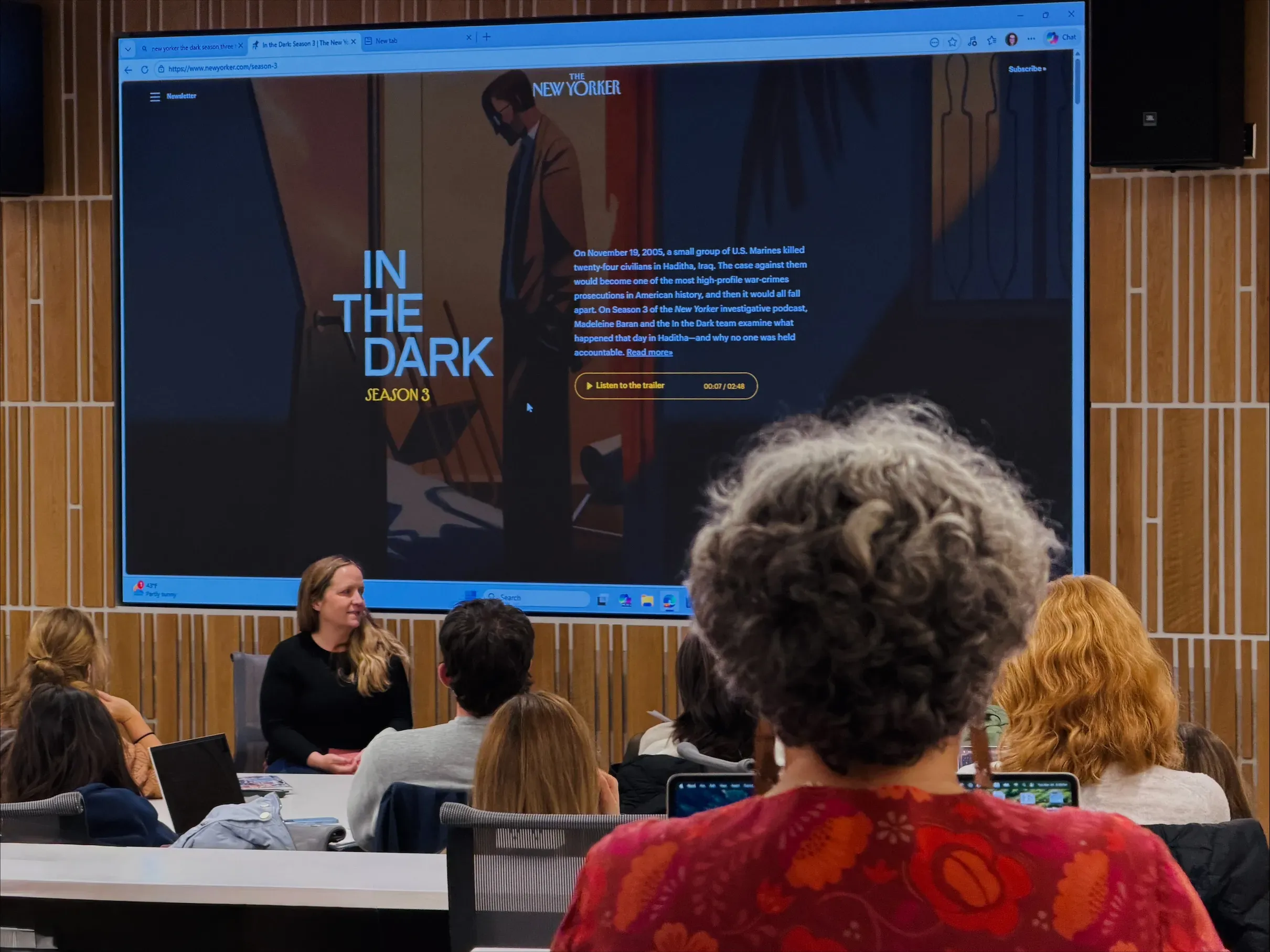
Madeleine Baran has built a career on following questions most people would give up on. Her latest investigation began with one that is as simple as it is unsettling: “Why was no one punished for this?”
Speaking to students ranging from freshmen to graduate level, Baran—a reporter and host of In the Dark, an investigative podcast from The New Yorker—didn’t begin with just a summary. She reconstructed it in real time, pulling the audience into the uncertainty, frustration and persistence that often define investigative journalism.
The conversation, hosted in partnership with the Pulitzer Center and held at Syracuse University, felt more like an unfolding story, mirroring the kind of narrative audio journalism she has spent years refining.
Diving deep into the third season of In the Dark, Baran explained the four-year investigation into one of the most high-profile war crimes prosecutions in U.S. history and the opaque justice system surrounding it. The project required a team of five reporters and producers, countless documents, and a level of persistence that stretched far beyond a typical newsroom timeline.
“It seemed like if there was any part of the justice system to understand, we should really understand this one,” Baran said. “And yet this was the hardest one to understand.”
Reporting on the military justice system meant navigating layers of bureaucracy where key moments of accountability were often invisible—or even missing entirely.
“It’s ridiculous how hard it is to get public records, and we want our listeners to feel how frustrating that is,” she explained.
Rather than smoothing over those obstacles, Baran builds them into the story. She described recording herself in real time while reviewing documents, capturing her own reactions as she uncovers new information. Those moments, she said, help translate the reporting process into something listeners can experience alongside her.
“One of the reactions we got from listeners is that they understand and they sort of feel it on a visceral level of why this stuff is so important,” Baran said.
That approach reflects a broader philosophy behind In the Dark. The reporting is rigorous and deeply sourced, but the storytelling and structure is intentionally human.
In stories centered on violence and trauma, Baran and her team focus on the people at the center—often victims and their families—to ground the narrative and give listeners someone to support and empathize with throughout the story.
“It’s not our job to make it not awful, but we do need to make it engaging to where you want to listen to it,” Baran said.
Baran’s path to this work was not exactly straightforward. She started as a freelancer, spent time working in mental health, and eventually joined Minnesota Public Radio as a part-time general assignment reporter while pursuing investigative stories on the side. A turning point came when she met collaborator Samara Freemark.
“It was one of those things where you just know this is what you should be doing,” she said.
Even now, the work remains demanding—not just logistically, but emotionally. Covering what Baran described as “some of the most difficult subject matter” requires both distance and support. Having a team, she said, is essential. Not only for the reporting itself, but for processing the weight of the stories.
“There is a purpose to this work. If you believe in that purpose, that can help you a lot to get through it,” Baran said.
Students in attendance pressed Baran on everything from navigating tight deadlines to the role of emerging technology in investigative reporting. While her team used artificial intelligence tools for transcription, she emphasized that the core of the work remains unchanged: persistent reporting, careful sourcing, and creative storytelling.
As the conversation turned to the broader media landscape, Baran reflected on the shifting world of podcasts and funding, from her time with American Public Media to her current work with The New Yorker. But despite those changes, her belief in the field remains constant.
By the end of the session, what lingered wasn’t just the scale of Baran’s reporting, but the mindset behind it: a willingness to sit with uncertainty, to follow questions without clear answers, and to bring audiences along for the process.
“Investigative journalism is the reason why journalism has some of the fundamental protections that it has in our country, because people recognize the importance of this type of work through democracy,” she said.