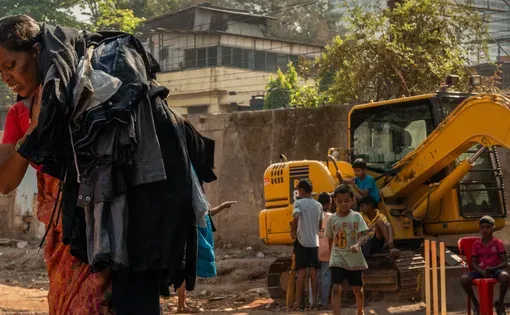
How an urban redevelopment project has become a vehicle for elite land capture
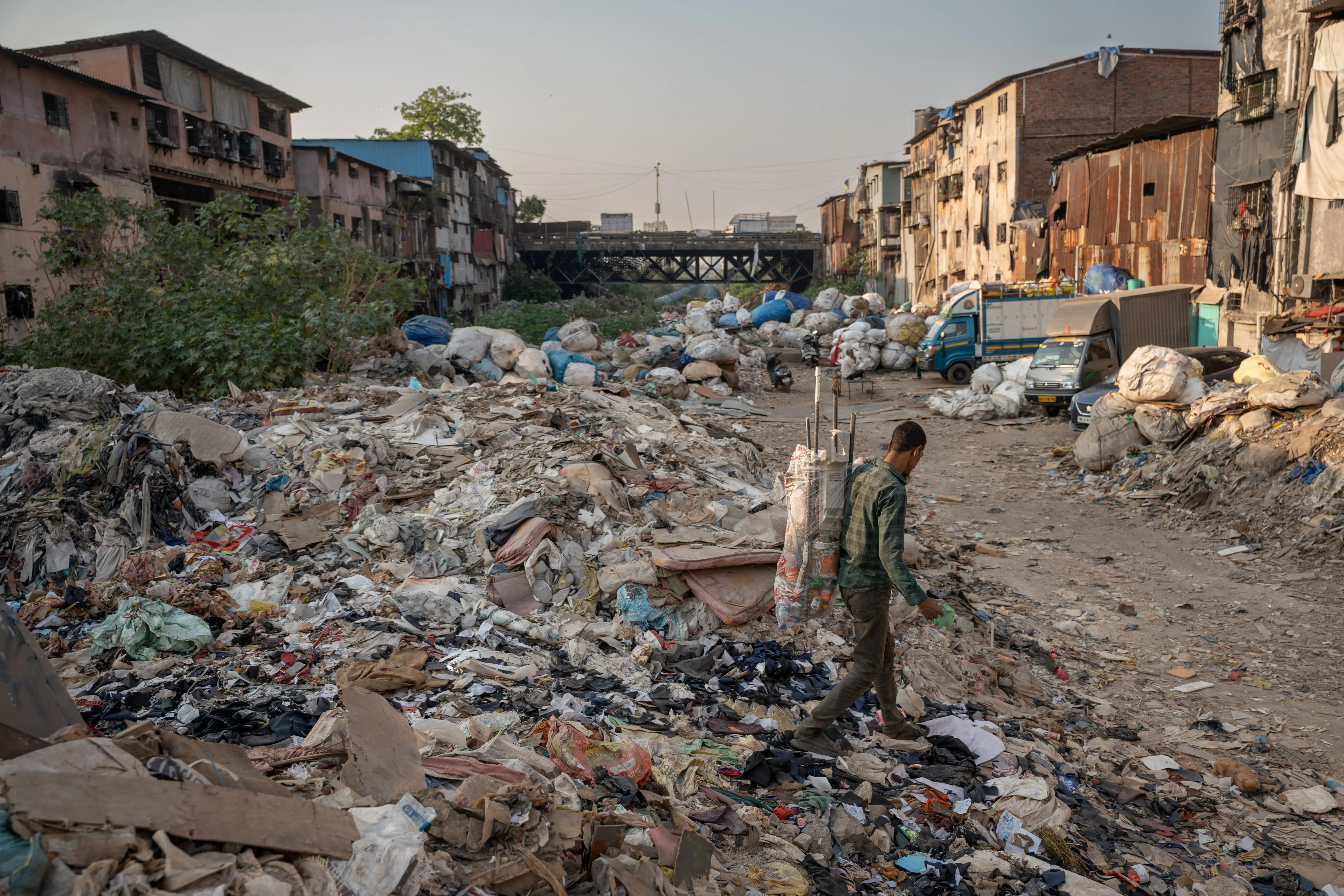
Dharavi occupies nearly 600 acres of centrally located land between Mumbai’s key business districts and transport corridors—some of the most valuable real estate in the country.
All day, Sirajuddin sits in a 10-by-7-foot unit, facing a mound of plastic and cartons. He works by sound and touch—bringing each piece down against the floor to hear what it is, crushing it in his hands to read its texture and grade, then trimming away what doesn’t belong with a quick stroke of the sickle. Around him, the pile separates into neat clusters: seven different grades of plastic, he says, each with its own value. Not everything stays. He gestures to a corner where rejects gather—glass perfume bottles, rubber containers, mixed scraps. “This isn’t useful for us,” he says. “It goes to other units.”
Sirajuddin migrated from a village in Faizabad, Uttar Pradesh, three years ago. He earns ₹500 a day at this unit in Dharavi’s 13th Compound, where he segregates nearly 300 kg of plastic daily. “My friends from the village were already here,” he says. “So I came.” Since then, the work has remained the same—long hours and a steady flow of the city’s discarded plastic passing through his hands.
Dharavi’s recycling economy is central to Mumbai’s waste system. The settlement processes a significant share of the city’s waste—by some estimates, up to 60-80% of its plastic—through thousands of small, interconnected units. At its core lies the 13th Compound, a dense cluster of recycling activity that anchors this informal economy. It sustains the livelihoods of up to 250,000 ragpickers who collect waste across the city, while roughly 40,000 people work within its micro-enterprises, sorting, shredding, and remoulding materials. Together, this forms a highly organised chain: waste pickers collect, traders aggregate, and workshops process, feeding recycled material back into manufacturing cycles.

As a nonprofit journalism organization, we depend on your support to fund more than 170 reporting projects every year on critical global and local issues. Donate any amount today to become a Pulitzer Center Champion and receive exclusive benefits!
But the sprawling informal economy that sustains thousands in Dharavi (even Mumbai) now sits at the centre of the city's most ambitious redevelopment projects. In 2022, the Maharashtra government awarded the ₹5,069-crore Dharavi redevelopment tender to the Adani Group-led special purpose vehicle, framing the project as a long-overdue intervention into what officials describe as Asia’s “largest slum.” State authorities have framed the Dharavi Redevelopment Project as an effort to improve living conditions through formal housing, wider roads, sanitation infrastructure, and integrated urban planning, while positioning it as central to Mumbai’s broader redevelopment ambitions.
The redevelopment plans have also specifically identified Dharavi’s recycling industry as an area requiring “rehabilitation.” Planning documents prepared under the Dharavi Redevelopment Project state that many recycling units currently operate in “crammed lofts” with poor ventilation and inadequate lighting, arguing that waste processing activities contribute to pollution and expose workers to illnesses such as asthma, tuberculosis, and skin diseases. The plans, therefore, propose relocating such industries into formalised industrial structures as part of the redevelopment process.
Urban planners and real estate experts, however, point to another reality underpinning the urgency: Dharavi occupies nearly 600 acres of centrally located land between Mumbai’s key business districts and transport corridors—some of the most valuable real estate in the country. For many researchers and activists, the redevelopment is not only about housing or infrastructure, but also about who gets to control the economic and spatial future of this land. As urban researcher Hussain Indorewala has argued, Dharavi is often viewed through the lens of “underutilised land” despite functioning as a dense and productive economic ecosystem whose value far exceeds conventional real estate calculations.
Within that uncertainty lies the fate of Dharavi’s vast recycling network—raising questions about whether this intricate chain of labour, trade, and processing can survive redevelopment at all, or what place, if any, it occupies within the project’s vision of a new Dharavi.
An industry without assurances
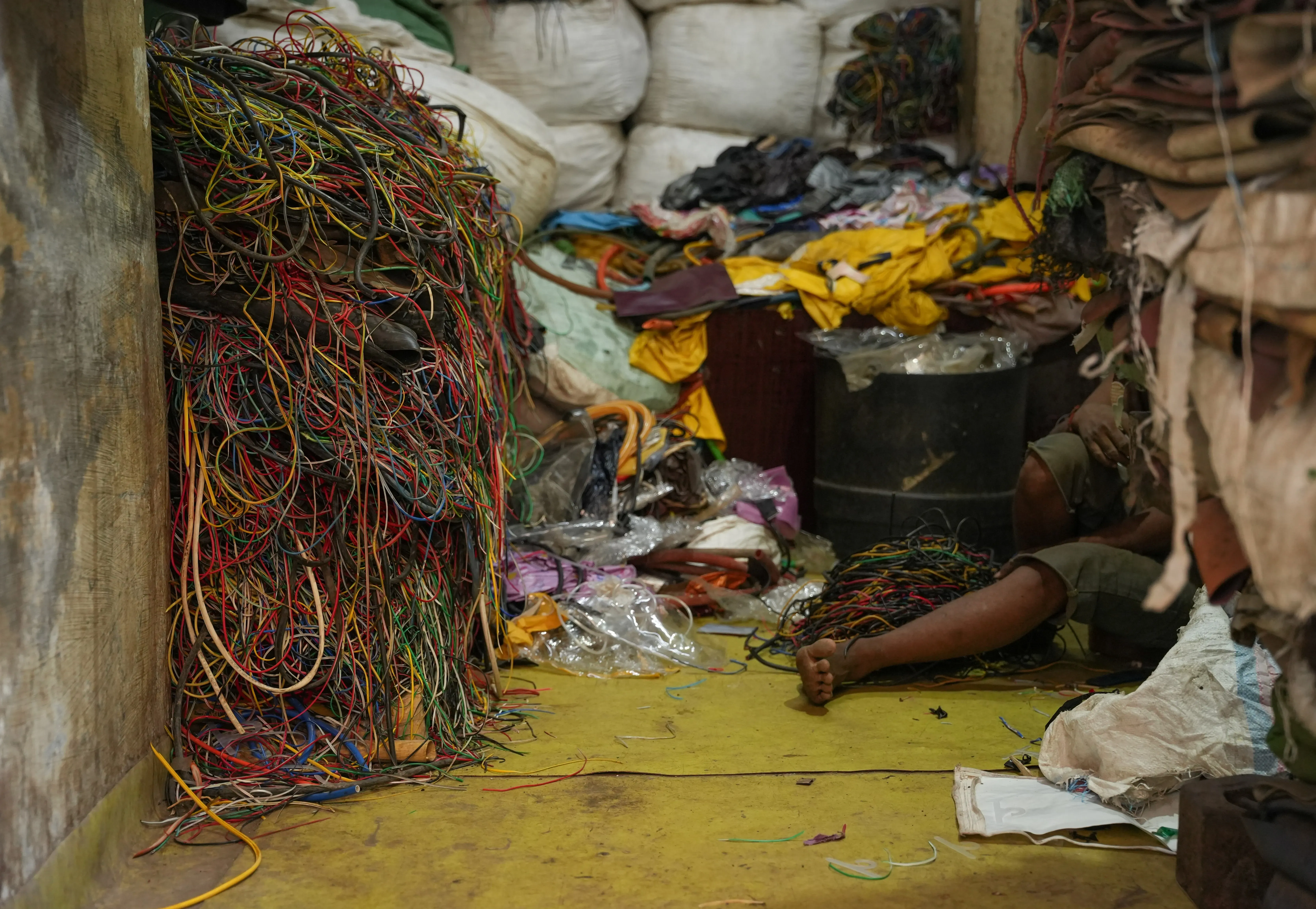
In the 13th Compound, Irfan now runs The Plastic Yard, one of Dharavi’s better-known recycling units. His father arrived in the late 1970s, working under a middleman in a small godown, sorting plastic by hand. Over time, that work grew into a business of their own, with machines gradually replacing manual labour. After completing his studies at Bandra College of Commerce, Irfan took over operations in 1994 and expanded the unit.
Today, the unit sorts plastic and processes it into granules, which are then washed—emerging clean, with a faint, almost bubble-gummy fragrance. “The pellets sell anywhere between ₹10 to ₹100 per kilo, depending on the grade and the industry they go to,” he says.
Over the years, he has seen the process evolve. “Earlier, cleaning was done manually in large containers with heated water. Many places still do it that way, but we’ve shifted to fully electric systems—it’s much faster.” The unit has also moved up the value chain, manufacturing recycled products like mugs and piggy banks, which sell for ₹5–9 per piece in wholesale markets.
But amid the constant churn of work, uncertainty looms. With Dharavi under the Adani-led redevelopment plan, Irfan is hopeful but unsure what lies ahead. “I don’t mind redevelopment, even relocation,” he says. “If they create a proper industrial park for this sector, it could work. But will it be affordable? That’s the question. Dharavi works because it’s cheap enough for businesses like ours to survive.”
“For my father, renting a unit in Dharavi made sense not just because the entire supply chain was here, but because it was far more affordable than anywhere else in the city—it was, after all, land nobody desired,” Irfan says. Today, he pays ₹22,000 in rent, a cost he fears will not remain viable under the redevelopment plan, which offers little clarity on rental spaces for businesses like his.
The Dharavi Redevelopment Project has repeatedly stated that existing economic activities, including recycling industries, would be accommodated through formalised industrial and commercial spaces. Officials have spoken about creating planned industrial zones, wider roads and mechanised infrastructure, arguing that the redevelopment would modernise the economy.
Yet detailed plans for how the recycling sector would function within the new development remain limited in the public domain, particularly for the thousands of small rental units and workshops that operate on thin margins.
Even where space has been promised to eligible businesses under the redevelopment plan, much of the anxiety centres on what those spaces will actually look like, how large they will be. Under the rehabilitation framework, several commercial and industrial establishments fear they may either receive significantly smaller units or be shifted into formal industrial structures with higher operating costs, maintenance charges, and stricter compliance requirements.
That uncertainty extends even to those who own their units. Rashid Khan, who operates out of a 1,600 sq. ft. workshop, sees the proposed rehabilitation terms as a clear loss. Under the plan, commercial and industrial units are expected to receive spaces of around 225 sq. ft., or their existing area, whichever is smaller. This raises concerns about the viability of scaling down operations so drastically.
Business owners also point out that recycling work in Dharavi depends on clustering. Segregators, grinders, pellet-makers, transporters, and wholesalers all operate within walking distance of one another, creating an ecosystem where materials move quickly and cheaply through multiple stages of processing. They fear that fragmenting or vertically relocating these activities into formal towers or distant industrial parks could break the chain that currently makes the industry economically viable.
In an interview with Scroll, Shaikh, president of the Dharavi Businessmen Welfare Association, said that multiple meetings have been held with officials. Still, while assurances have been offered verbally, nothing has been formalised in writing so far.
He added that their key demands include recognising all residents and industrial units as eligible under the redevelopment plan, and ensuring fair compensation if businesses are relocated outside Dharavi. According to Shaikh, the continued absence of written commitments has significantly weakened trust among residents and workers in the project.
The migrants with no place in the plan
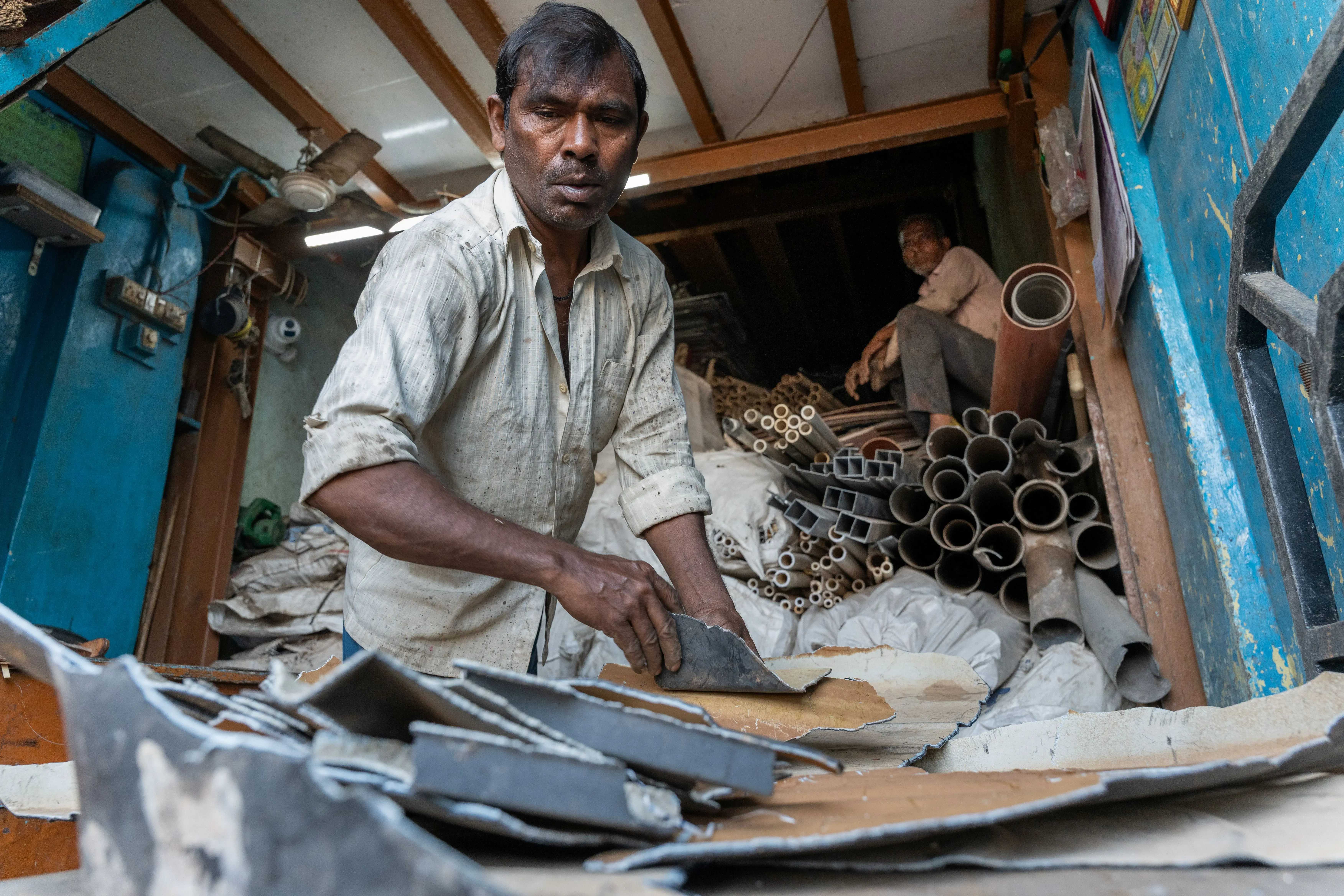
By evening, the clang of machines fades, and the lanes grow quieter, but the units are never fully vacant. Sirajuddin stays back after his shift, sleeping in the same space where he spends the day sorting waste. “By evening, the plastic stacks are moved out to other units in Dharavi or to factories across Mumbai,” he says. What remains is just enough room to lie down. He shares the workshop with five other men from Uttar Pradesh. Their lives are packed into bags hooked onto the walls—clothes, a comb, a small mirror. In one corner, a shared stove and a single saucepan for brewing tea. “Do you know the rents in this city?” he asks. “To send money home, you first have to save something.”
This floating population of migrants, largely from Uttar Pradesh and Bihar, move between sectors like waste, garments, and leather, wherever the work is. Their housing is not formal, but improvised: carved out of the gaps left behind by production cycles, occupying shop floors after dark. Yet, the redevelopment plan remains largely silent on their future. There is little clarity on whether alternative housing will be created or how workers who rely on proximity to these units will continue to survive if displaced.
Even more uncertain is the fate of their work itself. If workshops shrink or relocate, what happens to those whose livelihoods depend entirely on them? “No one asks us what we need from redevelopment,” Sirajuddin says. “The owners will fight for their properties. We are still figuring out what to fight for.”