Pulitzer Center Update April 23, 2026
African Journalists Spent Earth Day Mapping Mines. Here’s Why That’s Important to Pulitzer Center

Journalists from across Africa came together on Earth Day (April 22, 2026) to help build a powerful mining investigative tool for their own reporting community.
About 25 journalists—most of them covering mining on the continent—joined geospatial experts for an online mapathon, a collaborative mapping event. It was part of a joint effort by the Pulitzer Center, Code for Africa, and Earth Genome to build Africa Mining Watch (AfMW), a groundbreaking tool that uses satellite imagery and AI to detect mining activity on the continent.
Africa holds an estimated 30% of the world’s mineral reserves. It is at the center of the global race for rare-earth minerals. As demand intensifies, illegal operators are pushing deeper into protected forests and vulnerable communities, often with little scrutiny and even less accountability for the environmental and human costs.
That is why Africa Mining Watch matters. AfMW will help journalists detect and track mining activity across Africa at a regional scale, with far less time and cost. The open-source tool, expected to launch for public use in July 2026, builds on Amazon Mining Watch, which journalists have already used to produce impactful investigations in the Amazon.
For the Pulitzer Center, this is part of a larger approach. We are not only funding individual stories, we are also building replicable infrastructure that strengthens accountability reporting over time. Our partnership with Code for Africa is especially important in this effort. As the continent’s largest network of civic technology and data journalism labs, Code for Africa brings deep regional expertise and a strong commitment to ensuring this infrastructure is shaped by the people who will actually use it to serve their communities.
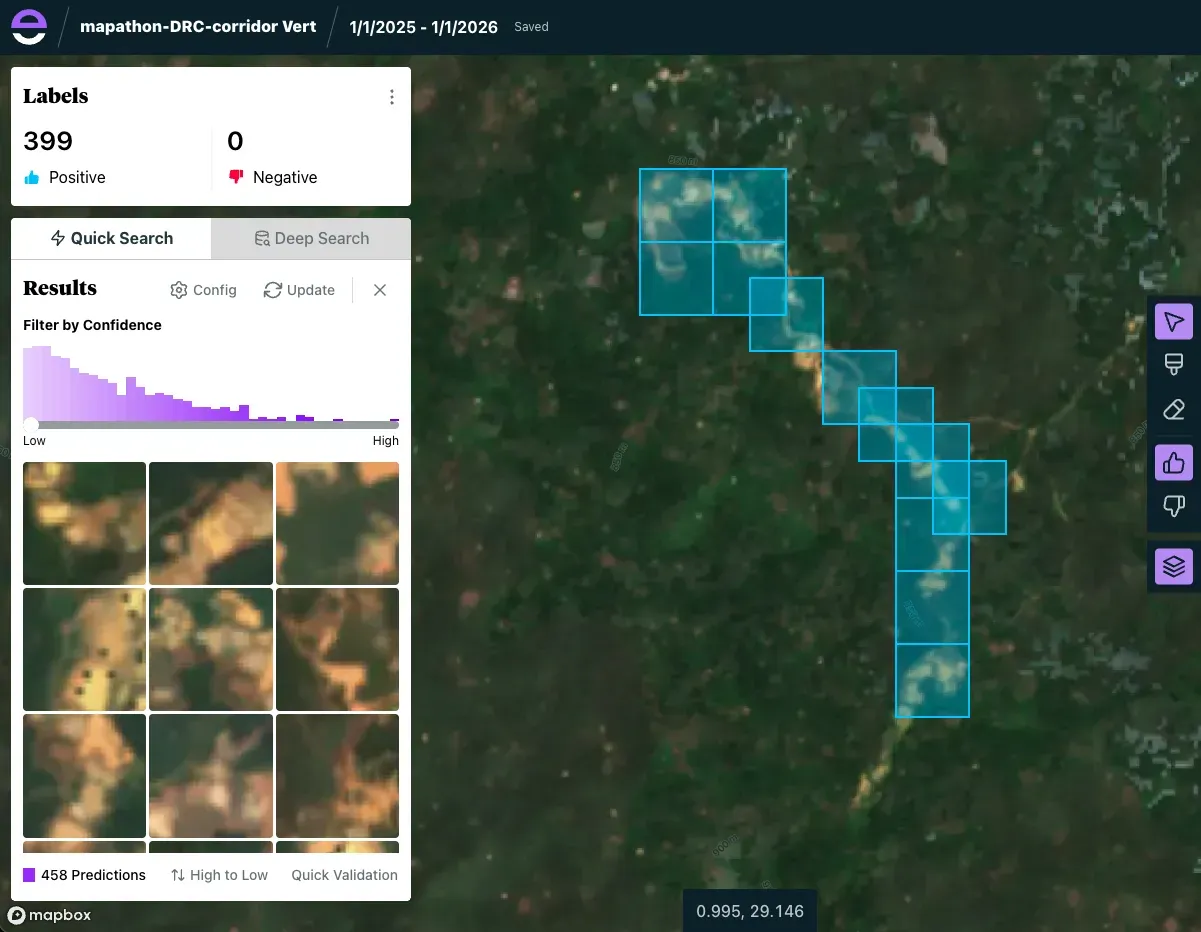
During the event, geospatial experts from Earth Genome trained participants to understand how satellite imagery and machine learning can reveal mining at scale. Journalists then took part in a hands-on session using Earth Index, the AI system behind AfMW, to identify mining operations in countries they know best.
Once the journalists became familiar with the platform, they began contributing something no model can generate on its own: local knowledge. They used their reporting experience and their understanding of the places they cover to identify mines in their regions and label them on the platform. That labeled data will help train and improve AfMW’s detection model.
As Edward Boyda, a data scientist at Earth Genome who led the mapathon, put it: “The most valuable output are points that are carefully verified and labeled by a human.”
That principle shaped the entire event. This was not a product demo where we built something and asked potential users to test it. It was a working session where journalists helped build the tool itself. Their expertise and local insight are what make a tool like this stronger and more practical for real investigations.
We also heard from two former Fellows of the Pulitzer Center’s Rainforest Investigations Network (RIN): Alexander Abdelilah and Hyury Potter, who shared how they used the AI tool in investigations into illegal gold mining in Brazil and Ghana. Their stories helped participants see how a technical system like AfMW can support reporting on the ground and lead to ambitious, evidence-based investigations.
During the session, I encouraged participants to turn what they found into story ideas and apply for support from the Pulitzer Center. I also highlighted the RIN, our yearlong Fellowship that supports investigative reporting on the structural drivers of deforestation across the world’s major tropical rainforest regions, including the Congo Basin.
We started with 36 participants, and about 30 remained when we said goodbye seven hours later. Because we were spread across time zones, some joined before dawn and others logged off after midnight, myself included. I was struck by that level of commitment. It reflected not only the urgency of the issues we face, but also the power of this community to build something larger than any one newsroom or story.
That, to me, is the real value of Africa Mining Watch: not just better detection, but better reporting—shaped by journalists who know the terrain, understand the stakes, and ask the questions that matter.

Kuek Ser Kuang Keng
Senior editor, Rainforest Investigations
This message appeared in the April 24, 2026, edition of the Pulitzer Center's weekly newsletter. Subscribe today.
Caption for homepage photo: A river was polluted by illegal mining in Ghana’s Western Region. Image by Delali Adogla-Bessa/Shutterstock.