Pulitzer Center Update April 8, 2026
Pulitzer Center Founder: 'We Are in This Together'
Country:

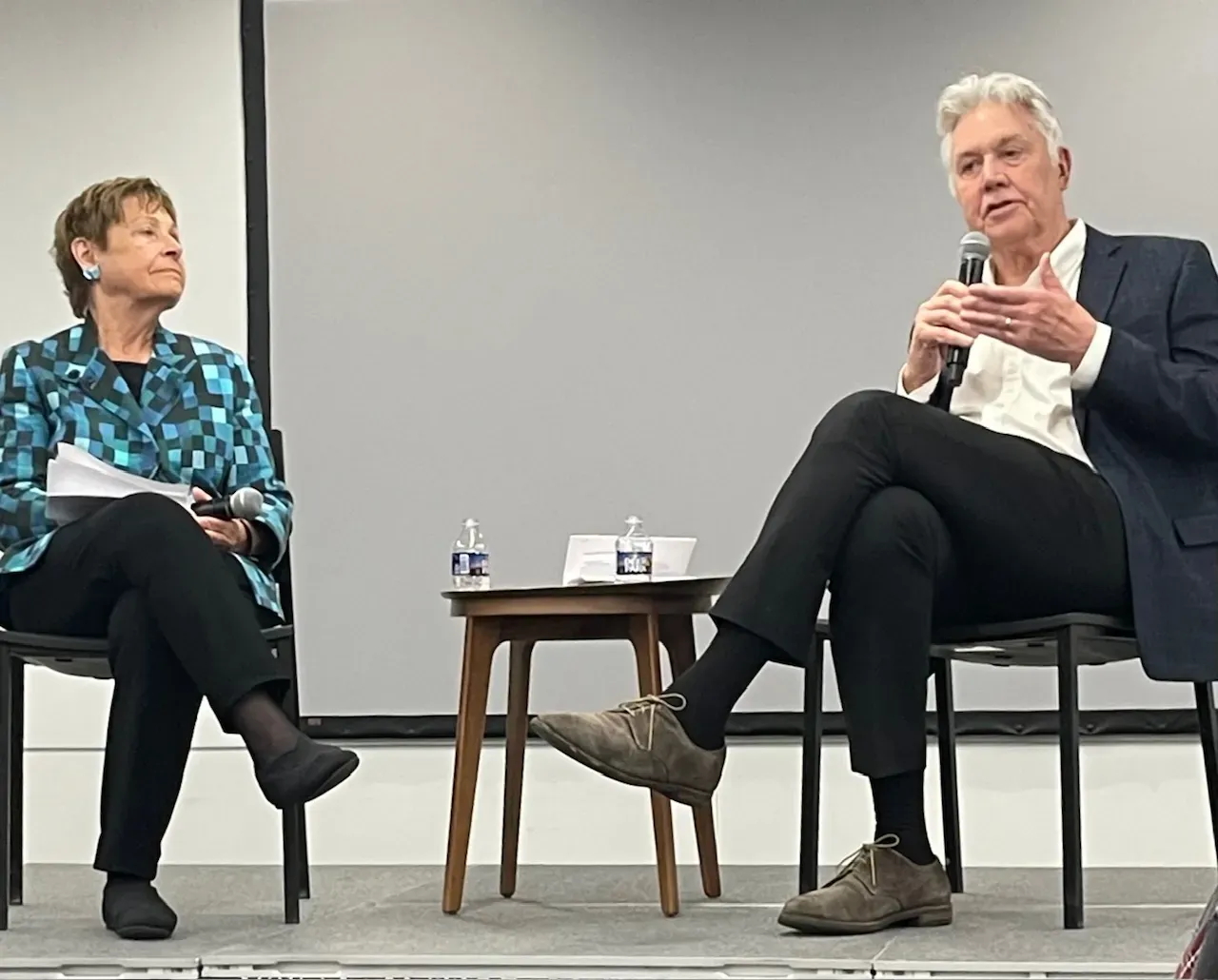
As the Pulitzer Center marks its 20th anniversary this year, Founder Jon Sawyer and board member Linda Winslow tell its story at a D.C. library.
In the early 2000s, many media organizations laid off journalists and curtailed coverage in an attempt to survive in the burgeoning internet age—even as those same news outlets faced public backlash against overly credulous coverage of the run-up to the U.S. war in Iraq.
Those same trends spurred the founding in 2006 of the Pulitzer Center on Crisis Journalism, a D.C.-based journalism and education nonprofit that has grown into one of the most significant sources of support for enterprise journalism around the world and a leader in innovative strategies for engaging audiences of every age and across political divides.
A full house of 150-plus at the Cleveland Park Library got a firsthand look of the Pulitzer Center at the "Tuesday Talks" event on March 10, 2026. The speakers were Jon Sawyer, the Center’s founder and senior adviser, and Linda Winslow, a longtime Pulitzer Center board member and the former executive producer of the PBS NewsHour.
Sawyer explained that the Pulitzer Center supports more than 250 journalism projects each year, with grants to individual freelancers and in partnership with news outlets that range from The New York Times, Le Monde, and NBC News to community radio services in Brazil and the Congo Basin. Sawyer said Winslow deserves special credit, as an early champion at NewsHour for partnering with the Pulitzer Center on in-depth reporting projects.
The Center also furnishes editorial support, training, and collaboration networks to give journalists the chance to pursue in-depth and high-impact reporting stories. Pulitzer Center projects focus on key systemic issues, from the environment and global health to peace and conflict, human rights, and the rise of artificial intelligence.
In the last several years, Pulitzer Center projects have won Pulitzer Prizes, Peabody Awards, national Emmys, Overseas Press Club Awards, and other prestigious honors, elevating the Pulitzer Center and its grantees to the highest echelons of the journalism profession. (The Pulitzer Center is not affiliated with the Pulitzer Prizes awarded each year, though it shares the same name with the prestigious awards.)
See the impact: Celebrating 20 years of the Pulitzer Center
At the same time, the Pulitzer Center connects journalists with schools, universities, and the public through its educational initiatives, helping teachers, students, and the public gain a greater understanding of the pressing issues of the day. As part of that effort, the Center partners with nearly 40 universities and colleges, in the United States and overseas, to bring Pulitzer Center journalists on campus to share their projects. The Center also funds reporting fellowships for students at each of its partner colleges and universities.
The Center’s budget, currently $14 million a year, is supported by members of the Pulitzer family, Campus Consortium university partners, individual donors, and foundations—among others, MacArthur, Rockefeller, and Open Society. Its work on rainforests, oceans, and related environmental issues has been supported in part by Norway’s International Climate and Forest Initiative.
Filling 'gaps in coverage'
The idea behind the Pulitzer Center grew out of Sawyer’s experience reporting from the Middle East after the 9/11 terrorist attacks, as the Washington bureau chief for the St. Louis Post-Dispatch (at the time a major regional newspaper owned by the Pulitzer family). That war was based on the premise that Iraqi dictator Saddam Hussein had weapons of mass destruction, a premise that turned out to be false.
Sawyer said that in his own reporting, inside Iraq and across the region, nearly everyone he encountered said a U.S. invasion would be a disaster—for Iraq, for the region, and for the United States. Yet nearly every major American media outlet and U.S. politicians across the board supported the war.
“My takeaway from the (Iraqi war) at the time was we needed to be much more proactive, ensuring there are multiple perspectives on whatever issue we are faced with,” said Sawyer.
Sawyer said one of the Center’s major goals is to “fill gaps in coverage.” That work is driven by great reporting and reporters who are willing to go beyond the initial broadcasts and written stories to engage with the public, said Sawyer, who worked for the St. Louis Post-Dispatch for 31 years before founding the Pulitzer Center.
“Eventually, you get to where you are trying to reach people who are maybe more diverse than we are in this room,” said Sawyer. “That has been a key part of the Pulitzer Center’s strategy.”
Sawyer asked, “How do we find ways to get in the room with people who come from across the political spectrum?”
One of the ways, he said, is “putting a good journalist in front of them and having them discover that it takes a lot of work to be a good journalist.”
That is a “long, slow battle,” Sawyer said. “But the idea is to persuade people—help people understand that we are in this together. We need to be talking to each other. We need to look for verifiable facts we can act on.”
Sawyer has reported from more than 80 countries on a wide range of topics, including the risk of nuclear waste, the fall of communism, the end of apartheid in South Africa, the rise of China, and U.S. policies in Iraq and Afghanistan.
The impact of AI
Sawyer and Winslow discussed some of the Pulitzer Center’s most compelling and controversial projects during the past several years, including the Center’s lead role on artificial intelligence accountability and as education partner to The New York Times Magazine on The 1619 Project.
“When we hear or talk about AI, it is usually in terms of how it is going to put all of these journalists out of business because the AI agent is going to do all the research and grunt work that interns used to do,” Winslow said. The end result is “we are not growing new journalists anymore,” she said.
Among the many AI reporting projects the Center has supported is that of Karen Hao, a former Wall Street Journal reporter and author of the groundbreaking book Empire of AI: Dreams and Nightmares in Sam Altman’s OpenAI. Hao has led the Pulitzer Center’s AI Spotlight Series, virtual webinars, and in-person events designed to give reporters and editors the knowledge and skills to cover and shape coverage of AI. The series can be viewed on the Pulitzer Center’s website.
Sawyer noted that the Center has also funded multiple reporting projects that used AI to break new ground. He cited as an example the major investigation by The New York Times and Intercept Brasil that used machine learning and satellite data to identify dozens of illegal airstrips and gold mines in the Brazilian Amazon. The Pulitzer Center is also funding a program in Indonesia that teaches journalists how to use AI to improve their journalism.
Sawyer credited the Center’s early lead on reporting AI to Marina Walker Guevara, its executive editor who came to the Center in 2020, shortly after completing a yearlong fellowship focused on AI.
“I didn’t really know a lot about artificial intelligence” at the time, Sawyer said. “Marina was telling me, ‘You are going to want to know a lot about it.’ She has led the [Center’s] AI work and has done a fabulous job.”
The 1619 Project
The Pulitzer Center serves as the official education partner for The New York Times’ 1619 Project, developing and distributing curriculum, lesson plans, and reading guides to thousands of K-12 and university educators throughout the United States.
The 1619 Project, which first appeared in The New York Times Magazine in 2019, seeks to reframe U.S. history by placing slavery and the contributions of Black Americans at the center of the story.
The 1619 Project represented “a fairly rare instance where the Pulitzer Center’s role was purely on the education side of a journalism project, one we had not funded ourselves,” Sawyer said.
The partnership grew out of previous Pulitzer Center-New York Times collaborations on the Middle East and on climate change that had strong educational outreach elements.
President Donald Trump denounced The 1619 Project as un-American, saying it should not be taught in U.S. schools. Trump used The 1619 Project as a campaign issue in his 2020 bid for re-election, and he also created a 1776 Initiative to counter The 1619 Project.
More than 5,000 schools and universities have opted to use the Pulitzer Center’s lesson plans to teach students about the enduring consequences of slavery. This, Sawyer said, is proof that school districts in different parts of the country are comfortable with the curricular materials.
Sawyer said that, after all the controversy, what’s most heartening to him is that at the classroom level “we’ve had next to no pushback. Teachers and administrators across the country know that this is real history, history that needs to be debated and shared.”
Sawyer praised the Freedom and Resistance exhibition, inspired by The 1619 Project. It has been on display this winter in the main lobby of the Martin Luther King Jr. Memorial Library (January 16-March 15). One-half of the exhibit is devoted to The 1619 Project, the other to artwork by students working from the curricular materials developed by the Pulitzer Center’s Education team.
The MLK exhibit is vivid proof, Sawyer said, that nearly seven years after the initial publication 1619 is “alive and strong.”
Humble beginnings
The Pulitzer Center began with an initial seed grant of $250,000 a year, for four years, from Emily Rauh Pulitzer, and an additional $50,000 a year from David Moore, a grandson of the first Joseph Pulitzer. Emily Pulitzer is the widow of Joseph Pulitzer Jr., former editor and publisher of the St. Louis Post-Dispatch and grandson of the founder of the Pulitzer Prizes, Joseph Pulitzer. She served as chair of the Pulitzer Center’s board of directors from 2006 until 2024.
“So I had this princely sum of $300,000 a year,” Sawyer said—and a firm admonition from the funders that he shouldn’t anticipate any additional support from them unless it was more than matched by other donors.
When Sawyer founded the Pulitzer Center in early 2006, he worked out of a friend’s office in downtown Washington, using a donated desk. He recalled that a year or two later he was sought out for advice on starting a nonprofit by a couple of Wall Street Journal executives who were in the process of creating what became the nonprofit ProPublica.
“They said, ‘We have this seed money—$30 million for the first three years,’” recalled Sawyer as the audience roared.
The Center’s modest beginning turned out to be an asset, Sawyer said, allowing him and the colleagues he recruited to learn the business as it grew.
“If you had given me $30 million in 2005 or 2006, I would not have had a clue what to do with it,” he quipped.
In the 20 years since, the Pulitzer Center has grown each year, its scope expanding over time to a staff of 63 based in 19 countries and work that range from documentary film, photography, and poetry to outreach and engagement via art exhibits, social media campaigns, and more.
Sawyer said he is especially grateful to Lisa Gibbs, his successor in 2024 as CEO, for all that she has done to keep the Center strong. Gibbs came to the Center after a long career with the Associated Press, including as lead editor for global business reporting and first director of the AP’s nonprofit partnerships initiative.
The 'price' of war
During the question-and-answer portion at the library, Sawyer was asked about the U.S. and Israeli bombing of Iran—like President George W. Bush’s invasion in Iraq, another war of choice.
The conflicts were similar, he said, in that each involved claims of imminent threats that were suspect at best. A major difference was that Bush, unlike Trump, spent the better part of two years building his case for war, recruiting an international coalition of allied nations and taking his case to Congress and the United Nations.
Trump, by contrast, took the United States into war with Iran with virtually no explanation or discussion with the American people. He did not consult Congress before attacking the Islamic Republic.
“I am sure he will pay—we all will pay—a significant price for that,” Sawyer said.
Even though the rationale for attacking and occupying Iraq in 2003 was based on a fabrication, “at least the leaders then went through the process of trying to inform and build a consensus for it,” Sawyer said.
What the Bush administration and the Trump administration shared, he said—and also, frequently, the Democratic administrations of this era, too—was an underlying hubris, a high level of condescension in response to any criticism, and a “blissful ignorance of history.”
Among the many gaps, that is, that the Pulitzer Center seeks to fill.
Jim Arvantes is a freelance writer based in Washington, D.C. You can find him on LinkedIn.