Pulitzer Center Update March 11, 2026
Why the World Convened in Rome To Talk About the Arctic
Country:

“There are dramatic changes in the world and Greenland has become a symbol of that.” Sara Olsvig, the international chair of the Inuit Circumpolar Council, was clear about why all eyes should be looking to the northernmost place on the planet.
She was speaking about Arctic sovereignty at the Arctic Circle Rome Forum, held on March 3-4, 2026. An odd location you might think to discuss all things High North, but it seemed the world had descended on La Città Eterna, the place they call the "Eternal City," named as such because ancient Romans believe that no matter what happened to the world, or how many empires rose or fell, that Rome would go on forever. From climate to politics, it’s surely an analogy of sorts about the state of the planet and why the world cannot go on forever in its current state.
Olsvig was referring to the self-determination of Indigenous peoples, united in their belief in their own rights and in their rejection of being recolonized in the midst of global interest and perceived (or otherwise) land grab. It was a reminder, if ever we needed one, of an even greater need for knowledge sharing, civic engagement, and a vibrant and independent news ecosystem.
The forum allowed for deep and meaningful conversations about everything from sovereignty to science diplomacy, from the threats of Russian disinformation in the Arctic, to the climate crisis (and its impact on the whole world), the vitality of global networks, Indigenous rights—and of course, geopolitics and security featured significantly.

The session “Bridges of the Arctic, Education and Communication” provided a much-needed conversation about the role of knowledge in developing global citizenship. “We want to create master educators in and from the North,” said Kirk Anderson, research chair of School Effectiveness and School Improvement, at the University of the Arctic. Anderson was emphatic about the need for empowering citizens through education, something that I’m proud the Pulitzer Center delivers in abundance.
Through curricular work, community-building, and public events, the Pulitzer Center harnesses journalism to spark curiosity, deepen understanding, and strengthen civic identity.
We believe that stories, and storytellers, have the power to change the world. And we don’t just stop at the top line, we invest in the story well beyond publication. The reporting we support, and each story’s impact, is planned from the very beginning. We connect journalism to classrooms, communities, and public forums worldwide–extending its reach beyond publication–so it leads to measurable outcomes in education, understanding, and policy change. That also holds true for the reporting we’ve supported from the Arctic.
Journalist Meral Jamal’s Pulitzer Center-supported project, What the Snow Can Teach, about how an Arctic snow school is responding to the climate crisis with Inuit help, documented the work of a team that spanned six countries and came together at the Canadian High Arctic Research Station (CHARS) in the Inuit community of Cambridge Bay in Nunavut, Canada, in 2023. Jamal talked to stakeholders across the world about what snow change in the Arctic means for people and communities beyond the region.
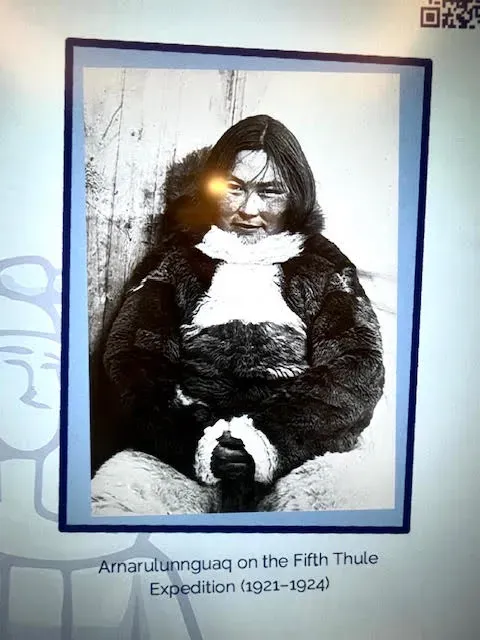
Ongoing global conversations are vital.
The forum also supported conversations about geopolitics, the United States’ fight for Greenland, and why security matters to all. What happens in the northernmost part of the world today will influence environmental stability, economic development, governance, and security far beyond the Arctic’s own borders. If you want to know what the view is from Greenland, read some of the reporting the Pulitzer Center has been proud to support.
It was clear from the two-day event that climate change is the biggest security threat to Indigenous peoples. The Arctic sits at the nexus of global climate change and environmental vulnerability. It matters to everyone around the globe, and directly impacts local communities.
Science, data, and research are critical to our understanding of what’s happening and the short-, mid-, and long-term impacts of the changes that we’re witnessing. It was fascinating to hear from Paolo Laj, chief of the Global Atmosphere Watch Programme of the World Meteorological Organization; Julia Schmale, a professor at the École Polytechnique Fédérale de Lausanne in Switzerland; Kerstin Ebell, a senior research scientist at the University of Cologne in Germany; and Mario Acquarone, deputy secretary at the Arctic Monitoring and Assessment Programme.
Observations are critical and data collection is certainly challenging in the Polar regions. Uniformity in data reporting will remain critical, and adaptations will most certainly continue to rely on Indigenous knowledge.
At the Pulitzer Center, we are seeking to deepen our support for public interest reporting in and from the Arctic. Expertise, it’s clear, is more than just knowledge. A key takeaway from the “Networks Through a Changing Arctic Geopolitical Landscape" session is that expertise is a social and relational process that supports the critical skills of framing, deep listening, and building trust. Journalism has a significant role to play in knowledge exchange and in bridging knowledge systems.
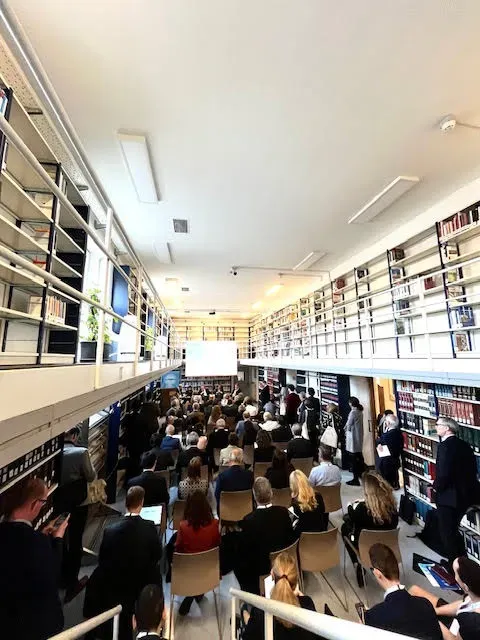
The emphasis on a multi-disciplinary approach throughout the forum was apparent. Communication, education, science, and also politics are interdependent. You can’t have knowledge without communication, and you can’t effect change without political willpower.
Chaired by Katrín Jakobsdóttir, chair of the Arctic Circle Polar Dialogue and a former Iceland prime minister, the panel—including Henry Burgess, president of the International Arctic Science Committee; David Hik, chief scientist and vice president, Research, at Polar Knowledge Canada; and Andrea Lenzi, president of the National Research Council of Italy—offered a compelling session on science diplomacy. We have more science knowledge than we’ve ever had before, and it was clear to see that a multi-disciplinary approach to the climate crisis—including, I would argue, through impact journalism—will be key.
An example of impact journalism includes the photographic work of Pulitzer Center grantee Louie Palu. Over the course of four years, Palu made more than 150,000 photos in the High Arctic, first supported by a Guggenheim Fellowship then followed by an assignment for National Geographic magazine.
The project, titled Arctic Passage, considered the history of the Arctic and the changing geopolitics of the Polar region in the face of climate change. As we stare down the very real possibility of a “blue Arctic”—one in which polar ice and snow melts to become traversable waterways—nations are competing for influence as well as for real and imagined natural resources, and northern peoples living in a territory defined by ice must find new ways to cope with their changing landscape.
People are at the center of everything. A clear and thematic point throughout the forum was the need to focus on the human dimension of climate change. “Our lives are being changed from day to day. It is happening now. Put a human face to climate change [so that] everyone feels the burden of it.”
Back to Arctic sovereignty and addressing the power imbalance, Sara Olsvig and Per-Olof Nutti, president of the Saami Council, were clear. Whilst geopolitics is important, and makes for clickable headlines, there was a feeling that the overfocus on these stories are deafening out the most urgent issue of our time.
The former president of Iceland Ólafur Ragnar Grímsson has certainly made the world sit up in the 13 years since he co-founded the Arctic Circle. Its work, now even more challenging given the intense geopolitical maneuvering, feels ever more necessary. The world needs to sit up, take note and lean in to the Arctic’s most urgent matters.
During one of the final plenary sessions, Musadik Malik, Pakistan’s minister for climate change, made a powerful case for putting evidence in the face of opinions. In Pakistan, 40 million people have been displaced, 20 million of those are of school age, which equates to 1.8 billion days of lost school time over three months.
“The glaciers are telling you the history of the future.”
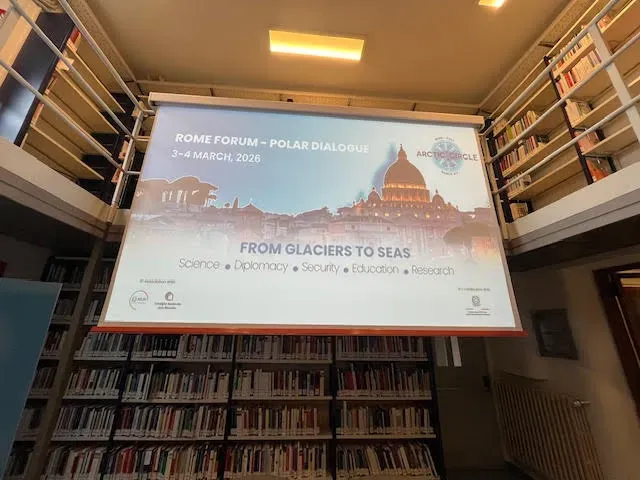
Malik went on to outline the need for a common and united approach to the Arctic. “The language of the glaciers is the language we share on all sides.”
“It’s not the rich who get devastated, it’s the poorest of the poor who live in harm’s way,” he said.
It was a privilege to represent the Pulitzer Center at the forum. It has given me vital knowledge, long-lasting connections, and made me ever more determined to push ahead on what we do best here at the Center: empowering citizens through public-interest reporting.
Breakthrough journalism doesn’t just inform. It helps people make sense of a complex, noisy, disconnected world, and discover their place in it. It bridges divides and moves people to work together to find solutions.