Other March 11, 2026
Virtual Journalist Visit on Demand: AI and Accessibility With Joanna S. Kao
Grades:


The Pulitzer Center Education team connects students directly with journalists reporting on the issues shaping our world through our virtual journalist visit program. Through virtual journalist visits on demand, we are excited to make this opportunity available to everyone by allowing educators and students to connect with journalists on their own schedule, at their own pace, and at no cost. On this page, you will find information about how to access the video recording, activities, and discussion prompts that prepare students to engage with the video, and opportunities for students to share their reflections and questions after watching.
In 2025, only 20% of surveyed students who participated in our live virtual visits reported that they had met a journalist before. Engaging directly with journalists has the power to deepen students’ understanding of global issues while strengthening empathy, critical thinking, and media literacy skills. After hearing from a Pulitzer Center-supported journalist, 86% of students reported that the story presented was important and that more people should hear about it. We also saw a 30% increase in the number of students reporting that they understand the steps a journalist takes to put together a news story after participating in a visit.
Here’s what teachers have said about the program:
“The conversation was powerful and as many students commented ‘down to earth’ to the point that they felt like journalism and media was no longer this disconnected entity that impacts their lives but something they can be a part of if they wish or at the very least, find ways to engage with it on a critical level.”
Elementary school teacher
“The opportunity to hear about these stories and take a deeper dive is so enriching for students. It fosters empathy and gets students to look critically and more deeply at a specific topic. My students always enjoy learning from the Pulitzer journalists. It is something I look forward to each year!”
High school teacher
About the Resource: Introducing Your Guest Speaker on Demand
Meet Joanna S. Kao! Kao is a journalist and editor whose work focuses on the societal impacts of emerging technologies. She leads the Pulitzer Center’s AI Accountability Network, which supports reporting projects investigating how artificial intelligence and machine learning shape communities, economies, and public life.
In this virtual journalist visit on demand, Kao discusses her Pulitzer Center-supported reporting project AI and Accessibility, which explores how artificial intelligence technologies affect people with disabilities. While AI tools are often presented as breakthroughs for accessibility, from automated captioning to assistive communication technologies. Kao’s reporting reveals that these tools can also expose serious gaps in design and data.
Her reporting highlights what some researchers call a “disability data desert,” where limited data and insufficient consultation with disabled communities can result in technologies that fail to meet the needs of the people they are intended to support.
In this conversation, Kao explains how journalists investigate emerging technologies, analyze data, and report on complex systems that influence everyday life. She also reflects on the role journalism plays in helping the public understand the social and ethical implications of artificial intelligence.
Finally, Kao answers questions commonly asked by students during virtual visits in a discussion with Pulitzer Center Education team member Jessica Mims.
After Watching Kao’s Presentation, Students Will Be Able to…
- Define artificial intelligence, accessibility, and algorithmic systems
- Explain how AI-powered tools can both support accessibility and create new barriers
- Identify why inclusive design and diverse data are important when developing new technologies
- Describe how journalists investigate emerging technologies and hold powerful institutions accountable
- Reflect on how journalism helps the public understand the social and ethical impacts of artificial intelligence
Video length: approximately 50 minutes
Appropriate audiences: Grades 4–12 (younger learners may benefit from additional introduction to key concepts such as artificial intelligence and accessibility)
How to Access This Resource
To access the video, please fill out this short form. You will receive a response with a link to view or download the video within 5 business days, along with links to three short surveys.
To help the Pulitzer Center continue making opportunities to learn about journalism and global issues accessible to students for free, we require educators sharing this video to complete the three surveys: one pre-video survey for students, one post-video survey for students, and one post-video survey for educators.
This resource is designed for K–12 students and educators, but may be accessed by other audiences. If you have questions about accessing the video or its appropriateness for your audience, please email [email protected].
You can use one or more of these activities to support students in preparing for and processing a meaningful virtual journalist visit on demand.
1. Build Journalism Awareness
Before watching the virtual visit, spend time discussing the role of journalism in understanding emerging technologies.
Discuss the following questions:
- What is journalism?
- What does a journalist do?
- How do journalists investigate complicated topics like artificial intelligence?
- Where do you usually get information about new technologies?
- Why might it be important for journalists to report on how technology affects people’s lives?
Journalism can serve many purposes. The Pulitzer Center's mission is to champion the power of stories to make complex issues relevant and inspire action. We believe that people and communities who actively engage with systemic challenges are better positioned to imagine solutions.
To explore the Pulitzer Center’s mission and the concept of underreported stories, watch the following videos:
Video: “What Are Underreported Stories?” (3:26)
This video introduces what qualifies as an underreported story and why important issues sometimes receive limited media coverage.
Video: “How to Find Underreported Stories” (6:57)
This video identifies key questions journalists ask when investigating stories that might otherwise go unnoticed.
For a deeper exploration, educators can use the lesson plan “How To Find and Analyze Underreported Stories: Critical Thinking, Text Analysis and Writing.”
2. Explore the Featured Speaker’s Reporting
A strong way to prepare students for the virtual visit is to explore the journalist’s reporting and the themes that shape their work.
In this visit, journalist Joanna S. Kao discusses her Pulitzer Center-supported reporting project, AI and Accessibility, which examines how artificial intelligence technologies affect people with disabilities.
As students explore the reporting, consider the following:
- Introduce key terms such as artificial intelligence, accessibility, algorithm, and assistive technology
- Ensure students understand the central questions guiding the reporting
- Encourage students to reflect on how technology shapes everyday life
Ask students:
- What role does technology play in your daily life?
- How might AI tools make tasks easier for some people?
- What challenges might arise if technology is designed without considering accessibility?
Encourage students to develop personal connections to the reporting:
- How might these issues connect to your community?
- Who benefits from accessibility tools?
- Who might be unintentionally excluded when new technologies are developed?
3. Investigate the Technology
To prepare for or reflect on the virtual journalist visit, invite students to think like journalists investigating emerging technologies.
Artificial intelligence tools often appear neutral or objective. However, journalists investigate how these systems are built, who designs them, and who may be affected by them.
Discuss the following questions:
- What does accessibility mean in the context of technology?
- How can AI-powered tools support people with disabilities?
- What risks might arise if accessibility is not prioritized when designing technology?
- Why might journalists need to investigate technology companies and digital systems?
Then ask students to step into the role of a journalist.
If you were reporting on AI accessibility tools:
- Who would you interview?
- What questions would you ask technology companies?
- What communities might be most affected?
- What information might companies not share publicly?
Explain that this type of questioning is part of technology accountability journalism, where reporters investigate how complex systems affect real people.
There are many ways to stay engaged after watching the virtual journalist visit on demand with Joanna S. Kao.
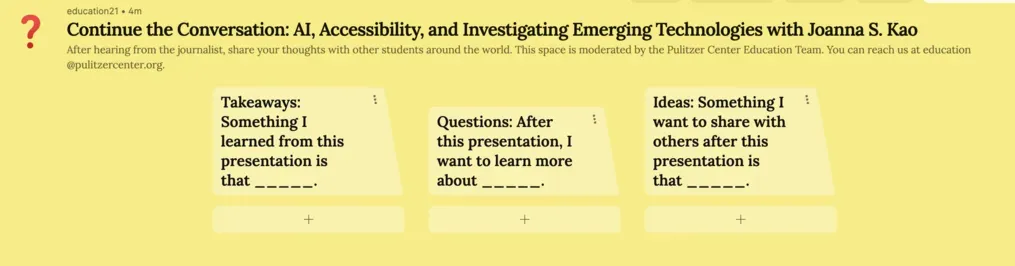
1. Share Your Reflections With Students Around the World
Visit our shared space for students and educators who have participated in this virtual visit on demand to share takeaways, questions, and ideas. Participants can respond to one another’s posts and continue the conversation about technology, accessibility, and journalism.
You will receive a link to access this optional space along with the video and required surveys after filling out the participation form.
2. Continue Exploring AI and Accessibility
Students interested in learning more can explore additional reporting from Joanna S. Kao’s Pulitzer Center-supported project, AI and Accessibility, which investigates how artificial intelligence tools can both help and hinder people with disabilities.
As AI technologies become increasingly embedded in everyday life, journalism plays a critical role in helping the public understand how these systems work and who they affect.
Students may reflect on the following questions:
- How should technology companies design tools that are inclusive and accessible?
- What responsibilities do journalists have when reporting on emerging technologies?
- What questions should the public ask about the technologies they use every day?
Encourage students to continue exploring journalism that examines the impact of artificial intelligence and other technologies shaping our world.