Pulitzer Center Update February 20, 2026
Human-Centered Climate Stories Spark Conversations in Pakistan's Universities
Country:

A dive into Pakistan's fight against climate change
Climate change is having a grave impact on Pakistan—from individuals to communities and provinces to the country overall.
I’m not a climate journalist. Twelve months ago, I wouldn’t have imagined myself covering climate change in detail. Now, I can’t stop discussing it or posting about it.
Managing news desks has taken away the precious hours in a day I would usually devote to writing about issues close to my heart. I’ve always been the kind of journalist placing the human voice at the centre of my reporting.
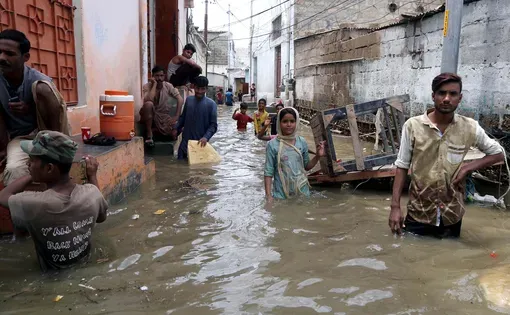
So when I took on the Can Pakistan Survive Climate Change project with the Pulitzer Center, that remained the heartbeat of my reporting plan. I spoke to people directly affected by melting glaciers, erratic weather pattern, late snowfall, heat waves, floods, and climate migration.
I started learning more about how climate change was transforming Pakistan’s landscapes and communities.
Having travelled to northern Pakistan several times as a child and carrying vivid memories of its beauty, it suddenly became impossible to ignore how much was at stake.
It began as curiosity as I dipped my toes in. Soon, I took it on as responsibility: to understand, report, and, eventually, spark conversations with young people who stand to inherit this crisis.
The aim of the reporting was to not talk about the crisis in numbers or statements. The statistics have always been add-ons, not the main story. Every statistic has a face behind it. I’ve always gravitated towards human stories—voices, lived realities, and the quiet ways people are shaped by forces.
That’s why the aim became to measure its impact through the eyes and lived experience of those who were directly affected by it or stood tall in its way, hoping to make their communities a symbol of resilience.
And when I realised that climate change really wasn’t the talk of the town—unless, of course, a massive flood hits the country—I tried that my content and reporting speak a simple language people can understand.
I spoke to researchers, journalists, and affected communities, to youth, educators, community leaders, and to politicians, ministers, and policymakers.
My climate reporting journey taught me one thing very quickly: This is not just an environmental or policy topic that should be discussed in fancy hotels, in conferences, or boardrooms. It is a deeply human story that should have a wider involvement.
And as I travelled to northern Pakistan, I realised how this is a topic ignored, one that needs a helping hand, no matter how small or soft.
Climate change is not a future threat. It is the daily reality of lost homes, ruined livelihoods, displacement, and uncertainty.
Soon after I started publishing the content, I decided to host these events aimed directly at the youth to not only create awareness but also educate them, hoping for the discussions to act as conversation starters.
The events were titled “Can Pakistan Survive Climate Change?” and were held in late November 2025 at Bahria University in the capital Islamabad and at Lahore University of Management Sciences (LUMS), a five-hour drive away in Lahore.
The goal was simple: Bring these human perspectives into spaces where young people could listen, question, and imagine their own roles in shaping the future. The aim was to start conversations that went beyond headlines and international climate summits.
Each event brought together a powerful mix of voices: journalist, researcher, analysts, experts, and climate survivors who shared their stories with remarkable honesty—bridging science, storytelling, and lived experience.
The survivors’ words spoke the loudest. Listening to them describe what they had endured— flooding, displacement, slow erosion of livelihoods, late snowfall, landslides, heat waves killing the crop, erratic weather patterns.
It was emotionally heavy but necessary because climate change affects us all. That’s why these conversations shouldn't be limited to those making decisions for people they have never met or spoken to.
The students’ reactions were equally memorable. Some shared lived experience, others thought-provoking questions—all in order to understand not just what was happening but why and what could be done.
It was also encouraging to see how many stayed back after both sessions to continue conversations, to learn more, to make contacts, to share their experiences.
Once I settled back into the office—covering wars, conflicts, and loss of human life—I realised that even though climate change still isn’t my beat or top of the priority list in the majority of newsrooms, I have a responsibility as a journalist to create space for these voices to be heard.
Empathy, curiosity, and willingness to hear people out—that’s what journalism is about. And climate change does not need more than that to start off conversations.