Story
 October 7, 2025
Analysis: Journalism in the Age of Prompts: How AI Pushes Newsrooms Deeper into an Existential Struggle for Relevance
Country:



Project
Automation Fever
The impacts of automation tools that are often glossed over by companies and policy makers
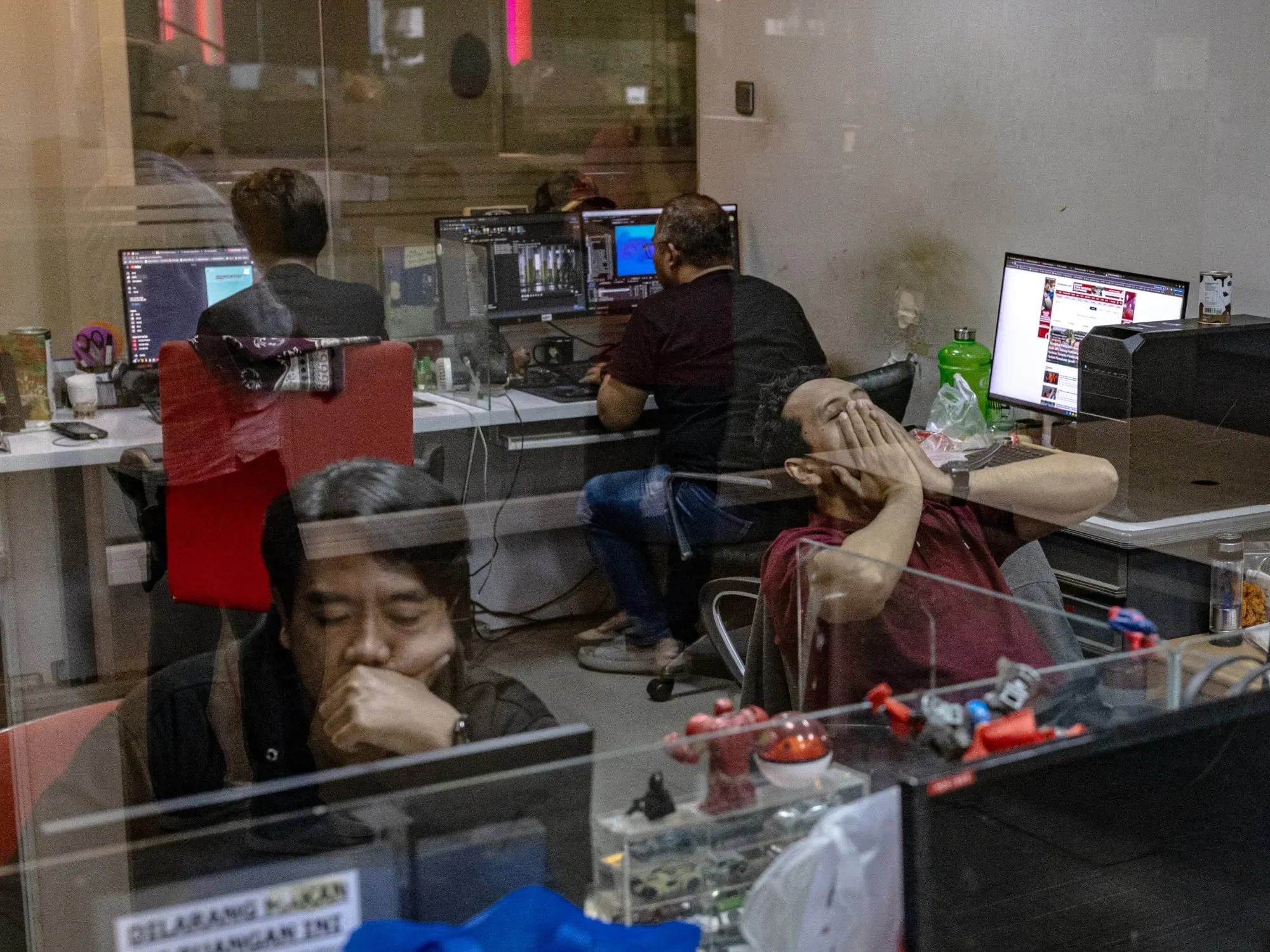
As newsrooms rush to roll out automation and partner with AI firms, they risk sinking deeper into ethical lapses, crises of trust, worker exploitation, and unsustainable business models. Stronger regulatory support is urgently needed.
This exchange reveals both the strengths and limits of artificial intelligence (AI) in today’s information ecosystem:
“Who was Affan Kurniawan?”
Affan Kurniawan (born July 18, 2004, in Bandar Lampung–died Aug. 28, 2025, in Central Jakarta) was an Indonesian online motorcycle taxi driver who tragically died after being accidentally hit and run over by a Brimob tactical vehicle during a protest near the House of Representatives building in Central Jakarta.
That was our Aug. 30 exchange with ChatGPT about Affan, whose death sparked the largest wave of public protests in Indonesia since 1998, when mass demonstrations forced the authoritarian president Soeharto to step down after more than three decades in power.
In the exchange, originally in Indonesian, ChatGPT used the prefix “ter-” with the verbs “tabrak” and “lindas“, which mean “hit” and “run over”, to describe what happened to Affan.
In Indonesian, “ter-” marks an unintentional or accidental action. By contrast, “di-” is the passive prefix used to imply intent.
In short, ChatGPT suggested that Affan was accidentally hit and then run over by Brimob, Indonesia’s elite paramilitary police unit, whereas much of the public believed otherwise.
Multiple video clips show the Brimob vehicle briefly stopping after striking Affan, as the driver appeared to be aware of an obstruction ahead, before accelerating and running over him.
Even the Indonesian Wikipedia page cited by ChatGPT used the prefix “di-“, while the English page stated that a Brimob armored vehicle “ran over and killed” Affan.
Hence, we asked once more: “Was he hit or accidentally hit?”
ChatGPT then presented multiple accounts of the incident from different parties. The police said it was an accident, while Affan’s family and many members of the public said it was not.
We pressed further: “So, who was at fault?”
Again, ChatGPT produced competing answers. The police’s account (listed first, labeled “official” by the chatbot) framed it as an accident, implying no fault on their part. Activists and many members of the public argued that the police were to blame.
ChatGPT can quickly synthesize information from multiple perspectives, but it lacks the epistemic judgment to determine which account is true. It is trained to sound neutral, yet it remains prone to bias.
Another Disruption, Another Race for Relevance
People are increasingly turning to AI for information, whether through brief, context-free summaries or personalized news tuned to their interests and beliefs.
In the 2025 Reuters Institute Digital News Report, 7% of survey respondents said they had used AI chatbots for news, with the share rising to 15% among those under 25. Indonesia, in particular, was among the top three countries most comfortable with news produced mostly by AI, behind only India and Thailand.
As people now get AI-generated information directly in search and chat interfaces without clicking through to cited sources, visits to news sites have dropped.
In May-June 2025, 19 Digital Content Next (DCN) member publishers reported a median 10% decline in Google Search referral traffic compared to a year before. DCN, whose members include The New York Times and Vox, attributed the decline to Google’s AI Overviews rollout.
For many online publishers, fewer visits mean less revenue, since advertising and sponsorship deals are tied to traffic. Even for subscription businesses, lower traffic means a smaller pool of readers to convert into paying subscribers.
If this trend persists, journalism will have less room to thrive, and the spread of low-quality AI-powered information will threaten not only democracy but also the basic functioning of society, said Sofie Syarief, a journalist and PhD candidate in media studies at Goldsmiths, University of London.
“If the exponential pace of technological development isn’t handled wisely, over time the media as an institution risks becoming irrelevant,” Sofie warned.
So far, she added, news organizations’ responses to AI disruption have been limited, largely because they have been left to fend for themselves to keep their businesses afloat.
AI isn’t the first shock to unsettle the news business. Each wave of technology has changed how people find the news and where the money goes, pushing journalists to adapt the way they tell stories and forcing publishers to rework their business models.
Following the internet’s arrival in the 1990s, print and broadcast outlets raced to keep pace with online media. Newsrooms hired SEO writers and used clickbait headlines as search engines began to shape news distribution.
In the 2010s, as social media took off, tech companies embedded AI into ranking systems to personalize our feeds and keep our eyes glued to the screen.
With feeds becoming the main gateway to information, people have increasingly consumed news and entertainment on social platforms. This has pushed news outlets to step up their presence on those platforms, competing for attention with content creators, influencers, and buzzers—paid online operatives who amplify narratives.
That’s why journalists now livestream on Facebook, join conversations on Twitter (now X), and produce videos for YouTube, Instagram, and TikTok.
Meanwhile, advertising revenue has continued to fall for news outlets, as advertisers shift spending to digital platforms run by the likes of Alphabet, Meta, Amazon, Alibaba, and ByteDance. Together, these five companies commanded more than half of global ad investment in 2024, according to WARC Media.
“Advertisers gain exposure from viral news stories, but they don’t pay the journalists who create them. Instead, they pay the platforms,” said Heru Andriyanto, managing editor of the English-language news site Jakarta Globe.
“And when platforms do pay news outlets, the share is minuscule.”
This unequal split of revenue has helped create a lopsided information ecosystem, in which global tech companies control distribution, while news organizations are relegated to mere producers.
“I don’t think the situation is fair,” said Andi Muhyiddin, editor-in-chief of Republika.
“They control the algorithms and everything else, while we get nothing.”
Consequently, the media industry had to seek new revenue streams and business models. Outlets were forced to restructure and cut costs to sustain operations, leading to relentless cycles of layoffs.
At the same time, public trust in the news continued to decline from 39% in 2021 to only 36% in 2025.
In this climate, generative AI emerged, intensifying the pressure on traditional news outlets to stay relevant.
AI’s Toll on Newsrooms
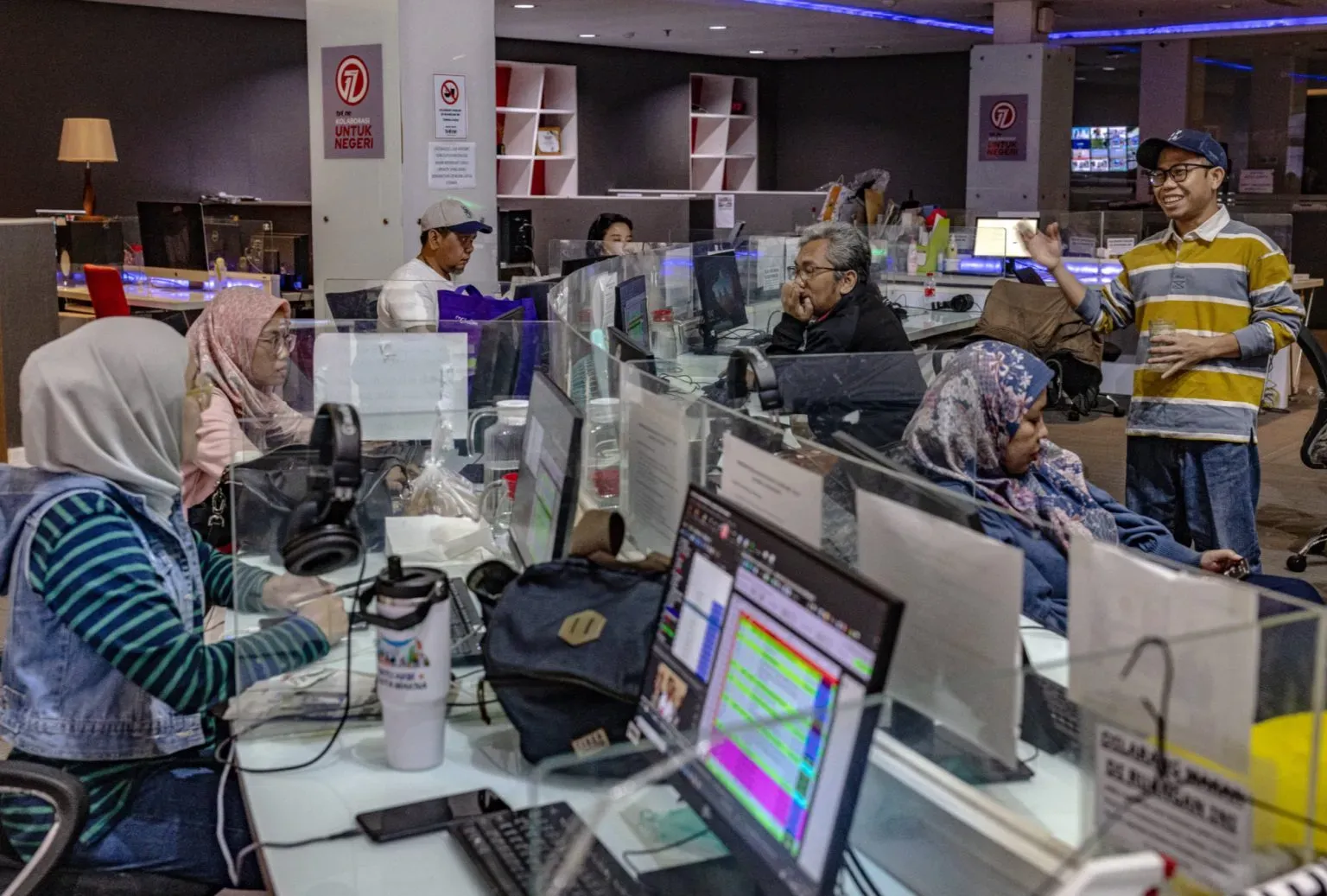
Media insiders told us that AI has, in some ways, lightened journalists’ workloads amid staff and budget cuts across the industry. Yet in increasingly automated newsrooms, AI also risks limiting job opportunities for reporters and eroding the human touch.
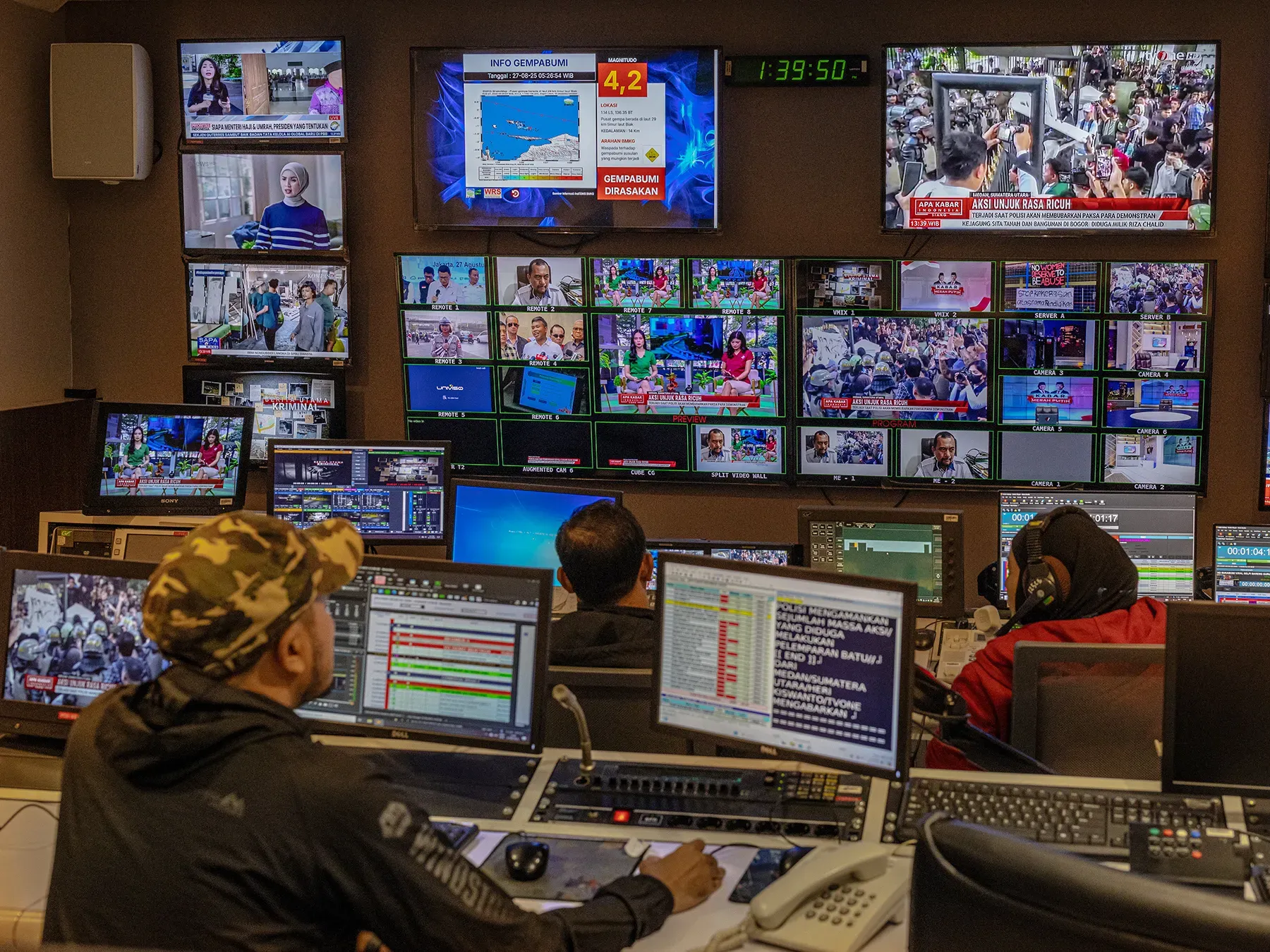
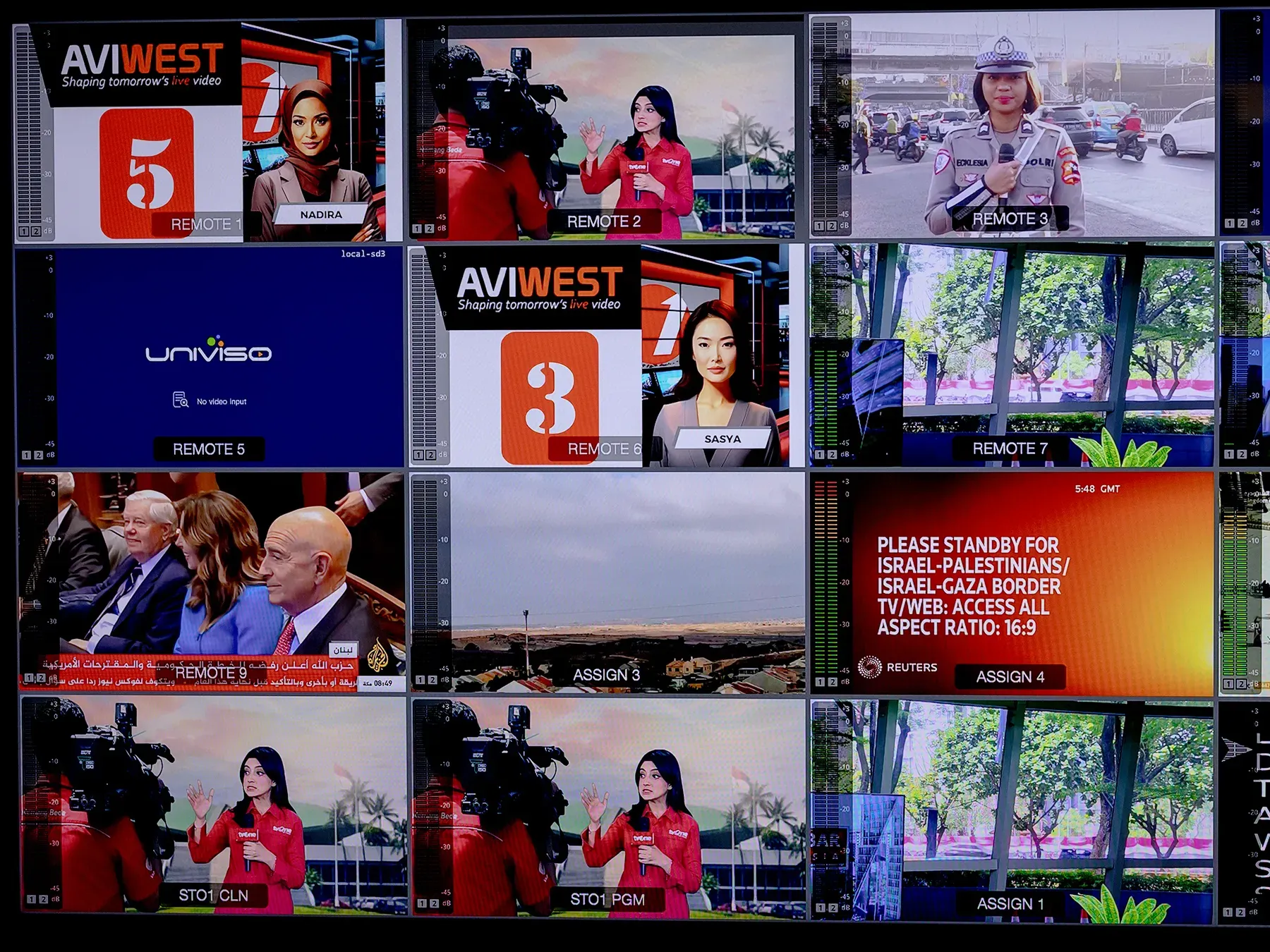
At the Indonesian broadcaster iNews, for instance, AI helps the graphics department meet production targets following a recent downsizing.
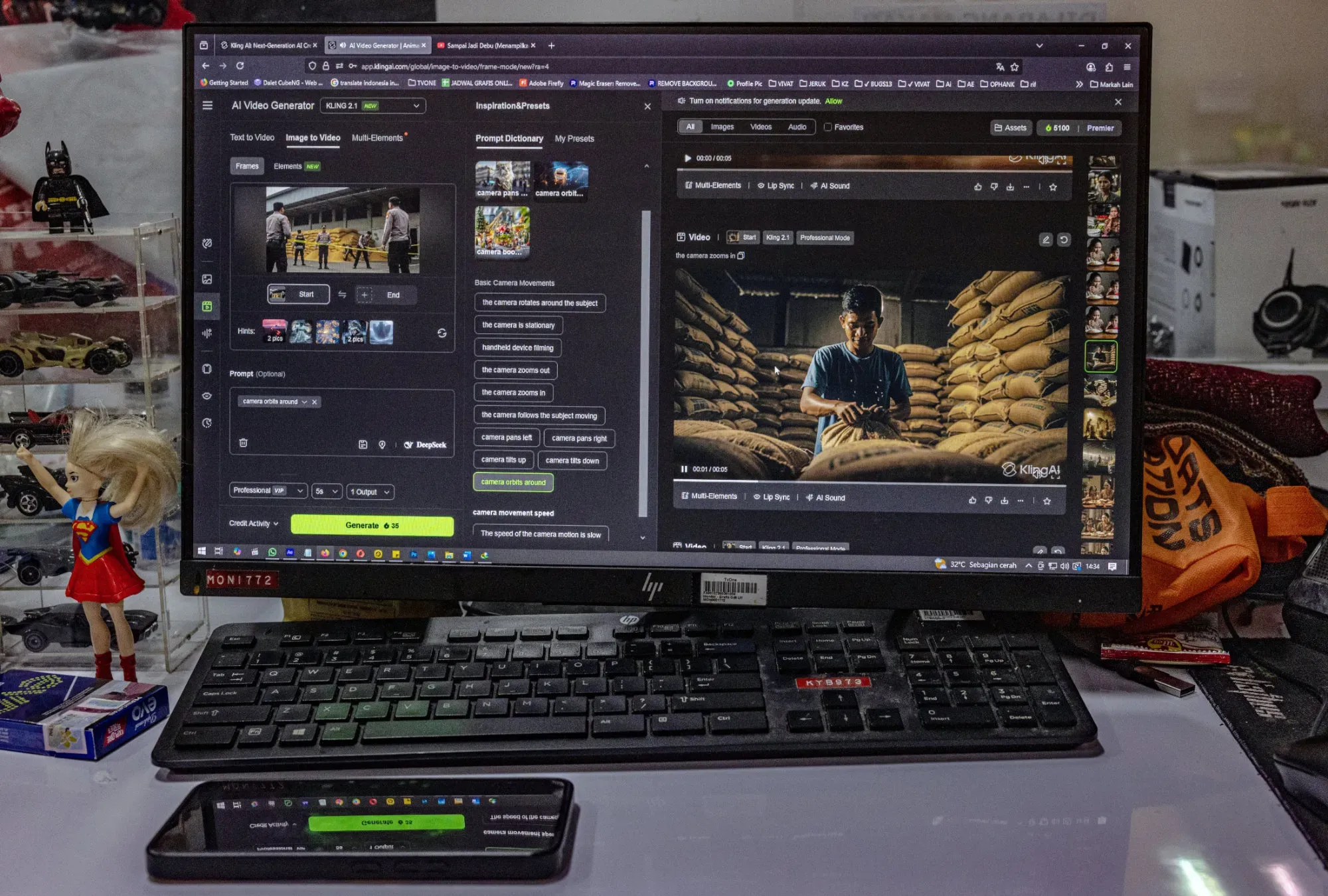
A few months ago, Nindyatmo, also known as Nino, was tasked with leading the department’s AI transition. His team now relies on tools such as Dreamina, Runway, and Envato to meet production demands.
In August, for the first time, they used AI-generated illustrations for a broadcast segment on rising fuel prices. Instead of hunting for stock images or drawing visuals from scratch, the team only needed to adjust layouts in Photoshop.
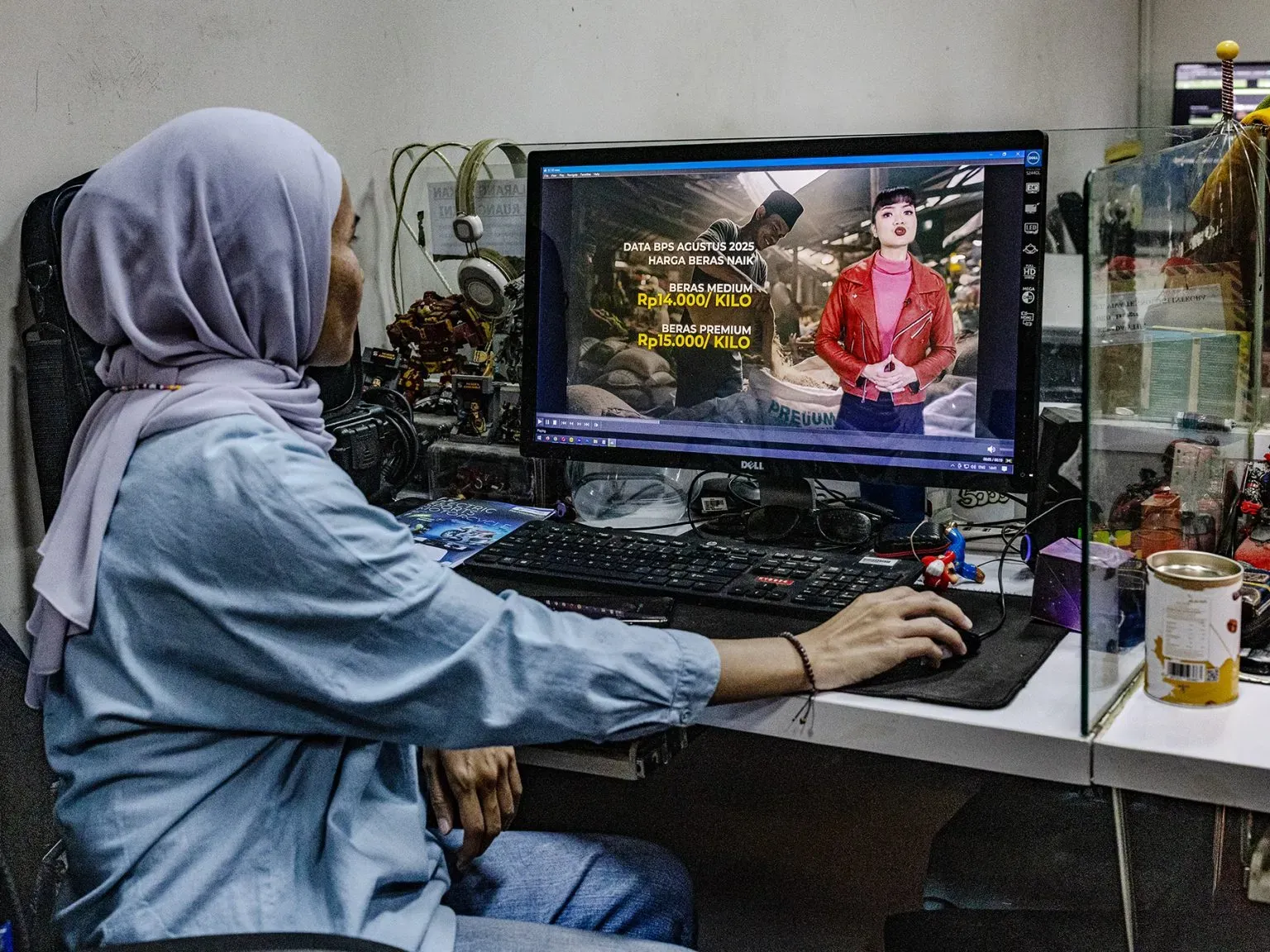
The broadcaster has also previously launched a virtual presenter and used AI to repackage TV programs into social-media content. Its Instagram account alone posts more than 20 reels a day.
“With fewer staff, we try our best not to compromise on quality. And so far, we haven’t,” said Nino, who leads a team of seven that produces broadcast graphics around the clock.
Meanwhile, at the tech-focused outlet Tech in Asia, management created a new role dedicated to experimenting with AI in the newsroom. Gilang Kharisma, formerly a data journalist, was appointed AI content builder to lead the effort.
“I was, in a way, forced to learn about AI, because I wanted to make sure there’s still a future for journalists in the AI era,” said Gilang.
“I’m afraid that if I refused to use AI entirely, one day I’d realize how much it had evolved. By then it would be too late, and I’d have missed my chance to adapt.”
To that end, Tech in Asia has launched News by AI, a collection of short articles produced with the help of automation tools such as Zapier, drawing on hundreds of press releases sent to the newsroom. These are routine, data-driven updates meant to track trends in the tech sector that the outlet covers.
By offloading these routine updates to AI, management hopes reporters can redirect their time toward pursuing “premium” stories, the kind that might attract paying subscribers.
But even for such premium pieces, Tech in Asia journalists are encouraged to use AI chatbots like ChatGPT and Gemini for brainstorming and developing story ideas.
As of 2024, at least a dozen news organizations in Indonesia have adopted AI, according to the Alliance of Independent Journalists (AJI).
One digital outlet uses AI to classify thousands of articles by the UN’s Sustainable Development Goals, while another uses Gemini to suggest alternative headlines. Another outlet has even deployed AI bots since as early as 2020 to produce routine reports on stock indexes, song lyrics, or weather updates.
Many newsrooms have embraced AI not only as a supporting tool in news production but also as a cost-effective solution amid declining revenues.
“In terms of efficiency, labor, and cost, AI offers a simpler way to handle complex tasks that once required large teams,” said Dyah Pitaloka, a professor of marketing and digital communications at Monash University Indonesia.
“You might not even need people anymore, maybe just one person to keep the whole thing running.”
As a result, newsroom downsizing is inevitable, said Masduki, a journalism professor at the Islamic University of Indonesia and a researcher at PR2Media.
“There will be a tightening of newsroom operations, with work becoming less human-centered and more dependent on tools and technology,” he said.
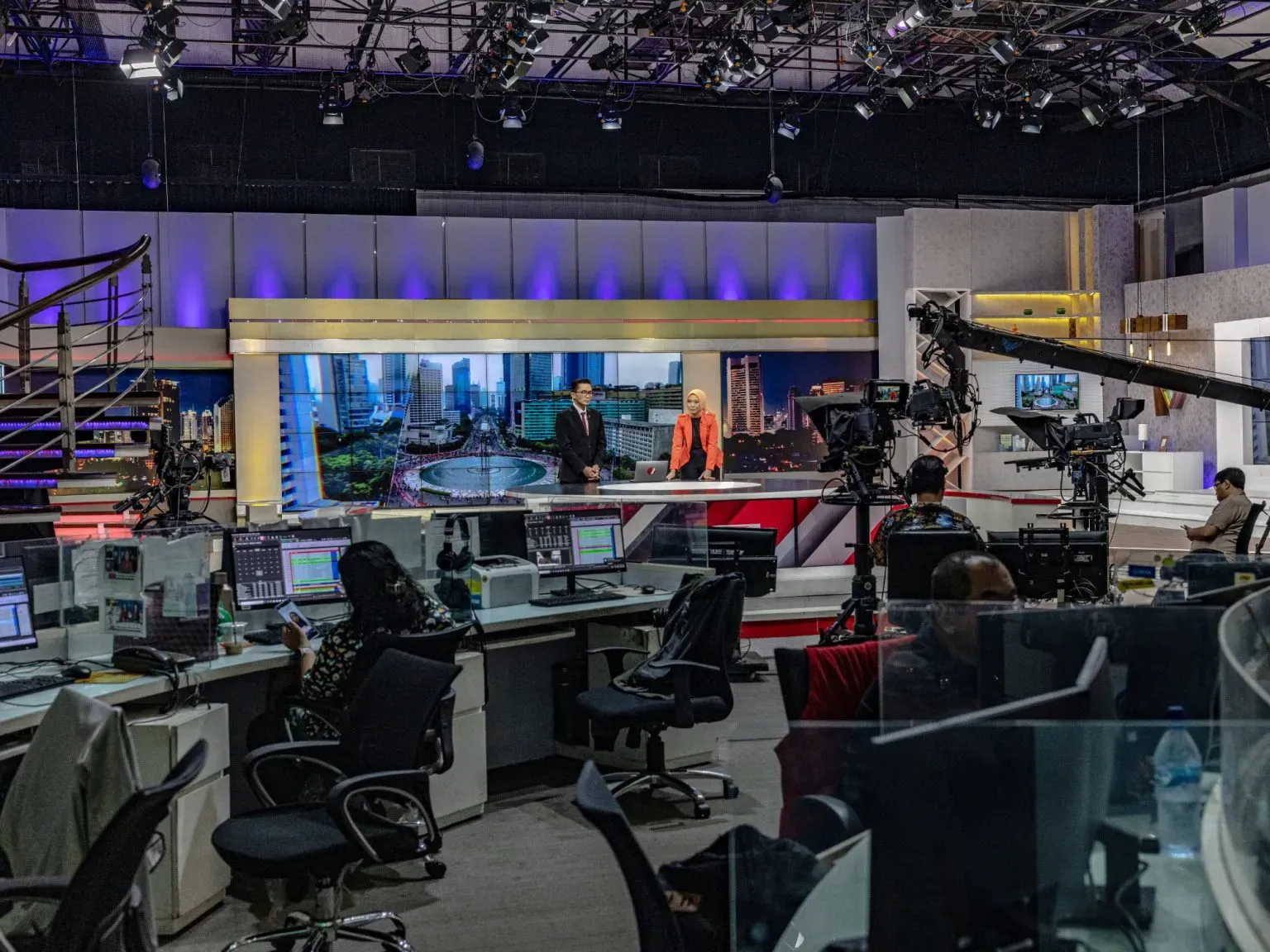
The signs are hard to miss. The rise of generative AI has coincided with waves of layoffs across the news business.
According to the Indonesian Press Council, about 1,200 media workers, including journalists, were laid off from 2023 to 2024. Meanwhile, AJI identified 2024 through early 2025 as a peak period of pressure on the media industry.
Amid shrinking newsrooms, young talents are struggling to find a way in, including Eliot Siahaan, who has waited six months for good news.
“In the past two months alone, I’ve sent out 39 applications,” said the communications graduate from Universitas Pembangunan Jaya.
“Even then, I got less than 10 interview calls. I’m starting to wonder if maybe I’m just not good enough for the job.”
Eliot has interned twice at national media outlets, once during university and again after graduating in September 2024. But after his internship ended, he watched those same outlets lay off scores of employees.

Mazaya Sofie had a similar experience. After a seven-month internship, she was not offered a position and was asked to extend her stint instead.
Realizing she might need to pivot, she began preparing to switch industries. After graduating, she paid a substantial sum out of pocket to enroll in a digital bootcamp.
“It was during that bootcamp that I realized I had, in a way, already given up on journalism,” said the journalism graduate from Universitas Padjadjaran.
Her decision soon paid off. After completing the bootcamp in February, she immediately received a stream of job offers. She never even had to use the CV she had painstakingly prepared.
Today, Mazaya works at a tech company that offers AI solutions to clients seeking to streamline their operations.
“But now I’m wondering if my job is actually helping to accelerate layoffs.”
Error-Prone Intelligence
Heru Andriyanto, managing editor of Jakarta Globe, said AI has helped his newsroom cut costs by eliminating the need to hire native English speakers. But for editorial work, he refuses to rely on it.
AI still makes basic factual errors, he said, like referring to Joko Widodo as the current Indonesian president instead of Prabowo Subianto, or listing Zulkifli Hasan as minister of environment and forestry instead of his current role as coordinating minister for food affairs.
“When AI gets those titles wrong, it means the data it draws from is outdated,” Heru said.
“So, when it comes to accuracy, it just cannot be trusted. You still see errors, misinterpretations, and sometimes even hallucinations.”
AI tools like Gemini, Grok, and ChatGPT cannot generate new or original information. They rely entirely on existing material online, including old or incomplete sources. When that material is outdated, unrepresentative, or biased, they risk reproducing the same biases and inaccuracies in their output.
A study in Indonesia found that bot journalism “fails to determine causality or formulate questions”. Another study noted that AI-generated writing “struggles to meet the principles of balance and social responsibility” that are foundational in journalistic ethics.
Therefore, we decided to test how well ChatGPT upholds journalistic balance by asking it about recent news stories. It summarized quickly but omitted opposing or balancing viewpoints.
Asked about the most important news in Indonesia on Aug. 17, 2025, for instance, ChatGPT responded with a summary titled “‘One Piece’ Flag Protest Symbol Draws Attention”.
The report framed the act as an expression of public discontent but offered no background on the flag’s use or symbolism. It concluded with an official government statement calling the flag “a threat to national unity”.
Dyah Pitaloka of Monash University Indonesia said the presence of human journalists on the ground and their understanding of social contexts are things that machines still cannot replicate.
“Technology is a tool to help journalists reach their goals,” she said. “But it could never replace their sense of social responsibility, their grasp of truth and fact, or their empathy for marginalized communities.”
Heru of Jakarta Globe emphasized that news is the product of journalistic depth and reflection, and not mere content.
“We are not in the business of selling shoes or clothes. Those can be made by machines. But that is not the case with news,” he said.
Despite those cautions, tightening budgets and a push for efficiency mean many newsrooms are automating more of their workflow and relying less on human reporters. For freelancers, this shift is starting to bite.
Brian, not his real name, has worked as a freelance journalist for an international news agency for six years. He feels his office has become increasingly dependent on AI.
In March 2025, his company rolled out Gemini Pro subscriptions for all permanent employees. It also entered into a deal with Perplexity AI to provide Pro access to all staff members.
Moreover, Brian has been sent into the field far less often. In the past, he could be assigned to cover stories across Indonesia. Now, he reports mostly around Jakarta. Last year, his pitch to cover the Aceh tsunami commemoration was rejected due to budget constraints.
“I’m afraid they’ll start relying on AI instead of field reporters, because they assume that AI can simply fill in and add context to the story, which is normally done by sending people out in the field,” he said.
“So, maybe one day they won’t need reporters on the ground at all. They might just lift stories from local media and extract their data.”
Bargaining with the Machine
In June 2025, major Indonesian outlets Tempo, Kompas, Republika, and Hukumonline announced a partnership with tech company GoTo and telecom operator Indosat to develop a large language model called Sahabat-AI.
Under the partnership, the media organizations have agreed to grant access to their journalistic archives for use in Sahabat-AI’s model development. In return, the outlets receive server capacity and staff training for building AI features on their own platforms.
For Tempo, widely known for its investigative work, this means unlocking its digital archive of articles, photos, and documents dating back to 2001.
“AI developers need a steady supply of fresh data to reduce hallucinations, bias, and other errors in their models,” said Heru Tjatur, chief technology officer at Tempo.
This ongoing demand for data, he added, ensures news organizations will continue to have a role in an ecosystem largely shaped by tech companies.

Partnerships between media and tech companies are growing following accusations that many AI developers have trained their models on copyrighted works. Globally, at least 26 news organizations now share their data with companies such as OpenAI, Microsoft, and Perplexity.
However, Sofie Syarief of Goldsmiths, University of London, argues that media companies should place greater value on their copyrights, archives, and decades of reporting.
“If all they get is server capacity and technical assistance, it’s media companies that stand to lose,” Sofie said.
She criticized how easily news organizations concede in such deals. Many seem to have internalized the belief that they can’t stand up to tech giants and thus operate on the assumption that “a few crumbs are better than nothing”.
“It’s short-sighted, when what’s needed is a long-term strategy,” she added.
These partnerships also raise ethical questions, said Dyah Pitaloka of Monash University Indonesia.
She said media outlets often report on vulnerable communities, yet the knowledge derived from those stories is then monetized by AI companies, embedded into their systems or sold to third parties for a range of purposes.
This means the people whose stories are reported have no say over whether their experiences are handed to AI companies for further processing or monetization. Their right to decide has been taken away.
Sofie echoed Dyah’s concerns.
“It raises a serious question,” Sofie said.
“Does our responsibility to uphold journalistic ethics end at publication, or does it extend to how that work is later processed, reused, and repurposed by third parties? We need to think this through carefully.”
Besides partnering with AI firms, some media organizations are experimenting with building their own AI systems.
Republika, for instance, has developed Aiman & Aisha, a chatbot designed to answer questions about Islam.
Users might ask, “Is it permissible to perform qurban if one hasn’t undergone aqiqah?” or “Given different methods for determining the Hijri calendar, how should Muslims navigate these differences?”
Unlike most chatbots trained on large datasets scraped from the internet, Republika limited Aiman & Aisha’s training data to the Ministry of Religious Affairs’ official publication of the Qur’an. The system is still being refined and has not yet been released to the public.
“It still hallucinates,” said Andi Muhyiddin, editor-in-chief of Republika.
“Sometimes the verse it cites is wrong, even if the explanation is correct. We don’t want to risk creating unnecessary controversy.”
While joining the AI wave, newsrooms are also grappling with AI crawler bots scraping their sites without permission or compensation.
According to Webflow, AI bot activity surged by 125% in the first half of 2025, driven largely by the millions of people prompting chatbots like ChatGPT every day.
Heru of Tempo, who also serves as head of information technology at the Indonesian Cyber Media Association (AMSI), said these bots are straining online news infrastructure. He estimated that 20-30% of infrastructure costs now go solely toward serving AI bots.
AMSI is currently reviewing a pay-per-crawl system via Cloudflare and OpenMind, which would require AI companies to pay each time they extract data from a news site. Still, implementing this model would require significant investment from media companies.
At its core, Heru said media companies need to figure out how to value their data and set a price for the AI developers who use it.
Partnerships, proprietary AI models, newsroom automation, and pay-per-crawl initiatives all reflect the news industry’s attempts to strengthen its bargaining position with tech companies. Yet with minimal government intervention, these efforts remain largely technical fixes and short-term strategies.
A similar pattern of short-term responses emerged during the earlier wave of digital transformation, when news organizations followed rules set by tech giants rather than creating their own.
When advertising was measured by clicks—standards defined by the platforms, media companies “adapted” by acquiring more online outlets, slicing stories into shorter pieces across multiple pages, and demanding that journalists produce faster and more frequently to chase traffic.
The idea was that more web pages would generate more views, which in turn would maximize profit.
The result was an explosion of content that diluted the value of news. The pressure to prioritize quantity and speed over depth and accuracy meant sacrificing information quality. Journalism then found itself jostling for attention in an increasingly crowded and ruthless digital space.
Learning from that experience, both observers like Sofie and industry insiders like Heru argue that confronting AI’s disruption will require not only technical innovation but also a political solution: stronger regulatory support from the government.
Policy and Power
So far, the government’s efforts to create a fairer information ecosystem remain limited.
One example is the establishment of the Publisher Rights Committee in 2024, tasked with negotiating revenue-sharing agreements between tech platforms and media organizations.
After a year, the committee issued the Publisher Rights Guidelines, which include a requirement for platforms to “help prioritize the facilitation and commercialization of news produced by registered press companies”. Two months later, Google announced a partnership with 34 news outlets.
But the problem isn’t solved. As experiences in Canada, South Korea, and Australia show, tech companies still hold the upper hand. They can always threaten to shut down operations and walk away.
That is not a scenario the committee wants to risk, said Sasmito Madrim, a committee member representing the Press Council.
“We’re always trying to find middle ground. If the platforms pull out of Indonesia, many media companies could collapse,” said Sasmito.
In Indonesia, Meta has stated it will not pay, arguing that nearly 90% of news content is voluntarily posted by publishers on its platforms.
Instead, Meta chose to sponsor the 2025 World Press Freedom Day event organized by the Publisher Rights Committee in Jakarta. In a similar vein, Google ran a series of training programs for journalists focused on fact-checking.
Most recently, the press community has been advocating for the creation of the Indonesian Journalism Fund, an endowment supported by the state budget, private philanthropy, and contributions from tech companies. It is intended to help sustain independent media in the digital era. A similar model is already in place in South Africa with Google’s support.
Yet once again, sponsorship ties complicate the relationship. Media organizations are increasingly positioned as firefighters, tasked with cleaning up misinformation and disinformation on digital platforms, while tech giants largely escape accountability.
The rise of generative AI has only reinforced the logic of those algorithms. Beyond its potential to amplify misinformation, a recent Indonesian study found that generative AI also drives the production of instant, viral content, prioritizing virality over substance.

Masduki of the Indonesian Islamic University described the media’s transition into the AI era as “deeply flawed”, citing weak government support and the industry’s inability to agree on fair financial and revenue-sharing models.
“This all depends on how the media positions itself in relation to hegemonic digital platforms,” he said.
Beyond calling for stronger government intervention, Sofie Syarief of Goldsmiths, University of London, argued that the media industry should stop seeing itself as powerless before big tech companies. She believes the press still has leverage to strengthen its position.
First, by mobilizing cross-sector efforts to challenge unchecked platform dominance. Second, by using the influence of editors-in-chief and media owners within government to advocate for journalism’s interests in policymaking.
And third, by fulfilling the press’s public role of educating audiences about tech giants’ growing control over daily life. This work requires more critical, investigative coverage of the tech industry.
“Educating the public is a long-term endeavor, and I think it’s often undermined by the lure of short-term profit. On the other hand, many media companies simply aren’t thinking that far ahead,” said Sofie.
Sofie also suggested that the public should start seeing journalism as a common good, a public right on par with education and healthcare, rather than a commodity to be sold.
Such a shift, she argued, is essential if society wants to design new financial models that free the media from dependence on advertising and tech giants.
In her view, Indonesia’s efforts to challenge digital monopolies remain fragmented, cautious, and half-hearted. By contrast, in other parts of the world, negotiations with tech giants are conducted collectively across sectors and even across countries, as in the European Union.
“If I were in a position to make policy at a major media organization… I would bring together every institution affected by digital platforms,” she said.
“If we want a fair shot at standing up to them, perhaps ASEAN countries should unite and confront these companies together.”
In the Philippines, Maria Ressa, editor in chief of Rappler and a 2021 Nobel Peace Prize recipient, has spent years calling for stronger regulation to prevent the total collapse of journalism.
She has questioned why tech giants are not regulated as tightly as the pharmaceutical companies, even though their products can have comparably serious effects on society. Ressa has also asked why the social costs of technological “innovation” and experimentation should be borne by ordinary citizens and governments.
As media organizations adapt and negotiate to survive, whether in response to artificial intelligence or future waves of technological disruption, they are expected to remain committed to the public good and to prioritize long-term needs over short-term gains.
And those who influence policy are urged to support this principle.
“Regulators must have the courage to confront the tech giants,” said Gilang Kharisma, Tech in Asia‘s AI content builder.
“I hope companies such as Google, OpenAI, and others are finally held accountable.”
Note: GoTo said it was willing to respond to our questions but had not provided answers by the time of publication.
This piece, originally published in Indonesian, was translated by Rara Rizal. The English-language editor was Viriya Singgih.


