


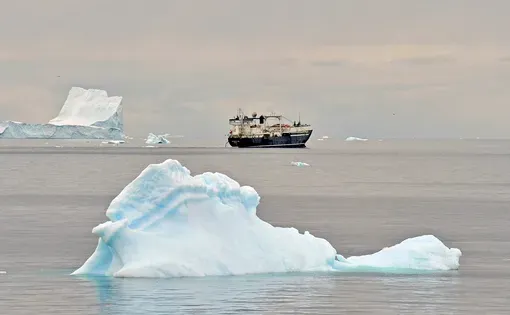
Norwegian and South Korean boats are fishing hard for Antarctic krill.
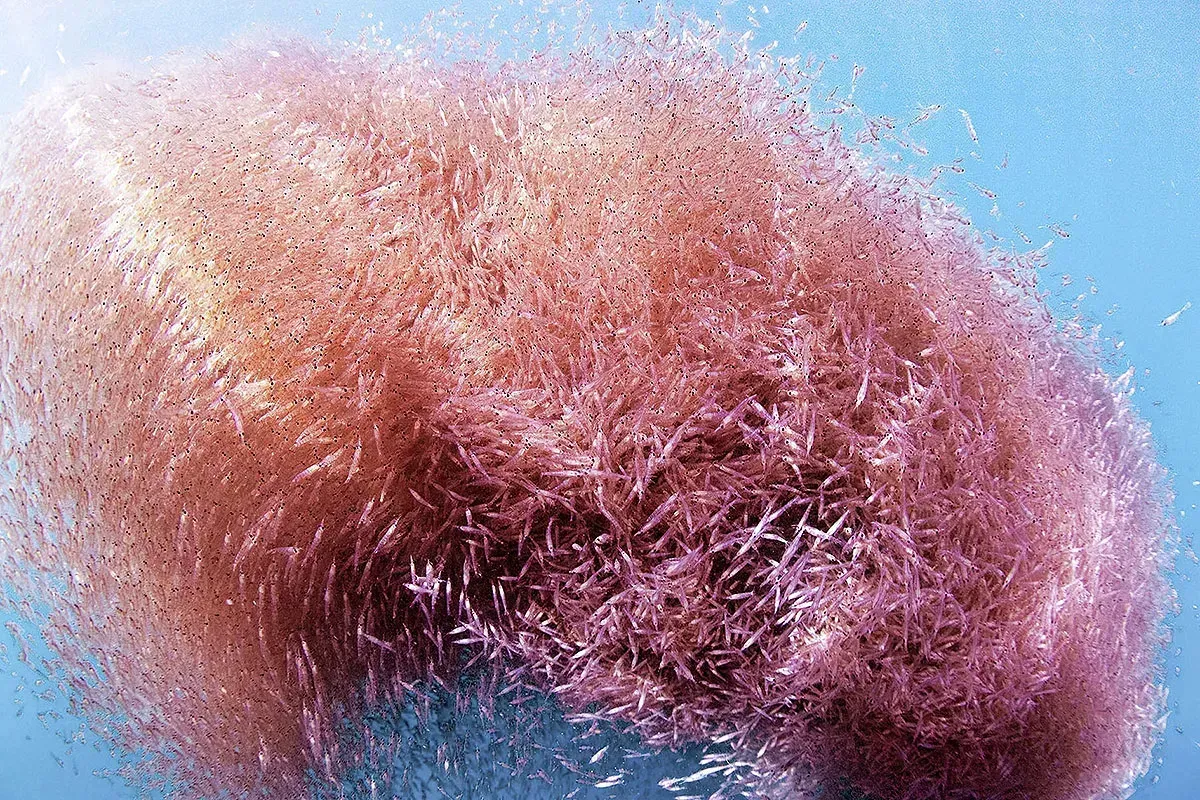
Antarctic krill, a tiny crustacean whose dense shoals (pictured) can be seen from space, are targeted for harvest because they produce an oil that humans love, and which is also used to fatten salmon. The guild is paid by whales, seals and penguins.
Read this story in Dutch, Russian, and Serbian.
The wind whips the foam off the waves of the Strait of Magellan, the famous sea route around South America. Anchored in the Chilean port city of Punta Arenas "Antarctica Endeavor," a fishing vessel almost as long as a football field. It will soon embark on a 1300-kilometer journey through the unforgiving Drake Passage to the icy waters off Antarctica.
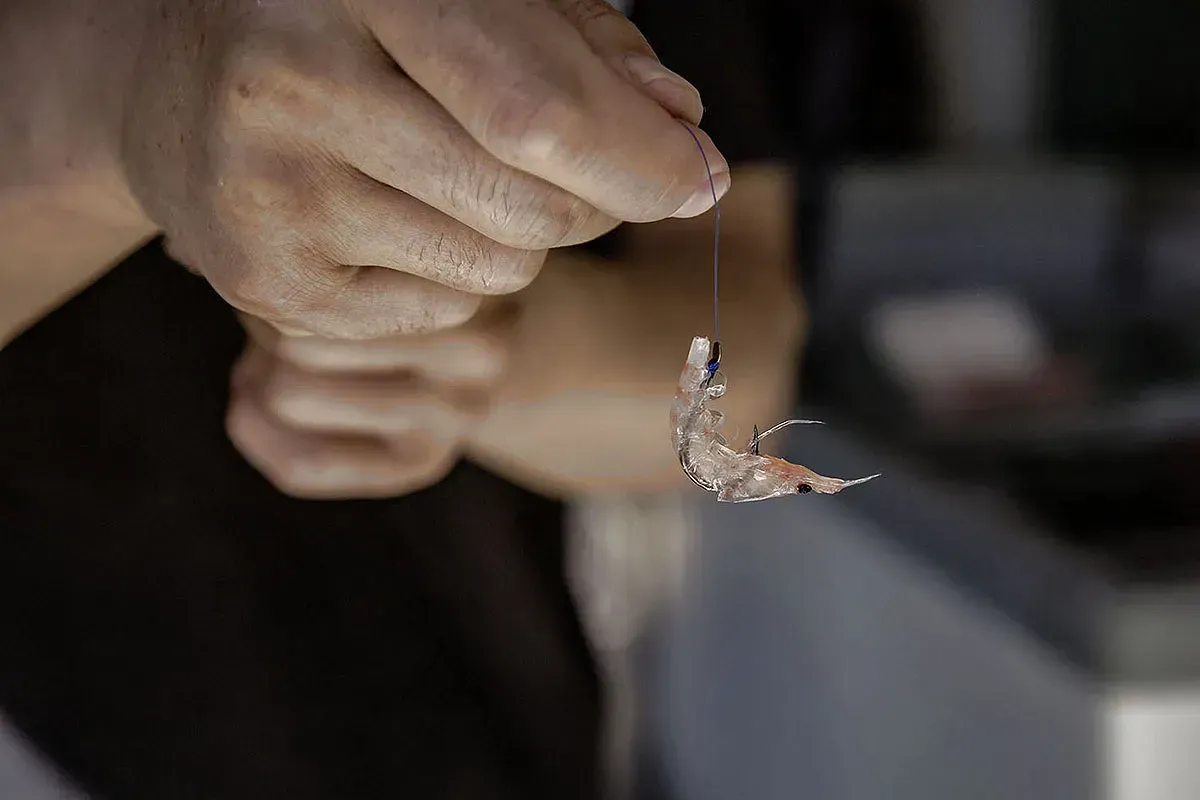
There swarms a precious thing smaller than a little finger - krill. It is a crayfish that resembles a shrimp in shape, but tiny, two to six centimeters in size, a creature from the bottom of the food chain.
But the crew must hurry because they are not the only ones. In these remote waters, the rule applies - the first to arrive, the first to catch. Fleets from Norway, China, South Korea and Ukraine will pull at least half a million tons of krill from polar waters these months. Thus, they will steal food from penguins, lipped whales, crustacean seals and sea birds. Krill is the main fuel of this giant food chain.

As a nonprofit journalism organization, we depend on your support to fund more than 170 reporting projects every year on critical global and local issues. Donate any amount today to become a Pulitzer Center Champion and receive exclusive benefits!
And the man wants this crayfish. And why? Mainly to feed farmed salmon with it - because krill makes salmon meat pink, and consumers want that. Pale salmon is considered less valuable. And also because krill is rich in omega-3 fatty acids, which people use as a dietary supplement or in cosmetics.
They say that the krill oil market alone will be worth $3,6 billion a year in ten years.
Null commission
The history of krill fishing begins in 1946, when the war had just stopped when the Soviet ship "Slava" set sail from Odessa, armed with harpoons - to hunt whales. It's the first time he's gone that far. After about fifteen years, they started hunting for krill there, on the tip of Antarctica.
The Commission for the Conservation of Antarctic Living Resources (CCAMLR), which includes 27 countries, has had a krill catch quota of 620.000 tons per year for decades. It refers to the area where hunting generally pays, between South Georgia and the South Shetland Islands off the Antarctic Peninsula, the tip of that continent that seems to stretch out towards Chile and Argentina.
And that area is divided into four sectors, so that the entire quota is not caught in one. Because krill can be dense, 30.000 shrimp in a cubic meter of water, on hundreds of square kilometers. Since it sparkles, it can even be seen from space. And the ships pick it up easily, leaving nothing for the animals.
But that division into four sectors last October went down in history. At the CCAMLR session, which took place in the bickering between Russia and Ukraine about the war and Britain and Argentina about whose Falkland Islands they belong to, the division into sectors was not extended. Now 620.000 tons can be fished from the same place. That still sounds like nothing compared to over two hundred million tons of krill throughout the waters around Antarctica. But to the penguins and seals that live in this very area, that can be anything.
"That quota is risky anyway," says Ryan Reisinger of the University of Southampton. "We can see from the maps where the fishing is going - a lot of catches in a small area leaves very little room for whales and other animals."
In a southern Chilean port, colorful huts are printed as if protecting each other from the winter. Punta Arenas is the gateway to Antarctica, fishermen, but also research missions and tourists ready to pay 20.000 euros each just to see icebergs and whales up close.
A white colonial building houses the Chilean Antarctic Institute (INACH), where they are particularly proud of their krill research. Marine biologist Cesar Cárdenas studies the impact of climate change on shrimp here, where glaciers are melting and ice sheets are breaking up. The period of winter, when sea ice grows, has been shortened by almost three months in half a century. Less ice and warmer seas means less food for the krill - it eats algae from the underside of the ice.
In addition, this animal is useful for preserving the climate. Plankton absorbs carbon dioxide, and krill eats plankton, and through its excrement and its sinking skeleton, it annually pushes up to 23 million tons of carbon dioxide into the depths of the sea. Admittedly, man quickly "makes up" for all that - let's say tiny Serbia emits two to three times more carbon dioxide than that.
Man as the great predator
The business of the Norwegian biotechnology company "Aker Qrill Company" brings bad days for krill. It is part of the giant Aker Group, which belongs to billionaire Kjell Inge Rokke. Aker catches about 300.000 tons of krill a year in Antarctic waters, which is 60 percent of the total catch of these shrimps.
"Last year, 498.000 tons were caught, the highest amount ever. I fear that the entire quota of 620.000 tons will be exhausted this season," says marine biologist Cardenas, who also heads the scientific council at CCAMLR. This year, he fears for whales, penguins and seals near the Antarctic Peninsula.
These animals are in competition with "industrial superpredators", says Matthew Savoca, a scientist from Stanford University. There are bigger and more efficient ships on the open sea, they have acoustic sensors that find the densest flocks of wings. "We are human predators in a system in which there are fewer wings than before," says Savoka.
And again the whale could get hurt. That largest mammal on the planet was almost exterminated until hunting was banned in 1982. Bans are not observed by Norway, Iceland and Japan. Whales in these waters only feed for a hundred days and then eat a third of their weight - every day. That's three tons of wings per day.
"If they don't have enough food during that time near Antarctica, they won't be able to accumulate the fat they need for the long migration to the mating area," says Savoka. Then the chances of reproduction drop dramatically.
Since everything in nature is connected and meaningful, the fact that man almost destroyed the whale population did not help the wing, on the contrary. It is believed that there are fewer crayfish the less the main predator, the whale, because the iron from the excrement of the whales improves the plankton, which in turn is food for the krill.
Kings of wings
When the dense nets retrieve the wings from the sea, they are immediately frozen on special ships or processed into flour from which the oil is later extracted. The Norwegian company Aker lives on it.
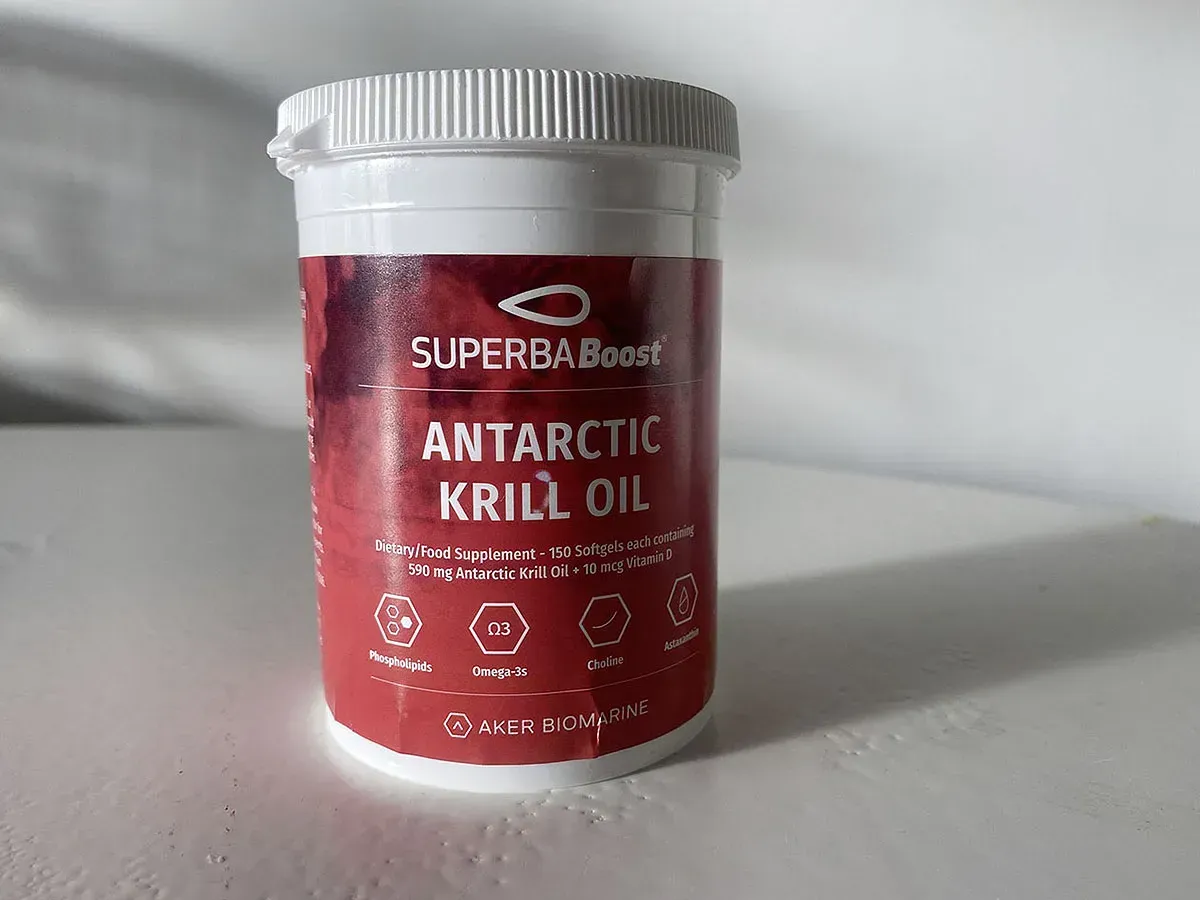
Their five-story building in Oslo shimmers in the sun like a futuristic iceberg. In the meeting room, there are red krill oil capsules on the table, and behind the desk is Pal Skogrand, who is the sustainability manager here. The capsules are advertised as an "ecological premium product from the pristine waters of Antarctica". And they say that they are excellent for human skin, immune system and heart. When people talk about it on forums, when the topic is picked up by influencers on social networks, it is often heard that krill cures PMS in women and even tumors. "We wouldn't go to the other side of the world if krill didn't have an extraordinary composition that makes it interesting for various applications," Skogrand tells us. Admittedly, there are wings closer to Norway, but this Antarctic one is ten times fatter and therefore more profitable.
After criticism, Aker voluntarily stopped "vacuuming" krill in zones 30 kilometers from penguin colonies. Every year, a few whales end up in krill nets and end up like that. Still, it's all worth it, Skogrand says, as demand for fish and seafood is growing, and krill is an exceptional food for farmed marine creatures.
"When you look at the proportion of biomass used, there is no more sustainable fishing than this with krill", he says.
Critics like Matthew Savoca are not convinced. "Kril products will not solve world hunger or human nutrient deficiencies. Those who eat healthily do not need additional omega-3 fatty acids," he says. "If we want to sustain the Antarctic ecosystem - for penguins, whales or the world's climate - we simply shouldn't be fishing there."
Ideals of beauty
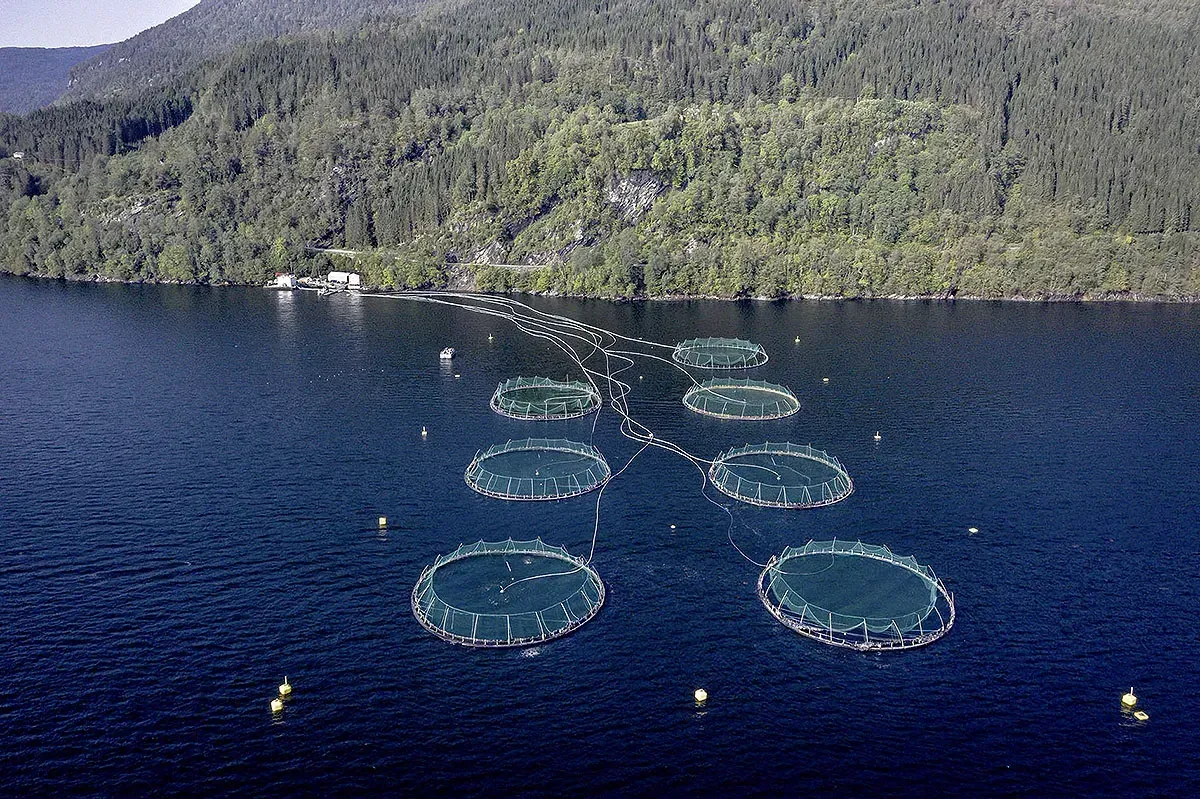
In the krill industry, it is rarely talked about that this shrimp actually suffers in order to fulfill the artificially created "ideals of beauty" of people. A few hours' drive from Bergen, Norway, the road winds around the Hardanger Fjord. The coves are deep blue and the studded salmon farms are circular. Norway is the largest exporter of farmed salmon, with 1,2 million tonnes. The plan is to have five million tons by 2050.
The idea itself is not silly - the farming of salmon, one of the most popular fish in the human diet, was supposed to prevent overfishing of wild salmon. But even in these sea ponds there are problems, parasites spread easily. The fish know how to escape from the cage, then they mix with the wild salmon. In 71 percent of Norwegian rivers, wild salmon are already genetically contaminated.
Salmon is a predator. In the cage, it is fed with a mixture of fish meal and oil, soy, pea and grain proteins, along with vegetable oil and krill meal. Namely, krill contains astaxanthin, a natural antioxidant that gives salmon its characteristic pink color. It is, therefore, about the aesthetics of fish that is considered a delicacy.
"It's the stupidest thing in the world - giant ships, which burn fossil fuels, go from Norway, China and South Korea to the end of the world to steal food from whales, seals and penguins, if only to make our salmon nice pink", says Savoka.
But it can be even more stupid than that. Yuwan Noh is a man who loves his job, the head of the company "BioCorp" in Goheung, in the very south of South Korea. In their building, you can see the manically clean pipes and large canisters in which the krill are processed through the glass-enclosed office. The main thing is oil. What's left goes into salmon feed.
Noh boasts an oil extraction process that it says is better absorbed by the human body than regular fish oil. "When people eat krill oil, it doesn't leave that fishy smell. If you eat and burp, the fishy smell doesn't come out of your mouth because the oil is absorbed. In South Korea, people don't care, but that's why the oil is popular in North America."
False advertising
But in Korea, people care about other things. So even seven or eight years ago, a range of products flourished that were praised because they contained krill oil - pills, creams, even dish detergent.
The whole country went crazy for the wing, and it became the essential fuel of the so-called K-beauty industry, which makes money from the ideal of beauty. Korean cosmetics are believed to keep the skin fresh, hydrated and exquisitely pale.
But that stopped at the end of 2020, when the authorities banned a number of products with wings because they had some substances in a greater amount than prescribed. Consumers recoiled. The Ministry of Food and Drug Safety announced that krill oil has no health effects and can only be considered as food.
"That's how it was all over," says Noh. "Orders have dropped to a twentieth of what they were, to tell you the truth. We no longer have domestic demand."
But they have demand from outside. The director says they export 99 percent of everything they produce.
On websites that monitor the movement of ships, the red arrows of fishing boats around the Antarctic islands are clearly visible. Those factories on the water are still there, vacuuming up the krill. Then they will go to ports, thousands of kilometers away. And they will come back again, while there is something to catch.
Translated by Nemanja Rujević