Other December 3, 2025
Virtual Journalist Visit on Demand: 'The End of USAID' With Molly Knight Raskin
Grades:

The Pulitzer Center Education team connects students directly with journalists reporting on the issues shaping our world through our virtual journalist visit program. Through virtual journalist visits on demand, we are excited to open this opportunity to everyone, making it possible for educators and students to connect with journalists on their schedule, at their own pace, at no cost. On this page, you'll find how to access the video recording, activities and discussion prompts that prepare students to engage with the video, and a place for students to share their takeaways, opinions, and questions with one another after they watch.
In 2025, only 20% of surveyed students who participated in our live virtual visits had met a journalist before. Engaging with journalists has the power to deepen students' knowledge about global issues, strengthen their empathy, and sharpen their critical thinking and media literacy skills. After hearing from a Pulitzer Center-supported journalist, 86% of students agreed that the story presented was important, and more people should hear about it. We also saw a 30% increase in the number of students reporting that they understand the steps a journalist takes to put together a news story after their visits. Here's what teachers have to say about the program:
The conversation was powerful and as many students commented 'down to earth' to the point that they felt like journalism and media was no longer this disconnected entity that impacts their lives but something they can be a part of if they wish or at the very least, find ways to engage with it on a critical level.
Elementary school teacher
The opportunity to hear about these stories and take a deeper dive is so enriching for students. It fosters empathy and gets students to look critically and more deeply at a specific topic. My students always enjoy learning from the Pulitzer journalists. It is something I look forward to each year!
High school teacher
About the Resource: Introducing Your Guest Speaker on Demand
Meet Molly Knight Raskin! Knight Raskin is a freelance journalist who writes and produces for television, documentary films, and newspapers. Her producing credits include reports for PBS NewsHour and the investigative documentary program FRONTLINE. Her documentary film credits include series for Netflix, National Geographic, and A&E.
In this virtual journalist visit on demand, Molly Knight Raskin dives deep into her Pulitzer Center-supported reporting project, Cuts and Consequences: The End of USAID, which aired on PBS NewsHour. The project documents the impact of the Trump administration’s decision to shut down the U.S. Agency for International Development (USAID), the agency responsible for distributing more than $40 billion a year to over 100 countries globally. She also explains how she reported this story on the ground in several countries on the African continent, and illuminates her job as a freelancer journalist. Finally, Knight Raskin answers some of the questions students most frequently ask during virtual visits through a Q&A with Pulitzer Center Education team member Jessica Mims.
After watching Knight Raskin's presentation, students will be able to...
- Define foreign aid, USAID, and international development
- Explain the goals of foreign aid and how countries can benefit, both as providers and recipients
- Identify several impacts of the decision to shut down USAID and suddenly withdraw large portions of foreign aid
- Understand the steps a journalist takes to put a news story together
- Describe what a freelance journalist and an underreported news story is
Video length: 52:16
Appropriate audiences: Grades 4-12 (younger learners may require more introduction to the concept of foreign aid and comprehension check pauses during the video)
How to Access this Resource
To access the video, please fill out this short form. You will receive an automated response with a link to view or download the video, and links to three short surveys.
To help the Pulitzer Center continue making opportunities to learn about journalism and global issues accessible to students for free, we require all those sharing this video with others to complete the three surveys: one pre-video survey for students, one post-video survey for students, and one post-video survey for educators.
This resource is designed for K-12 students and educators, but may be accessed by other audiences. If you have questions about accessing the video or its appropriateness for your audience, please email [email protected].
You can use one or more of these activities to support students in preparing for and processing a meaningful virtual journalist visit on demand.
1. Build Journalism Awareness
We encourage you to spend some time developing a foundation by discussing the following questions:
- What is journalism?
- What does a journalist do?
- How and where do you get news?
- Is news important? Why?
Journalism can serve many purposes. The Pulitzer Center's mission is to champion the power of stories to make complex issues relevant and inspire action. We believe that people and communities who actively engage with systemic challenges will find solutions together.
To explore the Pulitzer Center’s mission and the idea of underreported stories, explore these short videos:
● Video: "What Are Underreported Stories?" (3:26)
This video serves as a great introduction to what qualifies as an underreported story and why stories are underreported.
● Video: "How to Find Underreported Stories" (6:57)
For a deeper dive, this video identifies key questions that help students find underreported stories in their own communities or analyze the underreported angles of breaking news stories.
Those looking to do a deep dive into finding and analyzing underreported stories can use this lesson plan: "How To Find and Analyze Underreported Stories: Critical Thinking, Text Analysis and Writing"
2. Explore the Featured Speaker's Stories
A good way to set students up for success is to spend time analyzing the journalist’s stories on the Pulitzer Center website.
- Teach key terms and/or new vocabulary
- Ensure that students understand the main idea and key details of the article
- Make space for students to develop personal connections to the story
- How do the issues the story centers connect to your community?
- How can you relate to people in the story?
- Where does your curiosity lead you? What questions do you have?
Stories by Molly Knight Raskin discussed in her presentation:
- Video: "Cuts and Consequences: The End of USAID" (26:53)
- Video: "Ghana Struggles To Fight Disease and Poverty Without Vital U.S. Aid" (10:36)
- Video: "Project Bringing Water to Drought-Ridden Land Could End With USAID’s Dismantling" (8:55)
- Video: "How USAID Cuts Are Impacting the Fight Against HIV in Kenya" (11:13)
Related reported supported by the Pulitzer Center:
- Video: "Fight Against Tuberculosis Stalls in Bangladesh As U.S. Cuts Aid" (8:48)
- Audio, Text: "Ghana Battles Deadly Meningitis Outbreak Amid Shrinking Foreign Aid and Health System Struggles" (8:25)
- Text: "Aid Cuts Hit Uganda Hard. With Worry and Grit, It’s Finding New Ways To Save Lives"
- Text: "Without a Lifeline," on USAID Integrated Nutrition in Nepal
- Text: "U.S. Helped Beat Back Malaria in Guinea. Now, the Disease Is Set To Soar"
- Text: "U.S. Aid Helped Two African Countries Rein In HIV. Then Came Trump"
3. Discuss the Reporting
To prepare for or process the virtual journalist visit on demand, reflect on and discuss the topic of foreign aid.
- Have you heard anything about foreign aid, USAID, or international development in the news lately? If so, what have you heard?
- What are the arguments in favor of foreign aid? How can foreign aid be beneficial for the country providing aid, and for the country receiving aid?
- What are the arguments against foreign aid? How can foreign aid harm the country providing aid, and the country receiving aid?
- What do you think about these arguments? Which do you think are strong, which do you think are weak, and why?
- If you were a journalist, how would you report on "the end of USAID"? Where would you want to go, who would you want to talk to, and why?
There are lots of ways to stay engaged after your virtual journalist visit on demand with Molly Knight Raskin!
1. Share Your Thoughts With Students Around the World
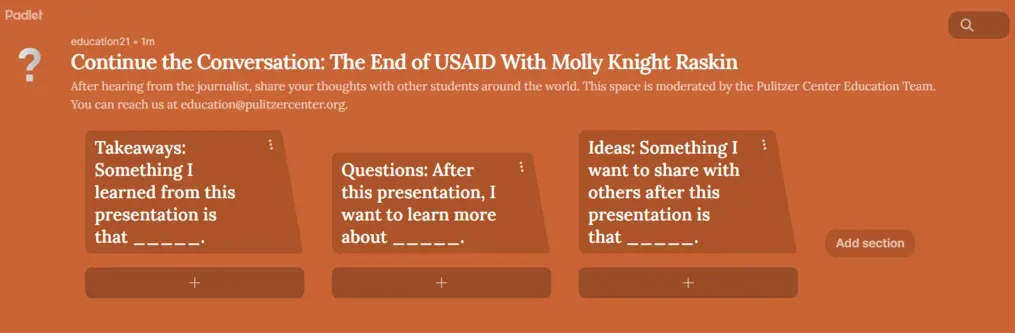
Visit our shared space for all students and educators who have participated in this virtual visit on demand to post their takeaways, questions, and ideas. You can react to and comment on others' posts with encouragement and constructive debate. You will receive a link to access this optional space along with the video and required surveys after filling out this form.
2. Stay Tuned for the Next Virtual Journalist Visit on Demand
Coming in January 2026: a virtual journalist visit on demand with Joanna S. Kao! Kao leads the Pulitzer Center’s AI Accountability Network, overseeing global reporting projects that investigate the impact of artificial intelligence and machine learning. She'll be speaking about her reporting on how AI-powered accessibility tools sometimes fail people with disabilities, revealing a “disability data desert” that limits innovation and raises serious ethical concerns.
Be the first to know about this and other resources and opportunities for K-12 educators and students by signing up for our weekly Education newsletter!