Pulitzer Center Update January 28, 2026
Winners and Finalists: Local Letters for Global Change 2025

Students are invited to make their voices heard this election season by writing a letter to a decisionmaker that explains the global issue they want to see prioritized. Deadline: November 1, 2026.

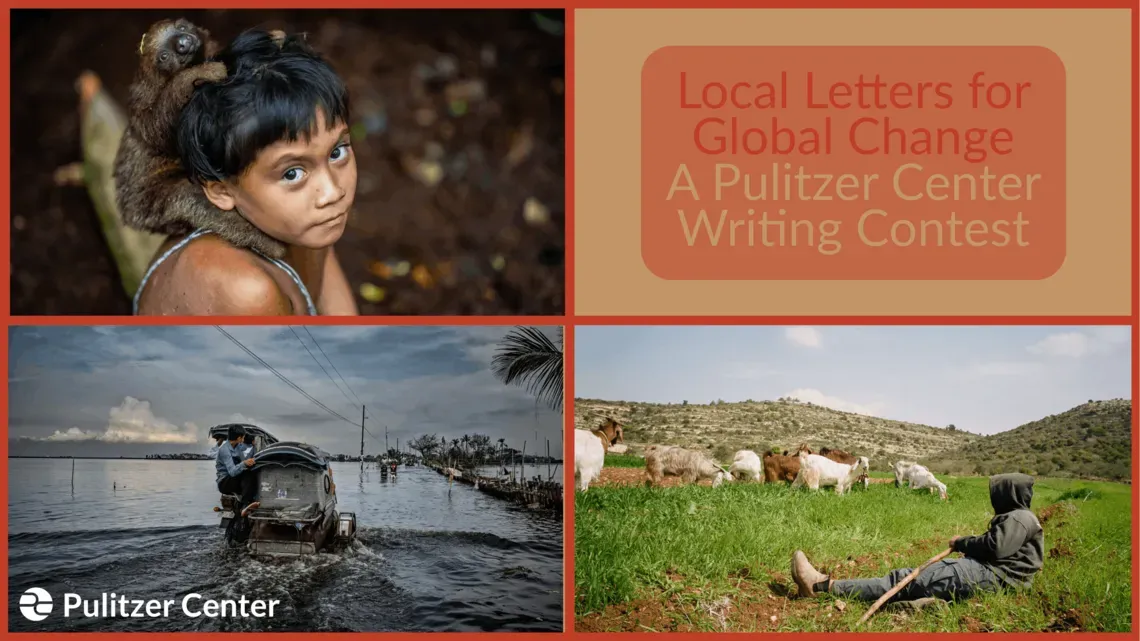
The Pulitzer Center congratulates the 2025 Local Letters for Global Change contest winners and finalists!
The Local Letters for Global Change initiative envisions news stories as a starting point for taking informed action. Students are invited to explore the Pulitzer Center-supported reporting of their choice and connect its content to their own communities, illuminating the global interconnections of local problems. Using the reporting and their own research, students identify solutions, and present them in letters to decision makers with the power to implement them.
In 2025, we received a record-breaking 1,500 entries to the contest, representing 30 countries, 25 U.S. states, and the District of Columbia. That’s 1,500 young voices raised to call attention to injustices in the world, and to offer their vision for change.
We are honored to share 23 of those student letters today. Explore the winning letters below, and take inspiration from their calls to action.
Contest Winners
Climate and Environment
First Place
Katelyn Eunice S. Roque, 9th grade, Bulacan State University Laboratory High School, Philippines
Letter on corruption in flood control
Finalists
Priya Kangbai, 7th grade, MS 915, New York
Letter on extreme heat and the rising cost of electricity
Alvin Su, 10th grade, Benjamin Franklin High School, Louisiana
Letter on urban tree canopy expansion
Krisha Umashankar, 11th grade, California High School, California
Letter on lithium mining for clean energy
Devang Pareek, 6th grade, Solon Orchard Middle School, Ohio
Letter on pollution in waterways
Global Health
First Place
Suhani Kakkar, 11th grade, Eastlake High School, Washington
Letter on Indigenous doula programs
Finalists
Rebecca Li, 11th grade, Hopkins School, Connecticut
Letter on the impact of sudden cuts to USAID and SNAP benefits
Tisha Sehrawat, 11th grade, 10X International School, India
Letter on quality control for pharmaceuticals
Louisa Gellhorn, 5th grade, Springside Chestnut Hill Academy, Pennsylvania
Letter on chronic hepatitis B impacts and prevention
Alliyah De Marco, 8th grade, Francine Delany New School for Children, North Carolina
Letter on insurance delays and denials for eating disorder-related health care
Human Rights
First Place
Yaxin Zhang, 12th grade, Arlington High School, Massachusetts
Letter on renters' rights and affordable housing
Finalists
Shaneir Williams, 11th grade, Miami Norland Senior High School, Florida
Letter on renters' rights and affordable housing
Leticia Angeles Roncal, 11th grade, IE 5026 José María Arguedas, Peru
Letter on land rights for uncontacted people [Spanish]
Yeslin L.D., 8th grade, Florida
Letter on immigration crackdowns
Eraj Wali, 12th grade, Thomas Jefferson High School for Science and Technology, Virginia
Letter on labor rights for gig workers
Information and Artificial Intelligence
First Place
Ria Goel, 12th grade, Thomas Jefferson High School for Science and Technology, Virginia
Letter on the environmental impacts of AI data centers
Second Place
Armaan Sheoran, 12th grade, Thomas Jefferson High School for Science and Technology, Virginia
Letter on the use of AI technology for school security
Third Place
Sunghun (Daniel) Chung, 11th grade, Oakton High School, Virginia
Letter on the mental health risks of AI chatbots
Peace and Conflict
First Place
Yoonsub David Choi, 11th grade, Oakton High School, Virginia
Letter on corporate accountability for gun violence
Finalists
David Reyes, 11th grade, Hopkins School, Connecticut
Letter on health care access for veterans who have experienced toxic exposure
Beckett Fox, 6th grade, Mitchell Elementary School, Illinois
Letter on the dangers of nuclear weapons
Sarai Zayet, 8th grade, Helios School, California
Letter on protection for peaceful protest in Palestinian territories
Armeen Khalili, 12th grade, The Oakridge School, Texas
Letter on declassifying reports on torture
Thank you to our semifinal and final round judges: Elliott Adams, Hannah Berk, Kendra Grissom, Donnalie Jamnah, Jessica Mims, Fareed Mostoufi, Sushmita Jaya Mukherjee, Mikaela Schmitt, and Mark Schulte.
Student letters reflect the authors’ views. Students choose their own topics and act independently if they decide to share their letters outside the classroom. The Pulitzer Center is a nonpartisan 501(c)(3) organization that does not endorse candidates, parties, or specific legislation. Our publication of student work is for educational purposes.
