Pulitzer Center Update November 18, 2025
The Ramifications of Cutting U.S. Foreign Aid: Journalist Molly Knight Raskin Gives an Inside Look.
Country:

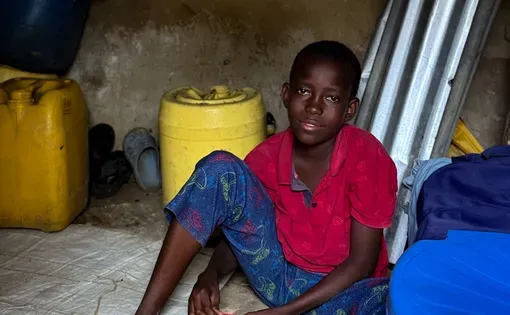
The impact of the Trump administration’s decision to shut down USAID


On September 18th, 2025, freelance journalist and Pulitzer Center grantee Molly Knight Raskin made her way to Boston University's College of Communication and School of Public Health to discuss the consequences of cutting USAID and other forms of global humanitarian aid. Her Pulitzer Center-supported project, Cuts and Consequences: The End of USAID, explores the real world implications of cutting USAID on communities across the world, specifically in Ghana and Kenya.
Knight Raskin is a freelance journalist, documentary filmmaker, and television producer with more than two decades of experience reporting for outlets such as PBS NewsHour and FRONTLINE, as well as producing documentaries for Netflix, National Geographic, and more.
During her presentation to communications students, Knight Raskin discussed the importance of journalistic integrity and shared with students how to craft a compelling story. In her presentation to students and faculty at the School of Public Health, she spoke about the intersection of global health and journalism. Knight Raskin also shared her experience reporting in Ghana and Kenya, where she witnessed firsthand both the devastating effects of funding cuts and the resilience of communities in these unprecedented times.
After the Trump administration abruptly cut funding for USAID, Knight Raskin and her colleagues reached out to USAID workers but received no response. These cuts upended the lives of former employees. Many were fearful of pushback if they spoke to the press.
“These are people who have spent, in some cases, decades of their lives or their entire careers doing something they feel really passionate about for the betterment of the world. [They] serv[ed] this country in a way that has always been viewed as positive,” Knight Raskin explained.
One of her most important informants was a former high-level USAID worker who shared how the cuts devastated the healthcare infrastructures created to sustain communities. “We're putting shots in people's arms and still shipping the medication, but we've cut all of [the] prevention work, all the education work, all the support work, all of the infrastructure work, all of the surveillance work, all of the data, the number crunching, epidemiologists. It's all gone,” the informant shared.
Knight Raskin and her team also traveled to Kenya, a hub for humanitarian organizations, where the effects of the funding cuts were stark. There, the cuts devastated the ecosystem through which medications were delivered. Nurses, doctors, and community health workers lost their jobs, making treatment inaccessible for many families. Just outside of Nairobi, Knight Raskin and her team met a family mourning the loss of their 11-year-old son, who died of tuberculosis after being unable to access his medication during the 90-day freeze on U.S. humanitarian aid. The devastating realities in Kenya confirmed what the former USAID worker had described.
Despite the cuts to life-saving aid and the upending of USAID workers' lives, Knight Raskin witnessed communities banding together and demonstrating resilience amid uncertainty. Isiolo, a town located in the upper eastern region of Kenya, received funding from USAID for a water sanitation project. During its implementation, the rates of diseases dropped drastically. However, once USAID funding was cut, the expansion of the project halted. Residents of Isiolo were left to fend for themselves. They took matters into their own hands, and dug a two-mile trench where new pipes can be placed. They remain hopeful that another organization will provide them with the pipes they need to continue the water sanitation project.
“People are extremely resilient and innovative, and they will find ways. And I do think those stories need to be told, because if we just keep telling the story of the failure, you also risk making people just look like victims, and that's not what I heard,” Knight Raskin explained.
Hearing Raskin highlight the resilience of communities inspired students to consider the broader lessons for public health. A Boston University Master’s of Public Health student shared her thoughts on the importance of Knight Raskin’s presentation and its relevance to the field.
“I think that's just kind of inspiring. It's good to know that, although the aid is not there, and the U.S. isn't putting [in] work to do something about it anymore,...individuals are able to kind of pick up where they left off,” says Ruth Seyoum, a second-year public health student concentrating in global health program design, monitoring, and evaluation, with a focus on maternal and child health.
While individuals step in to fill gaps on the ground, the public health community continues to try to find innovative ways to deliver aid across the globe. At Boston University School of Public Health, Associate Professor Brooke Nichols launched a digital tracking initiative to assess the impact of humanitarian aid cuts. The tracker has reported over 166,000 adult deaths and 345,000 child deaths as of June 26, 2025. Knight Raskin’s reporting project is able to put a name and a face to these numbers, conveying the urgency and harsh reality of the issue.
“I think the uncontestable truth of the story of USAID, again, is not the merits of foreign aid and how much we should give and how much we shouldn't,” Knight Raskin explained. “The story is that the administration made this decision very rashly and very hurriedly and almost overnight, and they cut those supply chains and in so doing, we have created a massive self-inflicted wound that is going to be very hard to recover from.”
