Pulitzer Center Update April 3, 2026
Pulitzer Center Invites Young People To Address Global Issues With Poetry

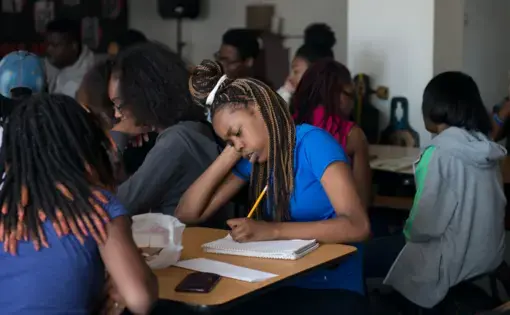
Students are invited to enter poems written in response to news stories to the Fighting Words Poetry Contest. This workshop guides teachers and students in how to craft a successful entry.

What can a poem do in the face of crisis? This April marks the 30th annual National Poetry Month, founded to celebrate the power and social relevance of the craft.
During nine years of the Pulitzer Center’s Fighting Words Poetry Contest, young people have offered expansive answers to the question of poetry's role in the world.
Estelle Wong, a 12th-grader and a 2025 contest finalist, amends the preamble to the U.S. Constitution to highlight border surveillance, showing how a poem can subvert familiar language to expose an underlying reality.
Collin Kim, a 10th-grader and 2025 first-place contest winner, centers the voices of hibakusha, the survivors of the atomic bombings of Hiroshima and Nagasaki, showing how a poem can uplift and preserve marginalized stories.
Rooted in a story about saline agriculture in Bangladesh, 11th-grader and 2025 first-place contest winner Perseas Kamalani Vanebo makes a direct appeal for climate action in resonant language. A poem can make demands. “So let the salt speak,” Vanebo writes, “Not just in fields and furrows, / but in boardrooms, in cities, / in every policy / that forgets where food begins.”
A poem does something for the poet, too. The urgency of global issues often encourages us to leap straight to action steps and solutions, but that necessary work of our logical brains is incomplete if it isn’t rooted in the emotional lives of the people involved. Poetry invites us to slow down, and to foreground feeling.
When we make space for our emotional responses to the news, we are better able to build empathy, understand our personal stakes in the story, and sustain the work of being attentive, active community members in a healthy way.
“Poetry, ultimately, is a craft of significance,” said 2023 contest finalist Fiona Jin in an interview with WBEZ about her poem. “Poetry is about exploring why issues are personal to you.”
In 2026, we are expanding the Fighting Words Poetry Contest to young adults ages 18–24 for the first time. We are excited to extend this resource for processing current events to young poets on the front lines of a shifting political, natural, and informational landscape, and we look forward to amplifying their voices. High school students and young adults are invited to join us for a virtual workshop on Tuesday, April 14, 2026, 7:30–8:45pm EDT to write and share in community.
The contest remains open to K–12 students worldwide, as well as poets 18–24, and entries are due by May 10, 2026.
Please share the opportunity with a young person in your life, and take some time to explore last year’s winning entries to discover new stories, original perspectives, and an invitation to make space for your own personal connections to global news stories.
Best,

Hannah Berk
Senior Program Manager
This message appeared in the April 3, 2026, edition of the Pulitzer Center's weekly newsletter. Subscribe today.
