Pulitzer Center Update February 19, 2026
Journalists Reflect on Building Trust in the Classroom
Country:

At a time when trust in journalism is fragile, opportunities for students to meet reporters face-to-face carry new significance.
Only about 30 percent of people in the United States say they trust the news most of the time, according to the Reuters Institute Digital News Report 2025. Among teenagers, perceptions are often even more troubling. A News Literacy Project survey found that the overwhelming majority of teens describe journalism in negative terms, such as "biased" or "boring." Misinformation and disinformation are a pressing global risk, amplified by social media platforms and rapidly evolving technologies that blur the line between fact and fabrication.
In this environment, trust in journalism cannot be assumed. It must be built through transparency and human connection. The Pulitzer Center’s virtual journalist visit program brings that process directly into classrooms, making the journalistic process visible and accessible. In 2025, only 21% of over 2,100 students surveyed as part of the program reported having met a journalist before.
The reflections below explore the experiences of two journalists who connected and built trust with classrooms last fall.
Clarissa Sosin: Making Accountability Journalism Transparent
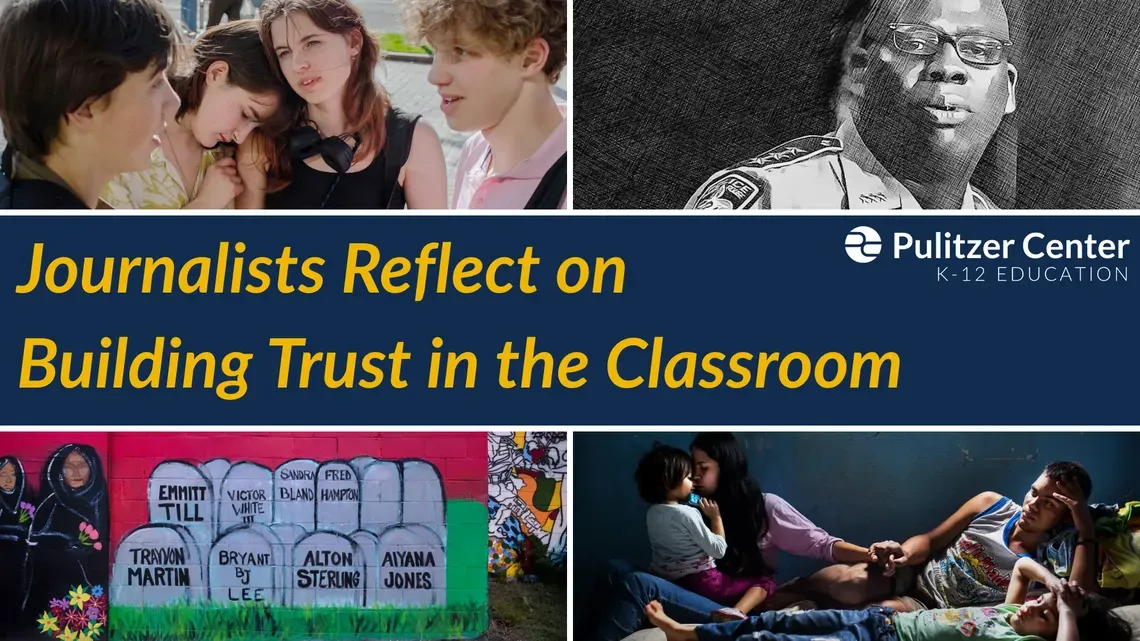
When investigative journalist Clarissa Sosin met with middle and high school students in fall 2025, she walked them through the process behind her Pulitzer Center-supported investigation for In the Dark, which examined accountability within the Baton Rouge Police Department’s Internal Affairs Division.
This investigation grew out of coverage of a police crackdown on peaceful protesters that revealed deeper, long-standing patterns of harm. Sosin explained, “My reporting partner Daryl [Khan] was directing coverage of a brutal crackdown on peaceful protesters in Baton Rouge. During that reporting, we kept hearing from residents that they encountered that kind of brutality from the police department all the time in the city. It was a problem that went back generations.
“We feel this story is important to share with students because it provides a roadmap on how to tackle a historical problem in a straightforward manner using the basic tools of our trade. Students can see how a reporter uses curiosity and persistence to expose institutional wrongs.”
Sosin emphasized that trustworthy reporting depends on listening to many voices. “It was vital that we captured all the perspectives in our reporting,” she said. “That meant finding people who had been abused by the police and had their complaints ignored. But just as importantly, we needed the perspective of the police department.” She also encouraged students to reflect on how these perspectives relate to lived experience. “Students need to understand that human rights issues are rooted in specific places, customs, and institutions.”
Students engaged with the reporting in practical ways. During one classroom visit, Sosin recalled, “I was asked to advise on how students could file their own complaints against police if they needed to. It showed me that our project also serves as a motivator for people to report and participate.”
She also explained what investigative reporting involves. Sosin said, “At a time of great distrust of reporters, it’s crucial that the next generation understands what we actually do. Public records requests, knocking on doors, building trust with sources, and tracking down the truth across many spaces.”
Ultimately, Sosin hopes students leave feeling empowered. Sosin said, “I hope students feel empowered to speak to people in the world, make their own public records requests, hold power to account, and stay curious and open-minded.”
Natalie Keyssar: Humanizing the Reporter and the Story
For documentary photographer Natalie Keyssar, classroom visits offer another pathway to building trust: human connection.
Her Pulitzer Center-supported reporting focuses on young people living through political upheaval and conflict, including her projects Kyiv Yearbook 2024 and The Office of Hope. “In my years as a journalist working in places affected by political violence and conflict,” Keyssar reflects, “I’ve been struck by the way that teens and young adults end up on the front lines of these struggles—both literally in terms of the age of many soldiers and protesters, but also due to the lasting impact that conflict has on the generations that come of age as their home is being torn apart.”
Sharing these stories with students felt especially meaningful. Keyssar said, “Pulitzer Center’s indispensable support for this project made it possible, and their [education] program gave me an opportunity to share it with the most important possible audience.”
Keyssar emphasized the importance of local voices, including Ukrainian photojournalist and recent high school graduate Anna Donets, whose work appears alongside her own in Kyiv Yearbook 2024. “Seeing the visual perspective of a journalist their age is a really important way for American teens to imagine themselves in this reporting and better empathize and understand the situation,” Keyssar suggests.
Keyssar believes that direct interaction reshapes young people’s perception of journalism. “Getting to meet the journalists behind the news they hear about completely changes the polarized and abstract concept of what a journalist is in their minds,” she said. It also allows her to address students’ curiosity about media literacy. “My favorite questions from students these days are often around media literacy in the social media landscape, which makes me realize the urgency of these teaching opportunities.”
She hopes these encounters leave a lasting impact. “First and foremost, I hope their understanding of the consequences of conflict for young people just like them all over the world is deepened and made to feel real,” she said. “Second, I hope that their understanding and appreciation for journalism and information literacy are sharpened.”
In these conversations, trust emerges through recognition. Journalists become visible as individuals engaged in complex work, striving to document reality with care and responsibility.
Why Trust Begins with Understanding
In an information environment shaped by algorithms, influencers, and artificial intelligence, trust in journalism must be built intentionally. When students meet journalists, they see the work behind reporting—the questions asked, the uncertainty navigated, the verification required, and the human relationships that make storytelling possible.
Research suggests audiences increasingly want this kind of transparency and connection. Programs that bring journalists directly into conversation with communities play an important role in building public trust.
For students, trust is not taught as a concept. It is established through dialogue, inquiry, and shared engagement with real-world reporting. And for journalists, those conversations serve as a reminder that trust grows not only from what we report, but from how we show up.
Interested in bringing a journalist into your classroom? Learn more about the Pulitzer Center’s virtual journalist visit program here.
