Pulitzer Center Update February 17, 2026
Jakarta Festival Raises Public Awareness of AI’s Impact
Country:



Project
Automation Fever
The impacts of automation tools that are often glossed over by companies and policy makers


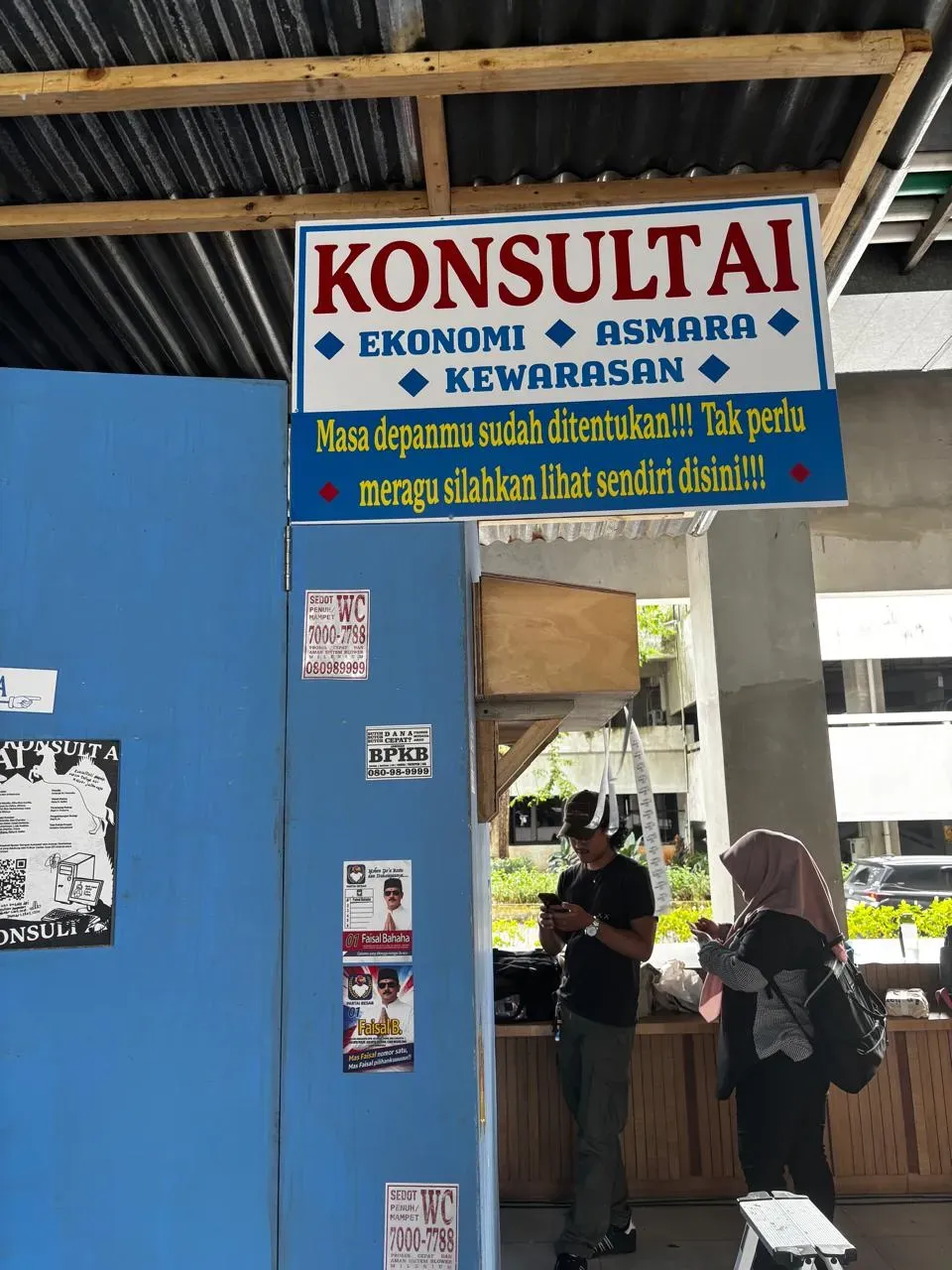
A semi-permanent structure tinted blue, with plywood walls and a corrugated metal roof, drew the attention of visitors at Taman Ismail Marzuki during Pesta Pinggiran, a community festival in Jakarta organized by Project Multatuli that took place from January 24 to 25, 2026.
Visitors of all ages—from children and young adults to middle-aged attendees—paused to observe the structure, many stepping inside out of sheer curiosity.
The installation stood a bit under 5 meters tall. It consisted of two narrow booths with adjacent doors at the front. At the top of the structure was the sign “Konsult AI,” accompanied by a provocative message inviting passers-by inside: “Your future has already been decided. No need to doubt .. see it for yourself here!”
Produced by Labtek Indie and Arthatronic, the art installation encouraged visitors to reflect on artificial intelligence and its impact on the way humans interact, think, and make decisions—from parent-child and teacher-student relationships to changing patterns of work and recruitment.
The installation was inspired by Automation Fever, a Pulitzer Center-supported reporting series by Center grantees Antonia Timmerman and Rio Tuasikal for Project Multatuli. Instead of presenting the investigation in a conventional exhibition format, the collaborators transformed it into an immersive spatial experience built around direct audience interaction.
Amanda M. Paramita, one of the installation’s concept developers, said the reporting series raised critical issues that are often overlooked by AI users, particularly the gradual replacement of human capabilities and the paradox of artificial intelligence as a tool that offers convenience while being used without full awareness of what is being traded in return.
“Through discussions with Antonia, Rio, and other collaborators, we decided to create this installation with the aim of making people not only feel entertained when they enter, but also think,” she said.
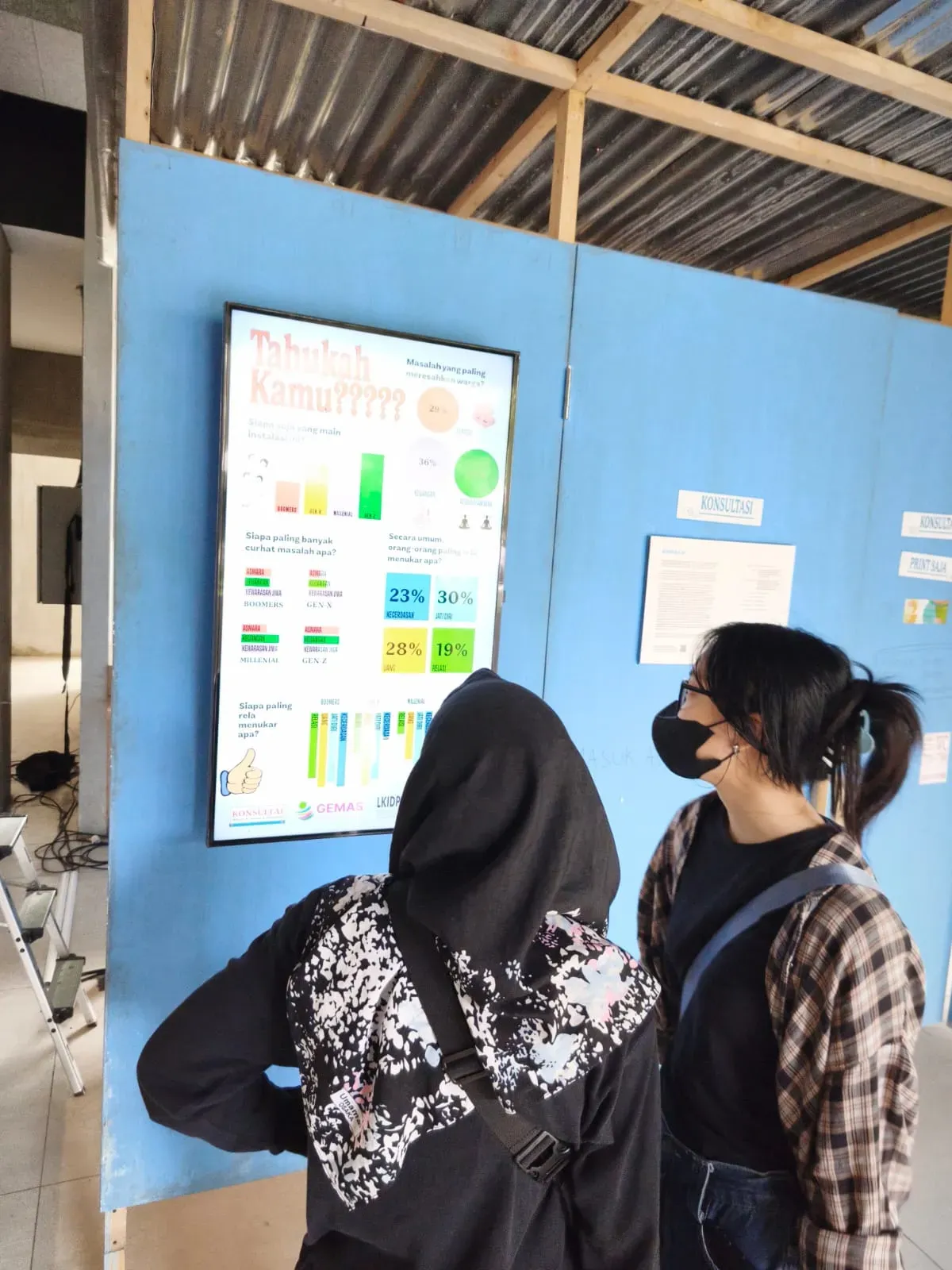
Inside the "Konsult AI" booth, visitors were asked to make symbolic choices: What problem they wanted to consult AI about, and what are they willing to give up in exchange—whether cognitive ability, personal identity, money, or human relationships.
These choices were then aggregated and displayed as real-time infographics at the front of the installation, allowing visitors to see collective patterns emerging from the responses.
The approach left a strong impression on visitors. Yulia, an attendee, said she was drawn to how Konsult AI presented the issue of artificial intelligence through symbolic, game-like choices that encouraged visitors to experiment while being honest about their relationship with AI.
She said the interactive format prevented visitors from feeling as though they were being lectured about the dangers of technology. At the same time, the installation highlighted that human creativity still occupies a space that machines cannot easily replicate.
“People rarely admit how dependent they actually are on AI,” Yulia said. “In this installation, I could be honest about that, and it felt enjoyable. When I came out and saw the infographic at the front, I realized I wasn’t alone. It felt like accepting the situation—and thinking that maybe this is something that needs to be addressed.”
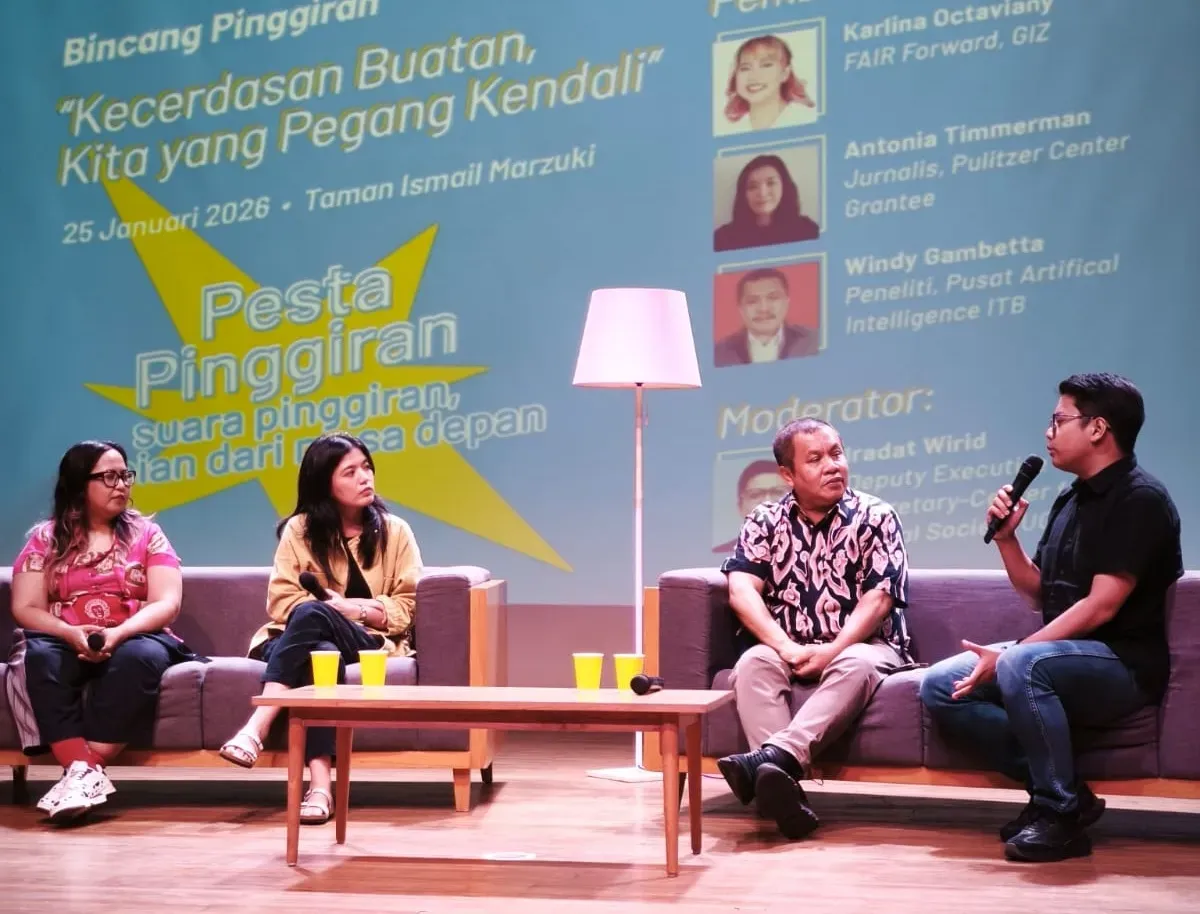
Beyond the interactive art installation, the issue of automation was also discussed in a panel session titled “Artificial Intelligence: Who Holds the Control?”
Timmerman joined Karlina Octaviany, artificial intelligence adviser at FAIR Forward GIZ Indonesia, and Windy Gambetta, a researcher at the Artificial Intelligence Center of the Bandung Institute of Technology, to discuss how AI has become an overhyped trend, its environmental impact, and how technological development can sometimes create new problems instead of solving existing ones.
During the discussion, Timmerman raised concerns she had previously explored in her reporting series, pointing to the paradoxes AI creates for workers: While it improves efficiency, it does not necessarily reduce workloads.
The impact, she said, is felt not only by workers, who are now expected to produce more due to AI-driven streamlining, but also by entry-level job seekers, who are finding it increasingly difficult to enter the workforce. Many beginner-level roles involving repetitive tasks can now be automated, even though such positions are crucial as learning stages for developing skills.
“Newbie workers—those who have just graduated and want to enter the workforce—are facing companies that only want experienced professionals, with AI there to support them,” she said.
Meanwhile, Octaviany noted that AI has the potential to support documentation efforts and strengthen community-based knowledge. In practice, however, technological development often does not stem from the real needs of society.
Her experience working with Indigenous communities and citizen laboratories showed that fundamental questions about people’s everyday problems are often addressed only after technology has already been introduced as a solution.
“As people in the Global South, we are rarely asked what kind of technology we actually need,” she said. “Instead, we are told to use what is available, because it is considered cool, and because not using technology today means being left behind.”